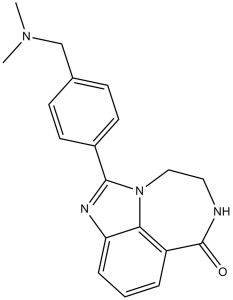
AG14361 (AG-14361) is a novel, potent and selective inhibitor of poly (ADP-ribose) polymerase-1 (PARP1) with potential anticancer activity. In a cell-free assay, it inhibits PARP1 with a Ki of less than 5 nM. It also exhibits strong in vivo antitumor efficacy and strong antiproliferative activity against a variety of cancer cells.
Physicochemical Properties
| Molecular Formula | C19H20N4O | |
| Molecular Weight | 320.39 | |
| Exact Mass | 320.163 | |
| Elemental Analysis | C, 71.23; H, 6.29; N, 17.49; O, 4.99 | |
| CAS # | 328543-09-5 | |
| Related CAS # |
|
|
| PubChem CID | 9840076 | |
| Appearance | White to off-white solid powder | |
| Density | 1.3±0.1 g/cm3 | |
| Index of Refraction | 1.676 | |
| LogP | 1.92 | |
| Hydrogen Bond Donor Count | 1 | |
| Hydrogen Bond Acceptor Count | 3 | |
| Rotatable Bond Count | 3 | |
| Heavy Atom Count | 24 | |
| Complexity | 460 | |
| Defined Atom Stereocenter Count | 0 | |
| SMILES | O=C1NCCN2C3=C1C=CC=C3N=C2C4=CC=C(C=C4)CN(C)C |
|
| InChi Key | SEKJSSBJKFLZIT-UHFFFAOYSA-N | |
| InChi Code | InChI=1S/C19H20N4O/c1-22(2)12-13-6-8-14(9-7-13)18-21-16-5-3-4-15-17(16)23(18)11-10-20-19(15)24/h3-9H,10-12H2,1-2H3,(H,20,24) | |
| Chemical Name | 2-[4-[(dimethylamino)methyl]phenyl]-1,3,10-triazatricyclo[6.4.1.04,13]trideca-2,4,6,8(13)-tetraen-9-one | |
| Synonyms | AG 14361; AG14361; AG-14361 | |
| HS Tariff Code | 2934.99.9001 | |
| Storage |
Powder-20°C 3 years 4°C 2 years In solvent -80°C 6 months -20°C 1 month |
|
| Shipping Condition | Room temperature (This product is stable at ambient temperature for a few days during ordinary shipping and time spent in Customs) |
Biological Activity
| Targets | PARP-1 ( Ki = 0.5 nM ) | |
| ln Vitro |
|
|
| ln Vivo |
|
|
| Enzyme Assay | Full-length recombinant human PARP-1 activity is assessed in a reaction mixture containing activated calf thymus DNA (10 μg/mL) at 25 °C, 500 μM NAD+ plus [32P]NAD+ (0.1–0.3 μCi per reaction mixture), and 20 nM PARP-1. The reaction is stopped after 4 minutes by adding ice-cold 10% (wt/vol) trichloroacetic acid. A PhosphorImager is used to quantify the reaction product [32P]ADP-ribose that is integrated into acid-insoluble material after it has been deposited onto Whatman GF/C glass fiber filters using a Bio-Dot microfiltration device. Inhibition of PARP-1 activity by AG14361 at 0–600 nM is measured, and the Ki for AG14361 is calculated by nonlinear regression analysis. | |
| Cell Assay | The luciferase-coupled ATP quantization assay of metabolically active cells in a 96-well plate is used in the cell viability assay along with MTT. One well of a 24-well plate is plated with one to two × 104 cells for MTT. The target medications (AG14361) are dissolved in DMSO at different concentrations and subsequently added to the cells in Dulbecco's modified Eagle's medium (DMEM) containing 10% fetal bovine serum. Additionally, each well receives an addition of the IC50 concentration of AG14361. The addition to medium results in a final DMSO concentration of 0.1%. The medium is removed after 48 hours, and each well receives 0.3 mL of 0.1% MTT in phosphate-buffered saline (PBS). The MTT solution is removed and 0.8 mL of 2-propanol is added after 30 minutes of incubation in a 37°C CO2 incubator. A plate reader is used to measure the OD560 following 30 minutes of shaking. Every time point is platented three times. | |
| Animal Protocol |
|
|
| References |
[1]. J Natl Cancer Inst . 2004 Jan 7;96(1):56-67. [2]. Clin Cancer Res . 2004 Feb 1;10(3):881-9. [3]. Clin Cancer Res . 2005 Dec 1;11(23):8449-57. |
|
| Additional Infomation | LSM-1988 is a member of benzimidazoles. |
Solubility Data
| Solubility (In Vitro) |
|
|||
| Solubility (In Vivo) |
Solubility in Formulation 1: ≥ 1 mg/mL (3.12 mM) (saturation unknown) in 10% DMSO + 40% PEG300 + 5% Tween80 + 45% Saline (add these co-solvents sequentially from left to right, and one by one), clear solution. For example, if 1 mL of working solution is to be prepared, you can add 100 μL of 10.0 mg/mL clear DMSO stock solution to 400 μL of PEG300 and mix evenly; then add 50 μL of Tween-80 to the above solution and mix evenly; then add 450 μL of normal saline to adjust the volume to 1 mL. Preparation of saline: Dissolve 0.9 g of sodium chloride in 100 mL ddH₂ O to obtain a clear solution. Solubility in Formulation 2: ≥ 1 mg/mL (3.12 mM) (saturation unknown) in 10% DMSO + 90% (20% SBE-β-CD in Saline) (add these co-solvents sequentially from left to right, and one by one), clear solution. For example, if 1 mL of working solution is to be prepared, you can add 100 μL of 10.0 mg/mL clear DMSO stock solution to 900 μL of 20% SBE-β-CD physiological saline solution and mix evenly. Preparation of 20% SBE-β-CD in Saline (4°C,1 week): Dissolve 2 g SBE-β-CD in 10 mL saline to obtain a clear solution. Solubility in Formulation 3: ≥ 1 mg/mL (3.12 mM) (saturation unknown) in 10% DMSO + 90% Corn Oil (add these co-solvents sequentially from left to right, and one by one), clear solution. For example, if 1 mL of working solution is to be prepared, you can add 100 μL of 10.0 mg/mL clear DMSO stock solution to 900 μL of corn oil and mix evenly. Solubility in Formulation 4: 4% DMSO+ddH2O: 2mg/mL (Please use freshly prepared in vivo formulations for optimal results.) |
| Preparing Stock Solutions | 1 mg | 5 mg | 10 mg | |
| 1 mM | 3.1212 mL | 15.6060 mL | 31.2120 mL | |
| 5 mM | 0.6242 mL | 3.1212 mL | 6.2424 mL | |
| 10 mM | 0.3121 mL | 1.5606 mL | 3.1212 mL |