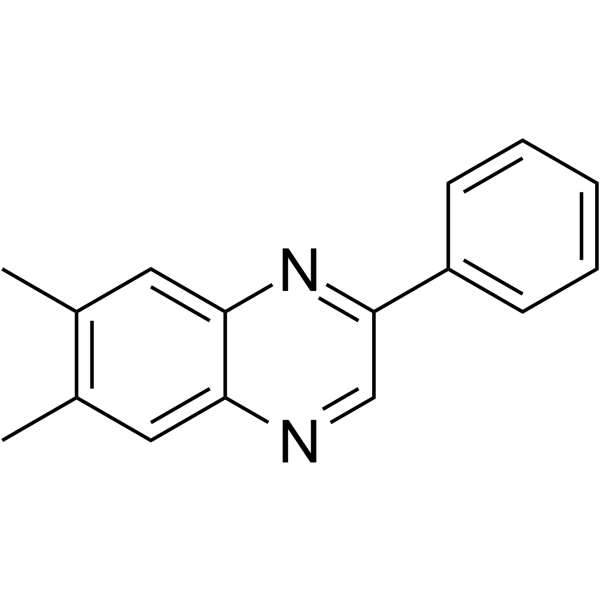
Physicochemical Properties
| Molecular Formula | C16H14N2 |
| Molecular Weight | 234.29600 |
| Exact Mass | 234.115 |
| Elemental Analysis | C, 82.02; H, 6.02; N, 11.96 |
| CAS # | 71897-07-9 |
| PubChem CID | 2048 |
| Appearance | Light yellow to yellow solid powder |
| Density | 1.1±0.1 g/cm3 |
| Boiling Point | 398.3±37.0 °C at 760 mmHg |
| Flash Point | 172.4±17.8 °C |
| Vapour Pressure | 0.0±0.9 mmHg at 25°C |
| Index of Refraction | 1.636 |
| LogP | 3.92 |
| Hydrogen Bond Donor Count | 0 |
| Hydrogen Bond Acceptor Count | 2 |
| Rotatable Bond Count | 1 |
| Heavy Atom Count | 18 |
| Complexity | 272 |
| Defined Atom Stereocenter Count | 0 |
| SMILES | N1C2C(=CC(C)=C(C)C=2)N=CC=1C1=CC=CC=C1 |
| InChi Key | FQNCLVJEQCJWSU-UHFFFAOYSA-N |
| InChi Code | InChI=1S/C16H14N2/c1-11-8-14-15(9-12(11)2)18-16(10-17-14)13-6-4-3-5-7-13/h3-10H,1-2H3 |
| Chemical Name | 6,7-dimethyl-2-phenylquinoxaline |
| Synonyms | AG1295; AG-1295; AG 1295; NSC 380341; Tyrphostin AG 1295. |
| HS Tariff Code | 2934.99.9001 |
| Storage |
Powder-20°C 3 years 4°C 2 years In solvent -80°C 6 months -20°C 1 month |
| Shipping Condition | Room temperature (This product is stable at ambient temperature for a few days during ordinary shipping and time spent in Customs) |
Biological Activity
| ln Vitro | AG 1295 suppresses PDGFR autophosphorylation, membrane autophosphorylation and the IC50 observed in Swiss 3T3 cells are 0.3-0.5 μM and 0.5-1 μM correspondingly [1]. AG1295 (10 μM, 100 μM) greatly reduces cell viability assay in vitro [2] |
| ln Vivo | In aortic allograft vascular damage, AG-1295 inhibits tyrosine phosphorylation caused by PDGFR-β, hence reducing neointima. AG1295 (12 mg/kg; intraperitoneal; daily; 14 or 21 days) was found to dramatically reduce interstitial fibrosis, as seen by larger regions stained with Sirius red, a decrease in macrophage counts, ED-A+ fibronectin deposition, and α-Smooth muscle actin-promoting protein cell counts [4]. |
| Cell Assay |
Cell Viability Assay[2] Cell Types: rabbit conjunctival fibroblasts Tested Concentrations: 1 μM, 10 μM, 100 μM Incubation Duration: 3 days Experimental Results: Inhibition of PDGF-AA or PDGF -BB-stimulated growth of rabbit conjunctival fibroblasts [2]. PDGF-AA or PDGF-BB stimulates the growth of rabbit conjunctival fibroblasts. |
| Animal Protocol |
Animal/Disease Models: SD (SD (Sprague-Dawley)) rats (240-270 g) [4] Doses: 12 mg/kg Route of Administration: intraperitoneal (ip) injection; daily; continued for 14 or 21 days Experimental Results: Rat renal interstitial fibers after unilateral obstruction Weakened. |
| References |
[1]. Selective platelet-derived growth factor receptor kinase blockers reverse sis-transformation. Cancer Res. 1994 Dec 1;54(23):6106-14. [2]. Platelet-derived growth factor receptor kinase inhibitor AG1295 and inhibition of experimental proliferative vitreoretinopathy. Jpn J Ophthalmol. 2003 Mar-Apr;47(2):158-65. [3]. Inhibition of aortic allograft vasculopathy by local delivery of platelet-derived growth factor receptor tyrosine-kinase blocker AG-1295. Transplantation. 2002 Nov 15;74(9):1335-41. [4]. PDGF receptor kinase blocker AG1295 attenuates interstitial fibrosis in rat kidney after unilateral obstruction. Cell Tissue Res. 2000 Jan;299(1):97-103. |
| Additional Infomation |
6,7-dimethyl-2-phenylquinoxaline is a quinoxaline derivative. It has a role as a geroprotector. Tyrphostin AG 1295 is a member of the Tyrphostin family of tyrosine kinase inhibitors that inhibits signal transduction through platelet-derived growth factor receptor and selectively attenuates smooth muscle cell growth. (NCI) |
Solubility Data
| Solubility (In Vitro) | DMSO : ~62.5 mg/mL (~266.75 mM) |
| Solubility (In Vivo) |
Solubility in Formulation 1: ≥ 2.08 mg/mL (8.88 mM) (saturation unknown) in 10% DMSO + 40% PEG300 + 5% Tween80 + 45% Saline (add these co-solvents sequentially from left to right, and one by one), clear solution. For example, if 1 mL of working solution is to be prepared, you can add 100 μL of 20.8 mg/mL clear DMSO stock solution to 400 μL PEG300 and mix evenly; then add 50 μL Tween-80 to the above solution and mix evenly; then add 450 μL normal saline to adjust the volume to 1 mL. Preparation of saline: Dissolve 0.9 g of sodium chloride in 100 mL ddH₂ O to obtain a clear solution. Solubility in Formulation 2: ≥ 2.08 mg/mL (8.88 mM) (saturation unknown) in 10% DMSO + 90% (20% SBE-β-CD in Saline) (add these co-solvents sequentially from left to right, and one by one), clear solution. For example, if 1 mL of working solution is to be prepared, you can add 100 μL of 20.8 mg/mL clear DMSO stock solution to 900 μL of 20% SBE-β-CD physiological saline solution and mix evenly. Preparation of 20% SBE-β-CD in Saline (4°C,1 week): Dissolve 2 g SBE-β-CD in 10 mL saline to obtain a clear solution. Solubility in Formulation 3: ≥ 2.08 mg/mL (8.88 mM) (saturation unknown) in 10% DMSO + 90% Corn Oil (add these co-solvents sequentially from left to right, and one by one), clear solution. For example, if 1 mL of working solution is to be prepared, you can add 100 μL of 20.8 mg/mL clear DMSO stock solution to 900 μL of corn oil and mix evenly. (Please use freshly prepared in vivo formulations for optimal results.) |
| Preparing Stock Solutions | 1 mg | 5 mg | 10 mg | |
| 1 mM | 4.2680 mL | 21.3402 mL | 42.6803 mL | |
| 5 mM | 0.8536 mL | 4.2680 mL | 8.5361 mL | |
| 10 mM | 0.4268 mL | 2.1340 mL | 4.2680 mL |