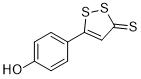
ADT-OH is a analogue of anethole dithiolethione (ADT) and synthetic hydrogen sulfide (H2S) donor. ADT-OH significantly reduced tPA-enhanced Akt activation and VEGF expression in brain microvascular endothelial cells in the in vitro glucose-oxygen deprivation (OGD) model. Last but not least, ADT-OH enhanced functional outcomes in mice given MCAO and tPA infusion. H2S donors may have prevented the Akt-VEGF-MMP9 cascade from increasing tPA-induced cerebral hemorrhage. Giving out H2S donors could be a novel way to increase the safety of tPA after a stroke.
Physicochemical Properties
| Molecular Formula | C9H6OS3 |
| Molecular Weight | 226.326 |
| Exact Mass | 225.958 |
| Elemental Analysis | C, 47.76; H, 2.67; O, 7.07; S, 42.50 |
| CAS # | 18274-81-2 |
| Related CAS # | 18274-81-2 |
| PubChem CID | 3082127 |
| Appearance | Yellow solid powder |
| Density | 1.48g/cm3 |
| Boiling Point | 322.2ºC at 760mmHg |
| Melting Point | 191-192 ºC |
| Flash Point | 148.6ºC |
| Vapour Pressure | 0.000284mmHg at 25°C |
| Index of Refraction | 1.757 |
| LogP | 3.101 |
| Hydrogen Bond Donor Count | 1 |
| Hydrogen Bond Acceptor Count | 4 |
| Rotatable Bond Count | 1 |
| Heavy Atom Count | 13 |
| Complexity | 241 |
| Defined Atom Stereocenter Count | 0 |
| SMILES | S1C(=C([H])C(=S)S1)C1C([H])=C([H])C(=C([H])C=1[H])O[H] |
| InChi Key | IWBBKLMHAILHAR-UHFFFAOYSA-N |
| InChi Code | InChI=1S/C9H6OS3/c10-7-3-1-6(2-4-7)8-5-9(11)13-12-8/h1-5,10H |
| Chemical Name | 5-(4-hydroxyphenyl)dithiole-3-thione |
| Synonyms | Desmethylanethol trithione ACS1; ADT-OH |
| HS Tariff Code | 2934.99.9001 |
| Storage |
Powder-20°C 3 years 4°C 2 years In solvent -80°C 6 months -20°C 1 month |
| Shipping Condition | Room temperature (This product is stable at ambient temperature for a few days during ordinary shipping and time spent in Customs) |
Biological Activity
| References |
[1]. ADT-OH, a hydrogen sulfide-releasing donor, induces apoptosis and inhibits the development of melanoma in vivo by upregulating FADD. Cell Death Dis. 2020;11(1):33. |
Solubility Data
| Solubility (In Vitro) |
DMSO: 45~125 mg/mL (198.8~552.3 mM) Ethanol: ~12 mg/mL (~53.0 mM) |
| Solubility (In Vivo) |
Solubility in Formulation 1: ≥ 2.08 mg/mL (9.19 mM) (saturation unknown) in 10% DMSO + 40% PEG300 + 5% Tween80 + 45% Saline (add these co-solvents sequentially from left to right, and one by one), clear solution. For example, if 1 mL of working solution is to be prepared, you can add 100 μL of 20.8 mg/mL clear DMSO stock solution to 400 μL PEG300 and mix evenly; then add 50 μL Tween-80 to the above solution and mix evenly; then add 450 μL normal saline to adjust the volume to 1 mL. Preparation of saline: Dissolve 0.9 g of sodium chloride in 100 mL ddH₂ O to obtain a clear solution. Solubility in Formulation 2: ≥ 2.08 mg/mL (9.19 mM) (saturation unknown) in 10% DMSO + 90% (20% SBE-β-CD in Saline) (add these co-solvents sequentially from left to right, and one by one), clear solution. For example, if 1 mL of working solution is to be prepared, you can add 100 μL of 20.8 mg/mL clear DMSO stock solution to 900 μL of 20% SBE-β-CD physiological saline solution and mix evenly. Preparation of 20% SBE-β-CD in Saline (4°C,1 week): Dissolve 2 g SBE-β-CD in 10 mL saline to obtain a clear solution. (Please use freshly prepared in vivo formulations for optimal results.) |
| Preparing Stock Solutions | 1 mg | 5 mg | 10 mg | |
| 1 mM | 4.4183 mL | 22.0916 mL | 44.1833 mL | |
| 5 mM | 0.8837 mL | 4.4183 mL | 8.8367 mL | |
| 10 mM | 0.4418 mL | 2.2092 mL | 4.4183 mL |