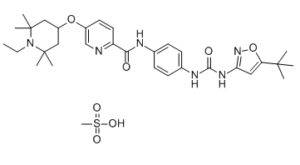
AC710 mesylate, the mesylate salt of AC710, is a potent, orally bioactive, and selective inhibitor of PDGFR (platelet-derived growth factor receptor) family kinase with Kd values of 0.6, 1.57, 1, 1.3, 1.0 nM for FLT3, CSF1R, KIT, PDGFRα and PDGFRβ, respectively. Because it inhibits PDGFR, AC710 may have anticancer properties. The preclinical development candidate for AC710 was chosen based on the outcomes of a seven-day in vivo tolerability study, a collagen-induced arthritis model, and a mouse tumor xenograft.
Physicochemical Properties
| Molecular Formula | C₃₂H₄₆N₆O₇S | |
| Molecular Weight | 658.81 | |
| Exact Mass | 658.315 | |
| Elemental Analysis | C, 66.17; H, 7.52; N, 14.94; O, 11.37 | |
| CAS # | 1351522-05-8 | |
| Related CAS # | AC710;1351522-04-7 | |
| PubChem CID | 54760052 | |
| Appearance | Solid powder | |
| LogP | 7.425 | |
| Hydrogen Bond Donor Count | 4 | |
| Hydrogen Bond Acceptor Count | 10 | |
| Rotatable Bond Count | 8 | |
| Heavy Atom Count | 46 | |
| Complexity | 972 | |
| Defined Atom Stereocenter Count | 0 | |
| SMILES | O=C(C1=NC=C(OC2CC(C)(C)N(CC)C(C)(C)C2)C=C1)NC3=CC=C(NC(NC4=NOC(C(C)(C)C)=C4)=O)C=C3.CS(=O)(O)=O |
|
| InChi Key | AUMMSMBRVDYUME-UHFFFAOYSA-N | |
| InChi Code | InChI=1S/C31H42N6O4.CH4O3S/c1-9-37-30(5,6)17-23(18-31(37,7)8)40-22-14-15-24(32-19-22)27(38)33-20-10-12-21(13-11-20)34-28(39)35-26-16-25(41-36-26)29(2,3)4;1-5(2,3)4/h10-16,19,23H,9,17-18H2,1-8H3,(H,33,38)(H2,34,35,36,39);1H3,(H,2,3,4) | |
| Chemical Name | N-[4-[(5-tert-butyl-1,2-oxazol-3-yl)carbamoylamino]phenyl]-5-(1-ethyl-2,2,6,6-tetramethylpiperidin-4-yl)oxypyridine-2-carboxamide;methanesulfonic acid | |
| Synonyms |
|
|
| HS Tariff Code | 2934.99.9001 | |
| Storage |
Powder-20°C 3 years 4°C 2 years In solvent -80°C 6 months -20°C 1 month |
|
| Shipping Condition | Room temperature (This product is stable at ambient temperature for a few days during ordinary shipping and time spent in Customs) |
Biological Activity
| Targets | PDGFRα (Kd = 1.3 nM); PDGFRβ (Kd = 1 nM); c-Kit (Kd = 1 nM); FLT3 (Kd = 0.6 nM); CSF1R (Kd = 1.57 nM) |
| ln Vitro | AC710 is a potent, orally active, and selective inhibits the PDGFR (platelet-derived growth factor receptor) family kinase, with Kd values of 0.6, 1.57, 1, 1.3, and 1.0 nM for FLT3, CSF1R, KIT, PDGFRα, and PDGFRβ, individually. AC710 may have anticancer properties because it is a PDGFR inhibitor. The preclinical development candidate AC710 was chosen based on outcomes from a rat in vivo tolerability study, a mouse tumor xenograft, and a collagen-induced arthritis model. |
| ln Vivo | AC710 shows a dose-dependent effect on disease in a mouse model of collagen-induced arthritis (CIA), starting at a dose of 3 mg/kg and lasting for 15 days (days 0–14). When given at a safe dosage, dexomethasone reduces joint swelling and inflammation more effectively than AC710, either equally or marginally better. At the tested doses, AC710 is well tolerated[1]. Tumor growth is momentarily stopped at 0.3 mg/kg of AC710, but it soon resumes. Tumors fully regress at 3 and 30 mg/kg of AC710, and the tumor volume remains suppressed long after dosing is stopped. Animals treated with AC710 at all doses show no signs of body weight loss, suggesting that mice can tolerate it well at effective dosages. |
| Enzyme Assay | AC710 is a potent, orally active, and selective inhibits the PDGFR (platelet-derived growth factor receptor) family kinase, with Kd values of 0.6, 1.57, 1, 1.3, and 1.0 nM for FLT3, CSF1R, KIT, PDGFRα, and PDGFRβ, individually. |
| Animal Protocol | Mice: The MV4-11cell line is used in a subcutaneous flank-tumor xenograft model in athymic nude mice to evaluate the antitumor efficacy of AC710. For two weeks, the dosage of AC710 is 0.3, 3, and 30 mg/kg. Growth of the tumor and body weight are tracked. |
| References |
[1]. Discovery of AC710, a Globally Selective Inhibitor of Platelet-Derived Growth Factor Receptor-Family Kinases. ACS Med Chem Lett. 2012 Sep 24;3(12):997-1002. |
Solubility Data
| Solubility (In Vitro) |
|
|||
| Solubility (In Vivo) |
|
| Preparing Stock Solutions | 1 mg | 5 mg | 10 mg | |
| 1 mM | 1.5179 mL | 7.5894 mL | 15.1789 mL | |
| 5 mM | 0.3036 mL | 1.5179 mL | 3.0358 mL | |
| 10 mM | 0.1518 mL | 0.7589 mL | 1.5179 mL |