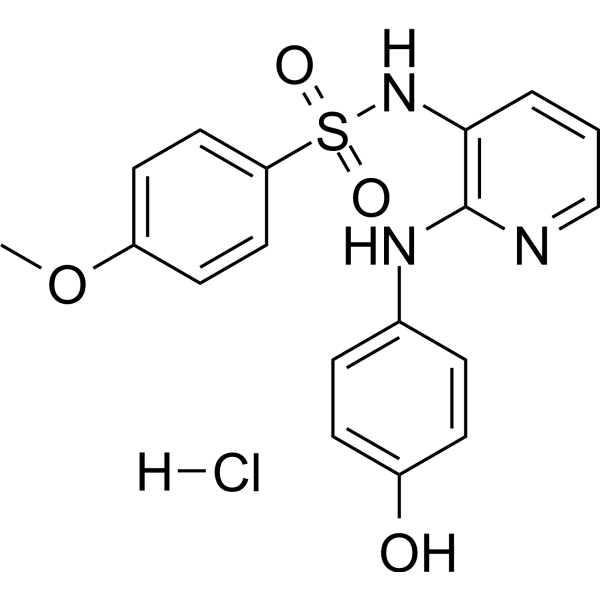
Physicochemical Properties
| Molecular Formula | C18H18CLN3O4S |
| Molecular Weight | 407.87 |
| Exact Mass | 407.071 |
| CAS # | 141450-48-8 |
| PubChem CID | 11983308 |
| Appearance | Typically exists as solid at room temperature |
| LogP | 5.369 |
| Hydrogen Bond Donor Count | 4 |
| Hydrogen Bond Acceptor Count | 7 |
| Rotatable Bond Count | 6 |
| Heavy Atom Count | 27 |
| Complexity | 523 |
| Defined Atom Stereocenter Count | 0 |
| InChi Key | KWQWWUXRGIIBAS-UHFFFAOYSA-N |
| InChi Code | InChI=1S/C18H17N3O4S.ClH/c1-25-15-8-10-16(11-9-15)26(23,24)21-17-3-2-12-19-18(17)20-13-4-6-14(22)7-5-13;/h2-12,21-22H,1H3,(H,19,20);1H |
| Chemical Name | N-[2-(4-hydroxyanilino)pyridin-3-yl]-4-methoxybenzenesulfonamide;hydrochloride |
| Synonyms | E7010 hydrochloride |
| HS Tariff Code | 2934.99.9001 |
| Storage |
Powder-20°C 3 years 4°C 2 years In solvent -80°C 6 months -20°C 1 month |
| Shipping Condition | Room temperature (This product is stable at ambient temperature for a few days during ordinary shipping and time spent in Customs) |
Biological Activity
| ln Vitro | ABT-751 hydrochloride (2 μM; 4, 8, 24h) disrupts mitosis, disrupts mitochondrial membrane potential, induces ROS generation and DNA damage in hepatocellular carcinoma-derived Hep-3B cells[9]. ABT-751 hydrochloride (2 μM; 4, 8, 24h) can cause DNA damage, inhibit cell proliferation and induce G2/M cell cycle arrest in Hep-3B cells[9]. ABT-751 hydrochloride (2 μM; 4, 8, 24h) induces autophagy in TP53-deficient Hep-3B cells by inhibiting the AKT/MTOR signaling pathway, and induces apoptosis through caspase-dependent, extrinsic and intrinsic pathways. When the TP53 gene is exogenously expressed, the autophagy and apoptosis of these cells induced by ABT-751 are further increased[9]. |
| ln Vivo | ABT-751 hydrochloride (100 mg/kg/day, oral, 5 days on, 5 days off x2, 21 days) has a significant inhibitory effect in neuroblastoma models. In rhabdomyosarcoma and Wilms tumor models, Can induce significant reduction or regression of tumor size. ABT-751 has a synergistic effect on Vincristine and Paclitaxel (HY-B0015) [7]. ABT-751 hydrochloride (100 mg/kg/day, oral, 5 days on, 5 days off x2) is synergistic with Docetaxel (HY-B0011) in mouse prostate, non-small cell lung cancer, and breast tumor xenograft models , improve the inhibitory effect on tumors [8]. |
| Animal Protocol |
Animal/Disease Models:xenograft models of neuroblastoma, osteosarcoma, Ewing sarcoma rhabdomyosarcoma, medulloblastoma and eight kidney cancer lines (six Wilms tumors, two rhabdoid)[7] Doses: 100 mg/kg Route of Administration: Oral gavage (p.o.) Experimental Results: Had obvious inhibitory effect in neuroblastoma model. Induced significant reduction or regression of tumor volume in rhabdomyosarcoma and nephroblastoma models. Had a synergistic effect on vincristine or Paclitaxel (HY-B0015). |
| References |
[1]. Huang SM et al.,Tankyrase inhibition stabilizes axin and antagonizes Wnt signalling., Nature. 2009 Oct 1;461(7264):614-20. [2]. A Phase I Study of ABT-751, an Orally Bioavailable Tubulin Inhibitor, Administered Daily for 21 Days Every 28 Days in Pediatric Patients with Solid Tumors Clin Cancer Res February 15, 2008 14; 1111 [3]. Antiangiogenic agents in the management of non-small cell lung cancer: where do we stand now and where are we headed?,Cancer Biol Ther. 2012 Mar;13(5):247-63. [4]. Silver M, Rusk A, Phillips B, Beck E, Jankowski M, Philibert J, Hahn K, Hershey E, McKeegan E, Bauch J, Krivoshik A, Khanna C.,Evaluation of the oral antimitotic agent (ABT-751) in dogs with lymphoma.,J Vet Intern Med. 2012 Mar-Apr;26(2):349-54. doi: 10.1111/j.1939-1676.2012.00892.x. Epub 2012 Feb 28. [5]. Gaynon PS, Harned TM; for the Therapeutic Advances in Childhood LeukemiaLymphoma (TACL) Consortium. [6]. Mechanism of action of E7010, an orally active sulfonamide antitumor agent: inhibition of mitosis by binding to the colchicine site of tubulin. Cancer Res. 1997;57(15):3208-3213. [7]. Evaluation of ABT-751 against childhood cancer models in vivo. Invest New Drugs. 2007;25(4):285-295. |
Solubility Data
| Solubility (In Vitro) | May dissolve in DMSO (in most cases), if not, try other solvents such as H2O, Ethanol, or DMF with a minute amount of products to avoid loss of samples |
| Solubility (In Vivo) |
Note: Listed below are some common formulations that may be used to formulate products with low water solubility (e.g. < 1 mg/mL), you may test these formulations using a minute amount of products to avoid loss of samples. Injection Formulations (e.g. IP/IV/IM/SC) Injection Formulation 1: DMSO : Tween 80: Saline = 10 : 5 : 85 (i.e. 100 μL DMSO stock solution → 50 μL Tween 80 → 850 μL Saline) *Preparation of saline: Dissolve 0.9 g of sodium chloride in 100 mL ddH ₂ O to obtain a clear solution. Injection Formulation 2: DMSO : PEG300 :Tween 80 : Saline = 10 : 40 : 5 : 45 (i.e. 100 μL DMSO → 400 μLPEG300 → 50 μL Tween 80 → 450 μL Saline) Injection Formulation 3: DMSO : Corn oil = 10 : 90 (i.e. 100 μL DMSO → 900 μL Corn oil) Example: Take the Injection Formulation 3 (DMSO : Corn oil = 10 : 90) as an example, if 1 mL of 2.5 mg/mL working solution is to be prepared, you can take 100 μL 25 mg/mL DMSO stock solution and add to 900 μL corn oil, mix well to obtain a clear or suspension solution (2.5 mg/mL, ready for use in animals). Injection Formulation 4: DMSO : 20% SBE-β-CD in saline = 10 : 90 [i.e. 100 μL DMSO → 900 μL (20% SBE-β-CD in saline)] *Preparation of 20% SBE-β-CD in Saline (4°C,1 week): Dissolve 2 g SBE-β-CD in 10 mL saline to obtain a clear solution. Injection Formulation 5: 2-Hydroxypropyl-β-cyclodextrin : Saline = 50 : 50 (i.e. 500 μL 2-Hydroxypropyl-β-cyclodextrin → 500 μL Saline) Injection Formulation 6: DMSO : PEG300 : castor oil : Saline = 5 : 10 : 20 : 65 (i.e. 50 μL DMSO → 100 μLPEG300 → 200 μL castor oil → 650 μL Saline) Injection Formulation 7: Ethanol : Cremophor : Saline = 10: 10 : 80 (i.e. 100 μL Ethanol → 100 μL Cremophor → 800 μL Saline) Injection Formulation 8: Dissolve in Cremophor/Ethanol (50 : 50), then diluted by Saline Injection Formulation 9: EtOH : Corn oil = 10 : 90 (i.e. 100 μL EtOH → 900 μL Corn oil) Injection Formulation 10: EtOH : PEG300:Tween 80 : Saline = 10 : 40 : 5 : 45 (i.e. 100 μL EtOH → 400 μLPEG300 → 50 μL Tween 80 → 450 μL Saline) Oral Formulations Oral Formulation 1: Suspend in 0.5% CMC Na (carboxymethylcellulose sodium) Oral Formulation 2: Suspend in 0.5% Carboxymethyl cellulose Example: Take the Oral Formulation 1 (Suspend in 0.5% CMC Na) as an example, if 100 mL of 2.5 mg/mL working solution is to be prepared, you can first prepare 0.5% CMC Na solution by measuring 0.5 g CMC Na and dissolve it in 100 mL ddH2O to obtain a clear solution; then add 250 mg of the product to 100 mL 0.5% CMC Na solution, to make the suspension solution (2.5 mg/mL, ready for use in animals). Oral Formulation 3: Dissolved in PEG400 Oral Formulation 4: Suspend in 0.2% Carboxymethyl cellulose Oral Formulation 5: Dissolve in 0.25% Tween 80 and 0.5% Carboxymethyl cellulose Oral Formulation 6: Mixing with food powders Note: Please be aware that the above formulations are for reference only. InvivoChem strongly recommends customers to read literature methods/protocols carefully before determining which formulation you should use for in vivo studies, as different compounds have different solubility properties and have to be formulated differently. (Please use freshly prepared in vivo formulations for optimal results.) |
| Preparing Stock Solutions | 1 mg | 5 mg | 10 mg | |
| 1 mM | 2.4518 mL | 12.2588 mL | 24.5176 mL | |
| 5 mM | 0.4904 mL | 2.4518 mL | 4.9035 mL | |
| 10 mM | 0.2452 mL | 1.2259 mL | 2.4518 mL |