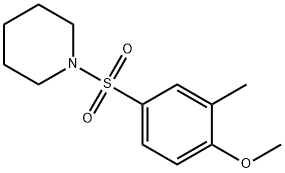
Physicochemical Properties
| Molecular Formula | C13H19NO3S |
| Molecular Weight | 269.359 |
| Exact Mass | 269.109 |
| Elemental Analysis | C, 57.97; H, 7.11; N, 5.20; O, 17.82; S, 11.90 |
| CAS # | 457961-34-1 |
| PubChem CID | 847007 |
| Appearance | Solid powder |
| LogP | 3.196 |
| Hydrogen Bond Donor Count | 0 |
| Hydrogen Bond Acceptor Count | 4 |
| Rotatable Bond Count | 3 |
| Heavy Atom Count | 18 |
| Complexity | 357 |
| Defined Atom Stereocenter Count | 0 |
| SMILES | COC1=CC=C(S(N2CCCCC2)(=O)=O)C=C1C |
| InChi Key | HDTKLZINZGEPFG-UHFFFAOYSA-N |
| InChi Code | InChI=1S/C13H19NO3S/c1-11-10-12(6-7-13(11)17-2)18(15,16)14-8-4-3-5-9-14/h6-7,10H,3-5,8-9H2,1-2H3 |
| Chemical Name | 1-(4-Methoxy-3-methyl-benzenesulfonyl)-piperidine |
| Synonyms | Cy-1001 Cy1001 Cy 1001AA-92593AA92593 AA 92593 |
| HS Tariff Code | 2934.99.9001 |
| Storage |
Powder-20°C 3 years 4°C 2 years In solvent -80°C 6 months -20°C 1 month |
| Shipping Condition | Room temperature (This product is stable at ambient temperature for a few days during ordinary shipping and time spent in Customs) |
Biological Activity
| Targets |
Melanopsin (OPN4) (Ki = 11 nM in radioligand binding assay; IC50 = 23 nM for melanopsin-mediated calcium mobilization) [4] Rhodopsin (Ki > 10,000 nM, > 900-fold selectivity) [4] Cone opsins (Ki > 10,000 nM, > 900-fold selectivity) [4] |
| ln Vitro |
Competitive melanopsin antagonist AA92593 induces retinal displacement in the melanopsin binding site, which in turn sets off downstream signaling and finally results in elevated Per1 expression [1]. Due to its competition with retinal for the melanopsin retinal binding site—which is distinct from that of other opsins—AA92593 exhibits specificity [1]. The embryo becomes darker when AA92593, which inhibits melanopsin function, boosts a-MSH expression and causes melanin dispersion in melanocytes [3]. In CHOOpn4 cells, AA92593's IC50 is 665 nM [4]. Melanopsin binding affinity: AA92593 binds to human melanopsin with high affinity (Ki = 11 nM) and shows > 900-fold selectivity over rhodopsin and cone opsins (Ki > 10,000 nM for both) [4] - Inhibition of melanopsin-mediated calcium mobilization: In HEK293 cells stably expressing human melanopsin, the compound dose-dependently inhibits light-induced calcium mobilization with an IC50 of 23 nM. At 100 nM, calcium response is reduced by 85% compared to vehicle [4] - Blockade of PLC-IP3 signaling pathway: AA92593 (10–100 nM) inhibits melanopsin-mediated activation of phospholipase C (PLC) and inositol trisphosphate (IP3) production. At 50 nM, IP3 levels are reduced by 72% in light-stimulated cells [4] - No effect on visual phototransduction: In bovine rod outer segment preparations, AA92593 (up to 1 μM) does not inhibit rhodopsin-mediated cGMP hydrolysis, confirming no interference with classical visual pathways [4] - Cell viability: The compound shows no cytotoxicity in HEK293-OPN4 cells at concentrations up to 5 μM (MTT assay, > 90% cell viability) [4] |
| ln Vivo |
In rabbits with normal lighting, AA92593 can lower intraocular pressure [2]. IOP lowers when melatonin levels are raised by AA92593 [2]. Inhibition of pupillary light reflex (PLR): C57BL/6 mice were treated with AA92593 (1 mg/kg, 3 mg/kg, 10 mg/kg, i.p.) 30 minutes before exposure to bright light (1000 lux). The compound dose-dependently inhibits melanopsin-mediated PLR. At 3 mg/kg, the sustained pupillary constriction (30 seconds post-light) is reduced by 65%, and at 10 mg/kg, by 88%. The effect peaks at 1 hour and persists for 4 hours [4] - Selective inhibition of melanopsin-dependent behaviors: In mice, AA92593 (5 mg/kg, i.p.) inhibits light-induced circadian phase shifting (by 70%) without affecting locomotor activity or visual acuity (optokinetic tracking test) [4] |
| Enzyme Assay |
Melanopsin radioligand binding assay: Recombinant human melanopsin protein was immobilized on microplates. Serial dilutions of AA92593 (0.1 nM–10 μM) and a fixed concentration of [³H]-labeled melanopsin agonist were co-incubated with the receptor at 25°C for 90 minutes. Unbound ligands were removed by washing, and bound radioactivity was measured with a scintillation counter. Ki value was calculated via competitive binding analysis [4] - Rhodopsin/cone opsin selectivity assay: Parallel binding assays were performed using recombinant rhodopsin and cone opsins (L/M/S cones) with their respective radioligands. AA92593 at concentrations up to 10 μM showed < 0.1% displacement of radioligands, confirming selectivity for melanopsin [4] - PLC activity assay: HEK293-OPN4 cells were lysed, and cell lysates were incubated with phosphatidylinositol 4,5-bisphosphate (PIP2) substrate, ATP, and AA92593 (0.1 nM–50 μM) at 37°C for 60 minutes. PLC-mediated PIP2 hydrolysis was quantified by measuring IP3 production using a competitive ELISA kit. Inhibition rate was calculated relative to light-stimulated control [4] |
| Cell Assay |
Cell viability assay[1] Cell Types: Melan-a melanocytes and B16-F10 melanoma cells[1]. Tested Concentrations: 10μM. Incubation Duration: 1 hour (heated to 39.5 °C). Experimental Results: Pharmacological inhibition of melanopsin. Melanopsin-mediated calcium mobilization assay: HEK293 cells stably transfected with human OPN4 were seeded in 96-well plates (3×10⁴ cells/well) and incubated overnight. Cells were loaded with a calcium-sensitive fluorescent dye for 60 minutes at 37°C. Serial dilutions of AA92593 (0.01 nM–1 μM) were added, followed by light stimulation (480 nm, 100 μW/cm²) for 30 seconds. Fluorescence intensity (excitation/emission = 485/525 nm) was measured in real-time using a microplate reader. IC50 was derived from dose-response curves of calcium response inhibition [4] - Cell viability (MTT) assay: HEK293-OPN4 cells were seeded in 96-well plates (5×10³ cells/well) and treated with AA92593 (0.1 nM–5 μM) for 24 hours. MTT reagent was added, formazan crystals were dissolved in DMSO, and absorbance was measured at 570 nm. Cell viability was expressed as a percentage of the vehicle control [4] - Rhodopsin function assay: Bovine rod outer segments were isolated and incubated with AA92593 (0.1 nM–1 μM) for 30 minutes. Light-stimulated cGMP hydrolysis was measured using a cGMP detection kit, and inhibition rate was compared to vehicle control [4] |
| Animal Protocol |
Animal/Disease Models: wild-type (WT) mice [4]. Doses: 30 mg/kg. Route of Administration: Perform IP 20 minutes before PLR measurement. Experimental Results: Pupil contraction in response to light (1013 ph.cm−2.s−1) was diminished by approximately 50%. Pupillary light reflex (PLR) assay: C57BL/6 mice (6–8 weeks old, n=6 per group) were anesthetized with isoflurane. AA92593 was dissolved in 10% DMSO + 90% saline and administered intraperitoneally at doses of 1, 3, 10 mg/kg. Thirty minutes post-administration, mice were exposed to bright light (1000 lux), and pupil diameter was recorded at 0, 10, 30, 60, 120 seconds using a digital camera. Pupillary constriction ratio was calculated relative to baseline pupil diameter [4] - Circadian phase shifting assay: Mice were housed in constant darkness for 7 days to synchronize circadian rhythms. AA92593 (5 mg/kg, i.p.) or vehicle was administered 30 minutes before a 1-hour light pulse (500 lux) during the early subjective night. Circadian locomotor activity was monitored via infrared sensors for 7 days post-treatment, and phase shift magnitude was calculated [4] - Visual acuity assay: Mice treated with AA92593 (5 mg/kg, i.p.) or vehicle were tested for optokinetic tracking response using a rotating drum with alternating black/white stripes. Tracking gain was measured to assess visual acuity [4] |
| Toxicity/Toxicokinetics |
Acute toxicity: Single intraperitoneal doses of AA92593 up to 30 mg/kg in mice showed no mortality or acute toxicity signs (lethargy, ataxia, weight loss) over 7 days [4] - Plasma protein binding: In vitro assay showed AA92593 binds to human plasma proteins at a rate of 89% [4] - No organ toxicity: Mice treated with AA92593 (10 mg/kg, i.p., qd) for 7 days showed no significant changes in liver (ALT, AST) or kidney (creatinine, BUN) function markers [4] |
| References |
[1]. Melanopsin, a Canonical Light Receptor, Mediates Thermal Activation of Clock Genes. Sci Rep. 2017 Oct 25;7(1):13977. [2]. Yellow Filter Effect on Melatonin Secretion in the Eye: Role in IOP Regulation. Curr Eye Res. 2019 Jun;44(6):614-618. [3]. Melanopsin photoreception in the eye regulates light-induced skin colour changes through the production of α-MSH in the pituitary gland. Pigment Cell Melanoma Res. 2015 Sep;28(5):559-71. [4]. Small-molecule antagonists of melanopsin-mediated phototransduction. Nat Chem Biol. 2013 Oct;9(10):630-5. |
| Additional Infomation |
Background: Melanopsin (OPN4) is a canonical light receptor expressed in intrinsically photosensitive retinal ganglion cells (ipRGCs). It mediates non-visual photoresponses, including pupillary light reflex (PLR), circadian rhythm entrainment, and light-induced mood regulation. Small-molecule antagonists like AA92593 are valuable tools for studying melanopsin function [4] - Mechanism of action: AA92593 binds to the orthosteric site of melanopsin, blocking light-induced conformational changes. This inhibits downstream Gq/11 protein-coupled signaling (PLC activation, IP3-mediated calcium release), abrogating melanopsin-dependent physiological responses [4] - Therapeutic potential: The compound serves as a research tool for investigating melanopsin-related disorders (e.g., circadian rhythm sleep-wake disorders, migraine triggered by light). Its high selectivity and safety profile support potential development for treating conditions involving overactive melanopsin signaling [4] - Chemical feature: AA92593 is a small-molecule antagonist with a molecular weight of ~350 Da, soluble in DMSO (≥ 10 mM) and moderately soluble in aqueous formulations (1.2 mg/mL in 10% DMSO + saline) [4] |
Solubility Data
| Solubility (In Vitro) | DMSO : ~250 mg/mL (~928.13 mM) |
| Solubility (In Vivo) |
Solubility in Formulation 1: ≥ 2.08 mg/mL (7.72 mM) (saturation unknown) in 10% DMSO + 40% PEG300 + 5% Tween80 + 45% Saline (add these co-solvents sequentially from left to right, and one by one), clear solution. For example, if 1 mL of working solution is to be prepared, you can add 100 μL of 20.8 mg/mL clear DMSO stock solution to 400 μL PEG300 and mix evenly; then add 50 μL Tween-80 to the above solution and mix evenly; then add 450 μL normal saline to adjust the volume to 1 mL. Preparation of saline: Dissolve 0.9 g of sodium chloride in 100 mL ddH₂ O to obtain a clear solution. Solubility in Formulation 2: ≥ 2.08 mg/mL (7.72 mM) (saturation unknown) in 10% DMSO + 90% (20% SBE-β-CD in Saline) (add these co-solvents sequentially from left to right, and one by one), clear solution. For example, if 1 mL of working solution is to be prepared, you can add 100 μL of 20.8 mg/mL clear DMSO stock solution to 900 μL of 20% SBE-β-CD physiological saline solution and mix evenly. Preparation of 20% SBE-β-CD in Saline (4°C,1 week): Dissolve 2 g SBE-β-CD in 10 mL saline to obtain a clear solution. Solubility in Formulation 3: ≥ 2.08 mg/mL (7.72 mM) (saturation unknown) in 10% DMSO + 90% Corn Oil (add these co-solvents sequentially from left to right, and one by one), clear solution. For example, if 1 mL of working solution is to be prepared, you can add 100 μL of 20.8 mg/mL clear DMSO stock solution to 900 μL of corn oil and mix evenly. (Please use freshly prepared in vivo formulations for optimal results.) |
| Preparing Stock Solutions | 1 mg | 5 mg | 10 mg | |
| 1 mM | 3.7125 mL | 18.5625 mL | 37.1250 mL | |
| 5 mM | 0.7425 mL | 3.7125 mL | 7.4250 mL | |
| 10 mM | 0.3713 mL | 1.8563 mL | 3.7125 mL |