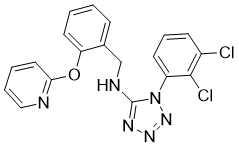
A839977 (A-839977) is a novel and potent P2X7R antagonist with antihyperalgesic and anti-inflammatory activity. The pro-inflammatory cytokine interleukin-1beta (IL-1beta) has been implicated in both inflammatory processes and nociceptive neurotransmission. Activation of P2X7 receptors is the mechanism by which ATP stimulates the rapid maturation and release of IL-1beta from macrophages and microglial cells. Recently, selective P2X7 receptor antagonists have been shown to reduce inflammatory and neuropathic pain in animal models.
Physicochemical Properties
| Molecular Formula | C19H14CL2N6O |
| Molecular Weight | 413.262 |
| Exact Mass | 412.061 |
| CAS # | 870061-27-1 |
| PubChem CID | 53325875 |
| Appearance | White to off-white solid powder |
| LogP | 4.19 |
| Hydrogen Bond Donor Count | 1 |
| Hydrogen Bond Acceptor Count | 6 |
| Rotatable Bond Count | 6 |
| Heavy Atom Count | 28 |
| Complexity | 489 |
| Defined Atom Stereocenter Count | 0 |
| InChi Key | GMVNBKZQJFRFAR-UHFFFAOYSA-N |
| InChi Code | InChI=1S/C19H14Cl2N6O/c20-14-7-5-8-15(18(14)21)27-19(24-25-26-27)23-12-13-6-1-2-9-16(13)28-17-10-3-4-11-22-17/h1-11H,12H2,(H,23,24,26) |
| Chemical Name | 1-(2,3-dichlorophenyl)-N-{[2-(pyridin-2-yloxy)phenyl]methyl}-1H-1,2,3,4-tetrazol-5-amine |
| Synonyms | A839977A-839977A 839977 |
| HS Tariff Code | 2934.99.9001 |
| Storage |
Powder-20°C 3 years 4°C 2 years In solvent -80°C 6 months -20°C 1 month |
| Shipping Condition | Room temperature (This product is stable at ambient temperature for a few days during ordinary shipping and time spent in Customs) |
Biological Activity
| ln Vitro | A 839977 specifically prevents agonist-induced YO-PRO uptake and IL-1beta release in differentiated human THP-1 cells by inhibiting BzATP-induced calcium influx at the mammalian P2X7 receptor (IC50=20-150 nM). In animal studies, it has been demonstrated to lessen neuropathic pain and inflammation [1]. In optic astrocytes, 839977 (50 nM, 1 hour pretreatment) effectively inhibits the rise in IL-1β initiation that is produced by stress [2]. |
| ln Vivo | In rats, A839977 (30 μmol/kg, 100 μmol/kg, 300 μmol/kg; 30 min preinjection) lowers thermal hyperalgesia in a dose-dependent manner when complete Freund's adjuvant (CFA) is injected plantarly [1]. The CFA model of inflammatory pain in wild-type mice was significantly affected by A839977 (10 μmol/kg, 30 μmol/kg, and 100 μmol/kg; pre-injection for 30 minutes), whereas IL-1alphabeta knockout mice were not significantly affected. Rats are ineffective [1]. In animals with cancer, A839977 reduces the responses of dorsal horn neurons [3]. |
| Cell Assay |
RT-PCR[2] Cell Types: Optic astrocytes Tested Concentrations: 50 nM Incubation Duration: 1 hour (pre-treatment) Experimental Results: Prevents IL-1β initiation in astrocytes |
| Animal Protocol |
Animal/Disease Models: Male SD (SD (Sprague-Dawley)), balb/c (Bagg ALBino) mouse and IL-1 (−/−) mice, for CFA-induced chronic inflammation Doses: 30 μmol/kg, 100 μmol/kg, 300 μmol/kg (rat); 10 μmol/kg, 30 μmol/kg, 100 μmol/kg (mouse) Route of Administration: injection; 30-minute pre-injection Experimental Results: Attenuated CFA-induced thermal hyperalgesia in a dose-related manner in rats and mice, However, it had no effect on IL-1 (−/−) mice. |
| References |
[1]. The antihyperalgesic activity of a selective P2X7 receptor antagonist, A-839977, is lost in IL-1alphabeta knockout mice. Behav Brain Res. 2009 Dec 1;204(1):77-81. [2]. Albalawi F et.al, The P2X7 Receptor Primes IL-1β and the NLRP3 Inflammasome in Astrocytes Exposed to Mechanical Strain. Front Cell Neurosci. 2017 Aug 8;11:227. [3]. P2X7 receptor-mediated analgesia in cancer-induced bone pain. Neuroscience. 2015 Apr 16; 291:93-105. |
Solubility Data
| Solubility (In Vitro) | DMSO : ~100 mg/mL (~241.98 mM) |
| Solubility (In Vivo) |
Solubility in Formulation 1: ≥ 2.5 mg/mL (6.05 mM) (saturation unknown) in 10% DMSO + 40% PEG300 + 5% Tween80 + 45% Saline (add these co-solvents sequentially from left to right, and one by one), clear solution. For example, if 1 mL of working solution is to be prepared, you can add 100 μL of 25.0 mg/mL clear DMSO stock solution to 400 μL PEG300 and mix evenly; then add 50 μL Tween-80 to the above solution and mix evenly; then add 450 μL normal saline to adjust the volume to 1 mL. Preparation of saline: Dissolve 0.9 g of sodium chloride in 100 mL ddH₂ O to obtain a clear solution. Solubility in Formulation 2: 2.5 mg/mL (6.05 mM) in 10% DMSO + 90% (20% SBE-β-CD in Saline) (add these co-solvents sequentially from left to right, and one by one), suspension solution; with ultrasonication. For example, if 1 mL of working solution is to be prepared, you can add 100 μL of 25.0 mg/mL clear DMSO stock solution to 900 μL of 20% SBE-β-CD physiological saline solution and mix evenly. Preparation of 20% SBE-β-CD in Saline (4°C,1 week): Dissolve 2 g SBE-β-CD in 10 mL saline to obtain a clear solution. Solubility in Formulation 3: ≥ 2.5 mg/mL (6.05 mM) (saturation unknown) in 10% DMSO + 90% Corn Oil (add these co-solvents sequentially from left to right, and one by one), clear solution. For example, if 1 mL of working solution is to be prepared, you can add 100 μL of 25.0 mg/mL clear DMSO stock solution to 900 μL of corn oil and mix evenly. (Please use freshly prepared in vivo formulations for optimal results.) |
| Preparing Stock Solutions | 1 mg | 5 mg | 10 mg | |
| 1 mM | 2.4198 mL | 12.0989 mL | 24.1978 mL | |
| 5 mM | 0.4840 mL | 2.4198 mL | 4.8396 mL | |
| 10 mM | 0.2420 mL | 1.2099 mL | 2.4198 mL |