|
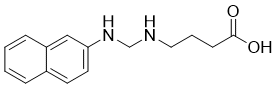
A 144 is a bioactive chemical with the name of 4-(((2-Naphthalenylamino)methyl)amino)butanoic acid.
|
Physicochemical Properties
| Molecular Formula |
C15H18N2O2
|
| Molecular Weight |
258.315623760223
|
| Exact Mass |
258.137
|
| CAS # |
41510-03-6
|
| Related CAS # |
|
| PubChem CID |
191061
|
| Appearance |
Typically exists as solid at room temperature
|
| LogP |
3.127
|
| Hydrogen Bond Donor Count |
3
|
| Hydrogen Bond Acceptor Count |
4
|
| Rotatable Bond Count |
7
|
| Heavy Atom Count |
19
|
| Complexity |
283
|
| Defined Atom Stereocenter Count |
0
|
| SMILES |
OC(CCCNCNC1C=CC2C=CC=CC=2C=1)=O
|
| InChi Key |
LJCZRFFCDLIUBV-UHFFFAOYSA-N
|
| InChi Code |
InChI=1S/C15H18N2O2/c18-15(19)6-3-9-16-11-17-14-8-7-12-4-1-2-5-13(12)10-14/h1-2,4-5,7-8,10,16-17H,3,6,9,11H2,(H,18,19)
|
| Chemical Name |
4-[(naphthalen-2-ylamino)methylamino]butanoic acid
|
| Synonyms |
|
| HS Tariff Code |
2934.99.9001
|
| Storage |
Powder-20°C 3 years
4°C 2 years
In solvent -80°C 6 months
-20°C 1 month
|
| Shipping Condition |
Room temperature (This product is stable at ambient temperature for a few days during ordinary shipping and time spent in Customs)
|
|
Biological Activity
| ln Vitro |
In vitro activity:
Kinase Assay:
Cell Assay: |
|
| ln Vivo |
|
| Animal Protocol |
|
| References |
N/A
|
|
Solubility Data
| Solubility (In Vitro) |
|
| Solubility (In Vivo) |
(Please use freshly prepared in vivo formulations for optimal results.)
|
| Preparing Stock Solutions |
|
1 mg |
5 mg |
10 mg |
| 1 mM |
3.8712 mL |
19.3558 mL |
38.7117 mL |
| 5 mM |
0.7742 mL |
3.8712 mL |
7.7423 mL |
| 10 mM |
0.3871 mL |
1.9356 mL |
3.8712 mL |
*Note: Please select an appropriate solvent for the preparation of stock solution based on your experiment needs. For most products, DMSO can be used for preparing stock solutions (e.g. 5 mM, 10 mM, or 20 mM concentration); some products with high aqueous solubility may be dissolved in water directly. Solubility information is available at the above Solubility Data section. Once the stock solution is prepared, aliquot it to routine usage volumes and store at -20°C or -80°C. Avoid repeated freeze and thaw cycles. |