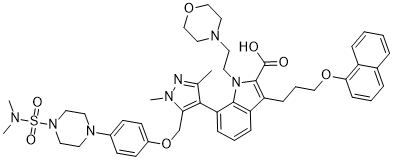
A-1210477 is a novel, potent and specific MCL-1 (Myeloid cell leukemia-1) inhibitor with Ki and IC50 of 0.45 nM and 26.2 nM, respectively. Treatment with A-1210477 at different doses caused dose-dependent cell death in MCL-1-dependent SVEC cells. Cell viability was assessed using SYTOX Green exclusion and live-cell imaging. A-1210477 induced cell death more quickly, which is consistent with its increased potency. BcL-xL-, BcL-2-, and MCL-1-dependent SVEC cells were subjected to A-1210477 treatment to investigate the drug's selectivity for focusing on Bcl-2 family members. Only cells dependent on MCL-1 were killed by A-1210477. While UMI-77 has an EC50 value of 10 µmol/L, A-1210477 demonstrated greater potency and specificity as an MCL-1 inhibitor.
Physicochemical Properties
| Molecular Formula | C46H55N7O7S | |
| Molecular Weight | 850.04 | |
| Exact Mass | 849.388 | |
| Elemental Analysis | C, 65.00; H, 6.52; N, 11.53; O, 13.17; S, 3.77 | |
| CAS # | 1668553-26-1 | |
| Related CAS # |
|
|
| PubChem CID | 66575373 | |
| Appearance | White to off-white solid powder | |
| Density | 1.3±0.1 g/cm3 | |
| Boiling Point | 1027.4±65.0 °C at 760 mmHg | |
| Flash Point | 575.1±34.3 °C | |
| Vapour Pressure | 0.0±0.3 mmHg at 25°C | |
| Index of Refraction | 1.655 | |
| LogP | 4.68 | |
| Hydrogen Bond Donor Count | 1 | |
| Hydrogen Bond Acceptor Count | 12 | |
| Rotatable Bond Count | 16 | |
| Heavy Atom Count | 61 | |
| Complexity | 1500 | |
| Defined Atom Stereocenter Count | 0 | |
| SMILES | S(N(C([H])([H])[H])C([H])([H])[H])(N1C([H])([H])C([H])([H])N(C2C([H])=C([H])C(=C([H])C=2[H])OC([H])([H])C2=C(C(C([H])([H])[H])=NN2C([H])([H])[H])C2=C([H])C([H])=C([H])C3C(C([H])([H])C([H])([H])C([H])([H])OC4=C([H])C([H])=C([H])C5=C([H])C([H])=C([H])C([H])=C45)=C(C(=O)O[H])N(C([H])([H])C([H])([H])N4C([H])([H])C([H])([H])OC([H])([H])C4([H])[H])C=32)C([H])([H])C1([H])[H])(=O)=O |
|
| InChi Key | XMVAWGSQPHFXKU-UHFFFAOYSA-N | |
| InChi Code | InChI=1S/C46H55N7O7S/c1-33-43(41(49(4)47-33)32-60-36-19-17-35(18-20-36)51-22-24-52(25-23-51)61(56,57)48(2)3)40-14-8-13-38-39(15-9-29-59-42-16-7-11-34-10-5-6-12-37(34)42)45(46(54)55)53(44(38)40)26-21-50-27-30-58-31-28-50/h5-8,10-14,16-20H,9,15,21-32H2,1-4H3,(H,54,55) | |
| Chemical Name | 7-[5-[[4-[4-(dimethylsulfamoyl)piperazin-1-yl]phenoxy]methyl]-1,3-dimethylpyrazol-4-yl]-1-(2-morpholin-4-ylethyl)-3-(3-naphthalen-1-yloxypropyl)indole-2-carboxylic acid | |
| Synonyms |
|
|
| HS Tariff Code | 2934.99.9001 | |
| Storage |
Powder-20°C 3 years 4°C 2 years In solvent -80°C 6 months -20°C 1 month |
|
| Shipping Condition | Room temperature (This product is stable at ambient temperature for a few days during ordinary shipping and time spent in Customs) |
Biological Activity
| Targets | Mcl-1 (Ki = 0.45 nM); Bcl-2 (IC50 = 132 nM); Bfl-1 (IC50 = 660 nM); Bcl-W (IC50 = 2280 nM); Apoptosis | |
| ln Vitro | A-1210477 (10 μM) causes MCL-1 elevation in a number of cancer cell lines, including the breast cancer cell line HCC-1806, and lowers the amount of BIM that is co-immunoprecipitated with MCL-1 antibody. With an IC50 of roughly 1 μM, A-1210477 blocks MCL-1-NOXA interactions but has no impact on BCL-2-BIM or BCL-XL-BCL-XS interactions. A-1210477 can kill MCL-1-dependent cell lines because it has a cell viability IC50<10 μM in the NSCLC cell lines H2110 and H23[1]. | |
| Enzyme Assay | TR-FRET-binding affinity assays are carried out for BCL-2, BCL-XL, and MCL-1 in solutions containing 4.52 mM monobasic potassium phosphate, 15.48 mM dibasic potassium phosphate, 1 mM sodium EDTA, 0.05% Pluronic F-68 detergent, 50 mM sodium chloride, and 1 mM DTT (pH 7.5) for BCL-XL.6 When performing MCL-1 assays, GST-tagged MCL-1 (1 nM) is combined with 100 nM f-Bak, 1 nM Tb-labeled anti-GST antibody, and compound at room temperature (RT) for 60 min. 340/35 nm excitation, 520/525 (f-Bak) and 495/510 nm (Tb-labeled anti-GST antibody) emission, and measurement of fluorescence are performed on an Envision plate reader. | |
| Cell Assay | Adherent cell lines are plated in 96-well plates with a seeding density of 50 000 cells per well and treated for 48 hours with chemicals that are diluted in half-log steps starting at 30 μM and ending at 0.001 μM. 15 000–20 000 cells per well are used to seed multiple myeloma cell lines, and they are all treated similarly. Promega's CellTiter-Glo reagent is used to measure effects on proliferation and viability in accordance with the manufacturer's instructions. Non-linear regression analysis of the concentration response data is used to calculate IC50 values. | |
| Animal Protocol |
|
|
| References | [1]. Cell Death Dis . 2015 Jan 15;6(1):e1590.. [2]. Mol Cancer Ther . 2015 Aug;14(8):1837-47. [3]. Blood Cancer J . 2015 Nov 13;5(11):e368. |
Solubility Data
| Solubility (In Vitro) |
|
|||
| Solubility (In Vivo) |
Solubility in Formulation 1: ≥ 1 mg/mL (1.18 mM) (saturation unknown) in 10% DMSO + 40% PEG300 + 5% Tween80 + 45% Saline (add these co-solvents sequentially from left to right, and one by one), clear solution. For example, if 1 mL of working solution is to be prepared, you can add 100 μL of 10.0 mg/mL clear DMSO stock solution to 400 μL of PEG300 and mix evenly; then add 50 μL of Tween-80 to the above solution and mix evenly; then add 450 μL of normal saline to adjust the volume to 1 mL. Preparation of saline: Dissolve 0.9 g of sodium chloride in 100 mL ddH₂ O to obtain a clear solution. Solubility in Formulation 2: 1 mg/mL (1.18 mM) in 10% DMSO + 90% (20% SBE-β-CD in Saline) (add these co-solvents sequentially from left to right, and one by one), suspension solution; with ultrasonication. For example, if 1 mL of working solution is to be prepared, you can add 100 μL of 10.0 mg/mL clear DMSO stock solution to 900 μL of 20% SBE-β-CD physiological saline solution and mix evenly. Preparation of 20% SBE-β-CD in Saline (4°C,1 week): Dissolve 2 g SBE-β-CD in 10 mL saline to obtain a clear solution. Solubility in Formulation 3: ≥ 1 mg/mL (1.18 mM) (saturation unknown) in 10% DMSO + 90% Corn Oil (add these co-solvents sequentially from left to right, and one by one), clear solution. For example, if 1 mL of working solution is to be prepared, you can add 100 μL of 10.0 mg/mL clear DMSO stock solution to 900 μL of corn oil and mix evenly. (Please use freshly prepared in vivo formulations for optimal results.) |
| Preparing Stock Solutions | 1 mg | 5 mg | 10 mg | |
| 1 mM | 1.1764 mL | 5.8821 mL | 11.7642 mL | |
| 5 mM | 0.2353 mL | 1.1764 mL | 2.3528 mL | |
| 10 mM | 0.1176 mL | 0.5882 mL | 1.1764 mL |