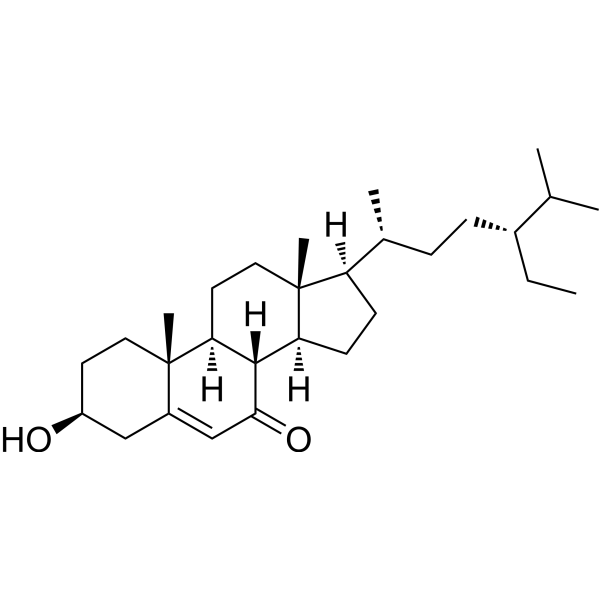
Physicochemical Properties
| Molecular Formula | C29H48O2 |
| Molecular Weight | 428.69 |
| Exact Mass | 428.365 |
| CAS # | 2034-74-4 |
| PubChem CID | 160608 |
| Appearance | Typically exists as solid at room temperature |
| Density | 1.0±0.1 g/cm3 |
| Boiling Point | 536.1±29.0 °C at 760 mmHg |
| Flash Point | 226.1±16.9 °C |
| Vapour Pressure | 0.0±3.2 mmHg at 25°C |
| Index of Refraction | 1.526 |
| LogP | 8.45 |
| Hydrogen Bond Donor Count | 1 |
| Hydrogen Bond Acceptor Count | 2 |
| Rotatable Bond Count | 6 |
| Heavy Atom Count | 31 |
| Complexity | 708 |
| Defined Atom Stereocenter Count | 9 |
| SMILES | O=C1C([H])=C2C([H])([H])C([H])(C([H])([H])C([H])([H])C2(C([H])([H])[H])C2([H])C([H])([H])C([H])([H])C3(C([H])([H])[H])C([H])(C([H])(C([H])([H])[H])C([H])([H])C([H])([H])C([H])(C([H])([H])C([H])([H])[H])C([H])(C([H])([H])[H])C([H])([H])[H])C([H])([H])C([H])([H])C3([H])C21[H])O[H] |
| InChi Key | ICFXJOAKQGDRCT-ZIHMWMKCSA-N |
| InChi Code | InChI=1S/C29H48O2/c1-7-20(18(2)3)9-8-19(4)23-10-11-24-27-25(13-15-29(23,24)6)28(5)14-12-22(30)16-21(28)17-26(27)31/h17-20,22-25,27,30H,7-16H2,1-6H3/t19-,20-,22+,23-,24+,25+,27+,28+,29-/m1/s1 |
| Chemical Name | (3S,8S,9S,10R,13R,14S,17R)-17-[(2R,5R)-5-ethyl-6-methylheptan-2-yl]-3-hydroxy-10,13-dimethyl-1,2,3,4,8,9,11,12,14,15,16,17-dodecahydrocyclopenta[a]phenanthren-7-one |
| Synonyms | 7-oxo-beta-sitosterol; 2034-74-4; 7-Ketositosterol; 3-Hydroxystigmast-5-en-7-one; Stigmast-5-en-7-one, 3-hydroxy-, (3beta)-; 3beta-hydroxy-stigmast-5-en-7-one; (3S,8S,9S,10R,13R,14S,17R)-17-[(2R,5R)-5-ethyl-6-methylheptan-2-yl]-3-hydroxy-10,13-dimethyl-1,2,3,4,8,9,11,12,14,15,16,17-dodecahydrocyclopenta[a]phenanthren-7-one; 7-Keto--sitosterol; . |
| HS Tariff Code | 2934.99.9001 |
| Storage |
Powder-20°C 3 years 4°C 2 years In solvent -80°C 6 months -20°C 1 month |
| Shipping Condition | Room temperature (This product is stable at ambient temperature for a few days during ordinary shipping and time spent in Customs) |
Biological Activity
| Targets | Natural product from fruits of the mulberry tree |
| ln Vitro | The aim of this study was to explore the protective effects of bioactive compounds from the fruit of the mulberry tree (Morus alba L.) against cisplatin-induced apoptosis in LLC-PK1 pig kidney epithelial cells. Morus alba fruit is a well-known edible fruit commonly used in traditional folk medicine. Chemical investigation of M. alba fruit resulted in the isolation and identification of six phytosterols (1-6). Their structures were determined as 7-ketositosterol (1), stigmast-4-en-3β-ol-6-one (2), (3β,6α)-stigmast-4-ene-3,6-diol (3), stigmast-4-ene-3β,6β-diol (4), 7β-hydroxysitosterol 3-O-β-d-glucoside (5), and 7α-hydroxysitosterol 3-O-β-d-glucoside (6) by analyzing their physical and spectroscopic data as well as liquid chromatography/mass spectrometry data. All compounds displayed protective effects against cisplatin-induced LLC-PK1 cell damage, improving cisplatin-induced cytotoxicity to more than 80% of the control value. Compound 1 displayed the best effect at a relatively low concentration by inhibiting the percentage of apoptotic cells following cisplatin treatment. Its molecular mechanisms were identified using Western blot assays. Treatment of LLC-PK1 cells with compound 1 decreased the upregulated phosphorylation of p38 and c-Jun N-terminal kinase (JNK) following cisplatin treatment. In addition, compound 1 significantly suppressed cleaved caspase-3 in cisplatin-induced LLC-PK1 cells. Taken together, these findings indicated that cisplatin-induced apoptosis was significantly inhibited by compound 1 in LLC-PK1 cells, thereby supporting the potential of 7-ketositosterol (1) as an adjuvant candidate for treating cisplatin-induced nephrotoxicity [1]. |
| Cell Assay |
Image-Based Cytometric Assay [1] Annexin V Alexa Fluor 488 staining was performed to determine the percentage of apoptotic cells. Briefly, cells were seeded in six-well plates at a density of 4 × 10⁵ cells/mL. After 24 h, cells were pretreated with 2.5 and 5 μM 7-ketositosterol (1) for 2 h at 37 °C. Next, 25 μM cisplatin was added to cells. After incubation for 24 h at 37 °C, cells were stained with Annexin V Alexa Fluor 488. The percentage of apoptotic cells was analyzed using a Tali image-based cytometer according to the method described in a previous study. Western Blotting Analysis Cells were seeded into six-well plates at a density of 4 × 10⁵ cells/mL. After 24 h, cells were pretreated with 2.5 and 5 μM 7-ketositosterol (1) for 2 h at 37 °C. Next, 25 μM cisplatin was added to cells. After incubation for 24 h at 37 °C, Western blot analysis was performed according to a previously described method. The same amount of protein was transferred to Immobilon-P (PVDF) transfer membranes from a precast 4–15% Mini-PROTEAN TGX gel. The membranes were then incubated with primary antibodies and secondary antibodies. The primary antibodies used in this study were phospho-p38 (1:1000 dilution), p38 (1:1000 dilution), phospho-JNK (1:1000 dilution), JNK (1:1000 dilution), cleaved caspase-3 (1:1000 dilution), and GAPDH (1:1000 dilution). |
| References |
[1]. Identification of Renoprotective Phytosterols from Mulberry (Morus alba) Fruit against Cisplatin-Induced Cytotoxicity in LLC-PK1 Kidney Cells. Plants (Basel). 2021 Nov 17;10(11):2481. |
| Additional Infomation |
3-Hydroxystigmast-5-en-7-one is a steroid. It derives from a hydride of a stigmastane. 3-Hydroxystigmast-5-en-7-one has been reported in Pourthiaea arguta, Ficus erecta var. beecheyana, and other organisms with data available. In summary, as part of an ongoing research project to discover bioactive natural products, we identified renoprotective phytosterols from the fruit of the mulberry tree (M. alba) that ameliorated cisplatin-induced cytotoxicity. All compounds displayed protective effects against cisplatin-induced damage in LLC-PK1 cells. 7-ketositosterol (1) displayed the best effect at a relatively low concentration. In addition, we demonstrated that 7-ketositosterol (1) blocked cisplatin-induced LLC-PK1 cell apoptosis by inhibiting expression levels of phosphorylated p38, phosphorylated JNK, and cleaved caspase-3. However, additional detailed mechanisms responsible for the renoprotective effects of 7-ketositosterol (1) need to be studied to support the potential of 7-ketositosterol (1) as an adjuvant candidate for treating cisplatin-induced nephrotoxicity. |
Solubility Data
| Solubility (In Vitro) | May dissolve in DMSO (in most cases), if not, try other solvents such as H2O, Ethanol, or DMF with a minute amount of products to avoid loss of samples |
| Solubility (In Vivo) |
Note: Listed below are some common formulations that may be used to formulate products with low water solubility (e.g. < 1 mg/mL), you may test these formulations using a minute amount of products to avoid loss of samples. Injection Formulations (e.g. IP/IV/IM/SC) Injection Formulation 1: DMSO : Tween 80: Saline = 10 : 5 : 85 (i.e. 100 μL DMSO stock solution → 50 μL Tween 80 → 850 μL Saline) *Preparation of saline: Dissolve 0.9 g of sodium chloride in 100 mL ddH ₂ O to obtain a clear solution. Injection Formulation 2: DMSO : PEG300 :Tween 80 : Saline = 10 : 40 : 5 : 45 (i.e. 100 μL DMSO → 400 μLPEG300 → 50 μL Tween 80 → 450 μL Saline) Injection Formulation 3: DMSO : Corn oil = 10 : 90 (i.e. 100 μL DMSO → 900 μL Corn oil) Example: Take the Injection Formulation 3 (DMSO : Corn oil = 10 : 90) as an example, if 1 mL of 2.5 mg/mL working solution is to be prepared, you can take 100 μL 25 mg/mL DMSO stock solution and add to 900 μL corn oil, mix well to obtain a clear or suspension solution (2.5 mg/mL, ready for use in animals). Injection Formulation 4: DMSO : 20% SBE-β-CD in saline = 10 : 90 [i.e. 100 μL DMSO → 900 μL (20% SBE-β-CD in saline)] *Preparation of 20% SBE-β-CD in Saline (4°C,1 week): Dissolve 2 g SBE-β-CD in 10 mL saline to obtain a clear solution. Injection Formulation 5: 2-Hydroxypropyl-β-cyclodextrin : Saline = 50 : 50 (i.e. 500 μL 2-Hydroxypropyl-β-cyclodextrin → 500 μL Saline) Injection Formulation 6: DMSO : PEG300 : castor oil : Saline = 5 : 10 : 20 : 65 (i.e. 50 μL DMSO → 100 μLPEG300 → 200 μL castor oil → 650 μL Saline) Injection Formulation 7: Ethanol : Cremophor : Saline = 10: 10 : 80 (i.e. 100 μL Ethanol → 100 μL Cremophor → 800 μL Saline) Injection Formulation 8: Dissolve in Cremophor/Ethanol (50 : 50), then diluted by Saline Injection Formulation 9: EtOH : Corn oil = 10 : 90 (i.e. 100 μL EtOH → 900 μL Corn oil) Injection Formulation 10: EtOH : PEG300:Tween 80 : Saline = 10 : 40 : 5 : 45 (i.e. 100 μL EtOH → 400 μLPEG300 → 50 μL Tween 80 → 450 μL Saline) Oral Formulations Oral Formulation 1: Suspend in 0.5% CMC Na (carboxymethylcellulose sodium) Oral Formulation 2: Suspend in 0.5% Carboxymethyl cellulose Example: Take the Oral Formulation 1 (Suspend in 0.5% CMC Na) as an example, if 100 mL of 2.5 mg/mL working solution is to be prepared, you can first prepare 0.5% CMC Na solution by measuring 0.5 g CMC Na and dissolve it in 100 mL ddH2O to obtain a clear solution; then add 250 mg of the product to 100 mL 0.5% CMC Na solution, to make the suspension solution (2.5 mg/mL, ready for use in animals). Oral Formulation 3: Dissolved in PEG400 Oral Formulation 4: Suspend in 0.2% Carboxymethyl cellulose Oral Formulation 5: Dissolve in 0.25% Tween 80 and 0.5% Carboxymethyl cellulose Oral Formulation 6: Mixing with food powders Note: Please be aware that the above formulations are for reference only. InvivoChem strongly recommends customers to read literature methods/protocols carefully before determining which formulation you should use for in vivo studies, as different compounds have different solubility properties and have to be formulated differently. (Please use freshly prepared in vivo formulations for optimal results.) |
| Preparing Stock Solutions | 1 mg | 5 mg | 10 mg | |
| 1 mM | 2.3327 mL | 11.6634 mL | 23.3269 mL | |
| 5 mM | 0.4665 mL | 2.3327 mL | 4.6654 mL | |
| 10 mM | 0.2333 mL | 1.1663 mL | 2.3327 mL |