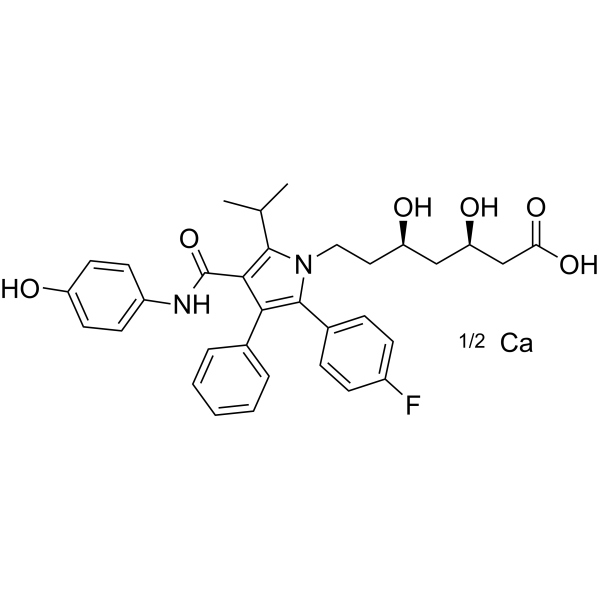
Physicochemical Properties
| Molecular Formula | C33H35FN2O6.1/2CA |
| Molecular Weight | 594.68 |
| CAS # | 265989-44-4 |
| Related CAS # | 4-Hydroxy Atorvastatin-d5 calcium;265989-45-5 |
| Appearance | White to off-white solid powder |
| LogP | 6.53 |
| SMILES | FC1C=CC(=CC=1)C1=C(C2C=CC=CC=2)C(C(NC2C=CC(=CC=2)O)=O)=C(C(C)C)N1CCC(CC(CC(=O)O)O)O |
| HS Tariff Code | 2934.99.9001 |
| Storage |
Powder-20°C 3 years 4°C 2 years In solvent -80°C 6 months -20°C 1 month Note: Please store this product in a sealed and protected environment, avoid exposure to moisture. |
| Shipping Condition | Room temperature (This product is stable at ambient temperature for a few days during ordinary shipping and time spent in Customs) |
Biological Activity
| References |
[1]. Long term efficacy and safety of atorvastatin in the treatment of severe type III and combined dyslipidaemia. Heart. 2002;88(3):234-238. [2]. Diabetes Atorvastin Lipid Intervention (DALI) Study Group. The effect of aggressive versus standard lipid lowering by atorvastatin on diabetic dyslipidemia: the DALI study: a double-blind, randomized, placebo-controlled trial in patients with type 2 diabetes and diabetic dyslipidemia. Diabetes Care. 2001;24(8):1335-1341. |
Solubility Data
| Solubility (In Vitro) | DMSO : ~100 mg/mL (~168.16 mM; with ultrasonication) |
| Solubility (In Vivo) |
Solubility in Formulation 1: ≥ 2.5 mg/mL (4.20 mM)(saturation unknown) in 10% DMSO 40% PEG300 5% Tween-80 45% Saline (add these co-solvents sequentially from left to right, and one by one),clear solution. For example, if 1 mL of working solution is to be prepared, you can add 100 μL of 25.0 mg/mL clear DMSO stock solution and add it to 400 μL PEG300, mix well; then add 50 μL Tween-80 to the above system, mix well; then continue to add 450 μL of normal saline to make up to 1 mL. Preparation of normal saline: Dissolve 0.9 g of sodium chloride in ddH₂O and make up to 100 mL to obtain a clear and transparent normal saline solution. Solubility in Formulation 2: ≥ 2.5 mg/mL (4.20 mM)(saturation unknown) in 10% DMSO 90% (20% SBE-β-CD in Saline) (add these co-solvents sequentially from left to right, and one by one),clear solution. For example, if 1 mL of working solution is to be prepared, you can add 100 μL of 25.0 mg/mL clear DMSO stock solution and add it to 900 μL of 20% SBE-β-CD saline solution and mix well. 2 g SBE-β-CD (sulfobutyl ether β-cyclodextrin) powder is diluted to 10 mL of saline and completely dissolved until clear and transparent. Solubility in Formulation 3: ≥ 2.5 mg/mL (4.20 mM)(saturation unknown) in 10% DMSO 90% Corn Oil (add these co-solvents sequentially from left to right, and one by one),clear solution. For example, if 1 mL of working solution is to be prepared, you can add 100 μL of 25.0 mg/mL clear DMSO stock solution and add it to 900 μL corn oil and mix well. (Please use freshly prepared in vivo formulations for optimal results.) |
| Preparing Stock Solutions | 1 mg | 5 mg | 10 mg | |
| 1 mM | 1.6816 mL | 8.4079 mL | 16.8158 mL | |
| 5 mM | 0.3363 mL | 1.6816 mL | 3.3632 mL | |
| 10 mM | 0.1682 mL | 0.8408 mL | 1.6816 mL |