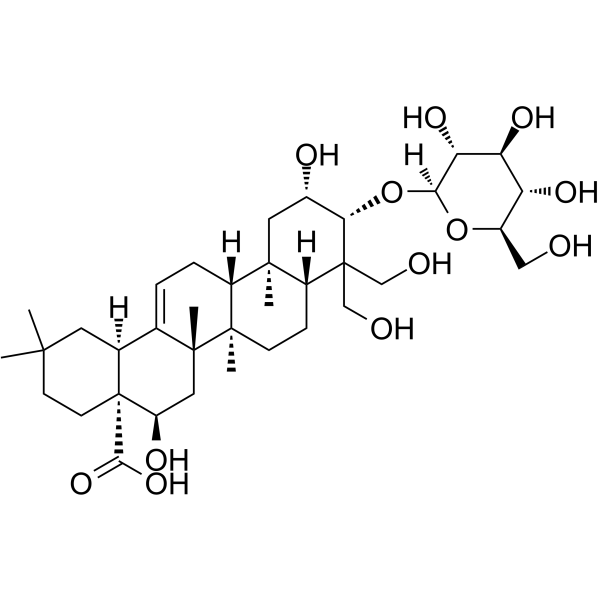
Physicochemical Properties
| Molecular Formula | C36H58O12 |
| Molecular Weight | 682.8385 |
| Exact Mass | 682.393 |
| CAS # | 38337-25-6 |
| PubChem CID | 102185205 |
| Appearance | White to off-white solid powder |
| LogP | 0.944 |
| Hydrogen Bond Donor Count | 9 |
| Hydrogen Bond Acceptor Count | 12 |
| Rotatable Bond Count | 6 |
| Heavy Atom Count | 48 |
| Complexity | 1280 |
| Defined Atom Stereocenter Count | 15 |
| SMILES | C[C@@]12CC[C@@H]3[C@@]([C@H]1CC=C4[C@]2(C[C@H]([C@@]5([C@H]4CC(CC5)(C)C)C(=O)O)O)C)(C[C@@H]([C@@H](C3(CO)CO)O[C@H]6[C@@H]([C@H]([C@@H]([C@H](O6)CO)O)O)O)O)C |
| InChi Key | HPVWWHYNAAZHQR-KNSUCORESA-N |
| InChi Code | InChI=1S/C36H58O12/c1-31(2)10-11-36(30(45)46)19(12-31)18-6-7-22-32(3)13-20(40)28(48-29-27(44)26(43)25(42)21(15-37)47-29)35(16-38,17-39)23(32)8-9-33(22,4)34(18,5)14-24(36)41/h6,19-29,37-44H,7-17H2,1-5H3,(H,45,46)/t19-,20-,21+,22+,23+,24+,25+,26-,27+,28-,29-,32+,33+,34+,36+/m0/s1 |
| Chemical Name | (4aR,5R,6aR,6aS,6bR,8aR,10R,11S,12aR,14bS)-5,11-dihydroxy-9,9-bis(hydroxymethyl)-2,2,6a,6b,12a-pentamethyl-10-[(2R,3R,4S,5S,6R)-3,4,5-trihydroxy-6-(hydroxymethyl)oxan-2-yl]oxy-1,3,4,5,6,6a,7,8,8a,10,11,12,13,14b-tetradecahydropicene-4a-carboxylic acid |
| HS Tariff Code | 2934.99.9001 |
| Storage |
Powder-20°C 3 years 4°C 2 years In solvent -80°C 6 months -20°C 1 month Note: Please store this product in a sealed and protected environment (e.g. under nitrogen), avoid exposure to moisture and light. |
| Shipping Condition | Room temperature (This product is stable at ambient temperature for a few days during ordinary shipping and time spent in Customs) |
Biological Activity
| ln Vitro |
Anti-proliferative activity against HSC-T6 cells (rat hepatic stellate cells): HSC-T6 cells were treated with 3-O-Beta-D-Glucopyranosylplatycodigenin at concentrations of 10 μM, 25 μM, 50 μM, 75 μM, and 100 μM for 24 hours, 48 hours, and 72 hours. The compound exhibited concentration- and time-dependent anti-proliferative effects, with the most significant activity at 72 hours: - Proliferation inhibition rates: 12.3 ± 1.5% (10 μM), 28.5 ± 2.3% (25 μM), 45.8 ± 3.1% (50 μM), 59.2 ± 3.8% (75 μM), and 68.0 ± 4.2% (100 μM) [1] - The IC50 value for inhibiting HSC-T6 cell proliferation at 72 hours was 45.2 ± 3.6 μM [1] |
| Cell Assay |
HSC-T6 cell culture and anti-proliferative assay (MTT method): 1. Cell culture: HSC-T6 cells were cultured in Dulbecco's Modified Eagle Medium (DMEM) supplemented with 10% fetal bovine serum and 1% penicillin-streptomycin. Cells were maintained at 37°C in a 5% CO₂ humidified incubator and passaged every 2–3 days to keep in logarithmic growth [1] 2. Assay procedure: - Cells were seeded into 96-well plates at 5×10³ cells per well and incubated overnight to allow attachment [1] - The medium was replaced with fresh medium containing 3-O-Beta-D-Glucopyranosylplatycodigenin (final concentrations: 10 μM, 25 μM, 50 μM, 75 μM, 100 μM); the control group received medium without the compound [1] - After incubation for 24, 48, and 72 hours, 20 μL of MTT solution (5 mg/mL) was added to each well, followed by 4 hours of incubation at 37°C [1] - The supernatant was removed, and 150 μL of dimethyl sulfoxide (DMSO) was added to dissolve formazan crystals. Absorbance was measured at 570 nm using a microplate reader [1] - Proliferation inhibition rate was calculated as: (1 - Absorbance of sample group / Absorbance of control group) × 100%. IC50 was determined via nonlinear regression of the concentration-inhibition curve [1] |
| References |
[1]. Two new oleanane-type triterpenoids from Platycodi Radix and anti-proliferative activity in HSC-T6 cells. Molecules. 2012 Dec 13;17(12):14899-907. |
| Additional Infomation |
1. Background of 3-O-Beta-D-Glucopyranosylplatycodigenin: It is a new oleanane-type triterpenoid isolated from the roots of Platycodon grandiflorum (Platycodi Radix), a traditional Chinese herb historically used for respiratory and digestive disorders [1] 2. Research significance: Hepatic stellate cell (HSC) activation and proliferation are key drivers of liver fibrosis. The anti-proliferative activity of 3-O-Beta-D-Glucopyranosylplatycodigenin against HSC-T6 cells suggests it may have potential for preventing or treating liver fibrosis, providing a basis for further studies on its in vivo efficacy and mechanism [1] |
Solubility Data
| Solubility (In Vitro) | DMSO : ~100 mg/mL (~146.45 mM) |
| Solubility (In Vivo) |
Solubility in Formulation 1: ≥ 2.5 mg/mL (3.66 mM) (saturation unknown) in 10% DMSO + 40% PEG300 + 5% Tween80 + 45% Saline (add these co-solvents sequentially from left to right, and one by one), clear solution. For example, if 1 mL of working solution is to be prepared, you can add 100 μL of 25.0 mg/mL clear DMSO stock solution to 400 μL PEG300 and mix evenly; then add 50 μL Tween-80 to the above solution and mix evenly; then add 450 μL normal saline to adjust the volume to 1 mL. Preparation of saline: Dissolve 0.9 g of sodium chloride in 100 mL ddH₂ O to obtain a clear solution. Solubility in Formulation 2: ≥ 2.5 mg/mL (3.66 mM) (saturation unknown) in 10% DMSO + 90% (20% SBE-β-CD in Saline) (add these co-solvents sequentially from left to right, and one by one), clear solution. For example, if 1 mL of working solution is to be prepared, you can add 100 μL of 25.0 mg/mL clear DMSO stock solution to 900 μL of 20% SBE-β-CD physiological saline solution and mix evenly. Preparation of 20% SBE-β-CD in Saline (4°C,1 week): Dissolve 2 g SBE-β-CD in 10 mL saline to obtain a clear solution. Solubility in Formulation 3: ≥ 2.5 mg/mL (3.66 mM) (saturation unknown) in 10% DMSO + 90% Corn Oil (add these co-solvents sequentially from left to right, and one by one), clear solution. For example, if 1 mL of working solution is to be prepared, you can add 100 μL of 25.0 mg/mL clear DMSO stock solution to 900 μL of corn oil and mix evenly. (Please use freshly prepared in vivo formulations for optimal results.) |
| Preparing Stock Solutions | 1 mg | 5 mg | 10 mg | |
| 1 mM | 1.4645 mL | 7.3224 mL | 14.6447 mL | |
| 5 mM | 0.2929 mL | 1.4645 mL | 2.9289 mL | |
| 10 mM | 0.1464 mL | 0.7322 mL | 1.4645 mL |