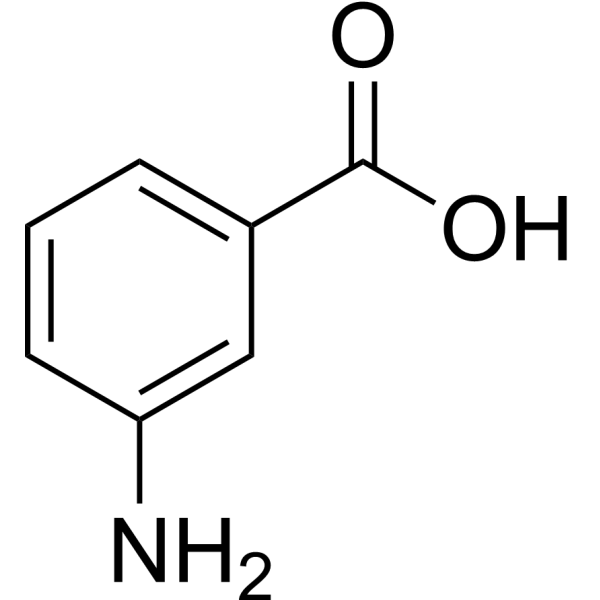
Physicochemical Properties
| Molecular Formula | C7H7NO2 |
| Molecular Weight | 137.14 |
| CAS # | 99-05-8 |
| Appearance | White to off-white solid powder |
| Density | 1.3±0.1 g/cm3 |
| Boiling Point | 352.5±25.0 °C at 760 mmHg |
| Melting Point | 178-180 °C(lit.) |
| Flash Point | 167.0±23.2 °C |
| Vapour Pressure | 0.0±0.8 mmHg at 25°C |
| Index of Refraction | 1.637 |
| LogP | 0.78 |
| SMILES | O([H])C(C1C([H])=C([H])C([H])=C(C=1[H])N([H])[H])=O |
| Synonyms | m-Aminobenzoic acid; 3ABA |
| HS Tariff Code | 2934.99.9001 |
| Storage |
Powder-20°C 3 years 4°C 2 years In solvent -80°C 6 months -20°C 1 month |
| Shipping Condition | Room temperature (This product is stable at ambient temperature for a few days during ordinary shipping and time spent in Customs) |
Biological Activity
| References |
[1]. Exploring 3-Aminobenzoic Acid as a Therapeutic Dietary Component for Enhancing Intestinal Barrier Integrity in Ulcerative ColitisJ. bioRxiv, 2024: 2024.08. 18.608525. [2]. P095 Accelerated degradation of gut barrier-protecting 3-aminobenzoic acid exacerbate colitis in Inflammatory Bowel DiseaseJ. Journal of Crohn's and Colitis, 2024, 18(Supplement_1): i374-i374. [3]. 3-Aminobenzoic Acid Analogues as a Novel GABA-at Inhibitors: Synthesis, Pharmacological Evaluation and Molecular Docking StudiesJ. Drug Discovery and Development, 2014, 1(2): 110-120. |
Solubility Data
| Solubility (In Vitro) | DMSO : ~100 mg/mL (~729.18 mM; with ultrasonication) |
| Solubility (In Vivo) |
Solubility in Formulation 1: ≥ 5 mg/mL (36.46 mM)(saturation unknown) in 10% DMSO 40% PEG300 5% Tween-80 45% Saline (add these co-solvents sequentially from left to right, and one by one),clear solution. For example, if 1 mL of working solution is to be prepared, you can add 100 μL of 50.0 mg/mL clear DMSO stock solution and add it to 400 μL PEG300, mix well; then add 50 μL Tween-80 to the above system, mix well; then continue to add 450 μL of normal saline to make up to 1 mL. Preparation of normal saline: Dissolve 0.9 g of sodium chloride in ddH₂O and make up to 100 mL to obtain a clear and transparent normal saline solution. Solubility in Formulation 2: ≥ 5 mg/mL (36.46 mM)(saturation unknown) in 10% DMSO 90% (20% SBE-β-CD in Saline) (add these co-solvents sequentially from left to right, and one by one),clear solution. For example, if 1 mL of working solution is to be prepared, you can add 100 μL of 50.0 mg/mL clear DMSO stock solution and add it to 900 μL of 20% SBE-β-CD saline solution and mix well. 2 g SBE-β-CD (sulfobutyl ether β-cyclodextrin) powder is diluted to 10 mL of saline and completely dissolved until clear and transparent. Solubility in Formulation 3: ≥ 5 mg/mL (36.46 mM)(saturation unknown) in 10% DMSO 90% Corn Oil (add these co-solvents sequentially from left to right, and one by one),clear solution. For example, if 1 mL of working solution is to be prepared, you can add 100 μL of 50.0 mg/mL clear DMSO stock solution and add it to 900 μL corn oil and mix well. (Please use freshly prepared in vivo formulations for optimal results.) |
| Preparing Stock Solutions | 1 mg | 5 mg | 10 mg | |
| 1 mM | 7.2918 mL | 36.4591 mL | 72.9182 mL | |
| 5 mM | 1.4584 mL | 7.2918 mL | 14.5836 mL | |
| 10 mM | 0.7292 mL | 3.6459 mL | 7.2918 mL |