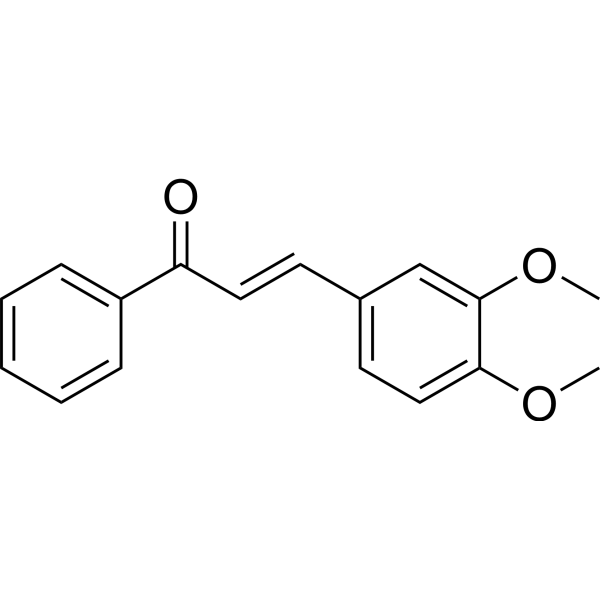
Physicochemical Properties
| Molecular Formula | C17H16O3 |
| Molecular Weight | 268.30714 |
| Exact Mass | 268.11 |
| CAS # | 5416-71-7 |
| Related CAS # | (E)-3,4-Dimethoxychalcone;53744-27-7 |
| PubChem CID | 5354494 |
| Appearance | Typically exists as solid at room temperature |
| Density | 1.128g/cm3 |
| Boiling Point | 421.8ºC at 760mmHg |
| Melting Point | 88ºC |
| Flash Point | 200.7ºC |
| LogP | 3.599 |
| Hydrogen Bond Donor Count | 0 |
| Hydrogen Bond Acceptor Count | 3 |
| Rotatable Bond Count | 5 |
| Heavy Atom Count | 20 |
| Complexity | 331 |
| Defined Atom Stereocenter Count | 0 |
| SMILES | COC1=C(C=C(C=C1)C=CC(=O)C2=CC=CC=C2)OC |
| InChi Key | LSHZPTCZLWATBZ-CSKARUKUSA-N |
| InChi Code | InChI=1S/C17H16O3/c1-19-16-11-9-13(12-17(16)20-2)8-10-15(18)14-6-4-3-5-7-14/h3-12H,1-2H3/b10-8+ |
| Chemical Name | (E)-3-(3,4-dimethoxyphenyl)-1-phenylprop-2-en-1-one |
| HS Tariff Code | 2934.99.9001 |
| Storage |
Powder-20°C 3 years 4°C 2 years In solvent -80°C 6 months -20°C 1 month Note: This product requires protection from light (avoid light exposure) during transportation and storage. |
| Shipping Condition | Room temperature (This product is stable at ambient temperature for a few days during ordinary shipping and time spent in Customs) |
Biological Activity
| ln Vitro | In HepG2 and U2OS cells, 3,4-Dimethoxychalcone (30 μM, 8 hours) boosts autophagic flux [1]. In U2OS cells, 3,4-Dimethoxychalcone (30 μM, 6 hours) drives TFEB and TFE3 translocation into the nucleus [1]. |
| ln Vivo | In the liver and heart tissue of female C57/BL6 mice, 3,4-Dimethoxychalcone (230 mg/kg administered intraperitoneally) causes nuclear translocation of TFEB and TFE 3 [1]. |
| References |
[1]. Okolo EN, et al. New chalcone derivatives as potential antimicrobial and antioxidant agent. Sci Rep. 2021 Nov 5;11(1):21781. [2]. Chen G, et al. 3,4-Dimethoxychalcone induces autophagy through activation of the transcription factors TFE3 and TFEB. EMBO Mol Med. 2019 Nov 7;11(11):e10469. |
Solubility Data
| Solubility (In Vitro) | DMSO : 100 mg/mL (372.70 mM) |
| Solubility (In Vivo) |
Solubility in Formulation 1: ≥ 2.5 mg/mL (9.32 mM) (saturation unknown) in 10% DMSO + 40% PEG300 + 5% Tween80 + 45% Saline (add these co-solvents sequentially from left to right, and one by one), clear solution. For example, if 1 mL of working solution is to be prepared, you can add 100 μL of 25.0 mg/mL clear DMSO stock solution to 400 μL PEG300 and mix evenly; then add 50 μL Tween-80 to the above solution and mix evenly; then add 450 μL normal saline to adjust the volume to 1 mL. Preparation of saline: Dissolve 0.9 g of sodium chloride in 100 mL ddH₂ O to obtain a clear solution. Solubility in Formulation 2: ≥ 2.5 mg/mL (9.32 mM) (saturation unknown) in 10% DMSO + 90% (20% SBE-β-CD in Saline) (add these co-solvents sequentially from left to right, and one by one), clear solution. For example, if 1 mL of working solution is to be prepared, you can add 100 μL of 25.0 mg/mL clear DMSO stock solution to 900 μL of 20% SBE-β-CD physiological saline solution and mix evenly. Preparation of 20% SBE-β-CD in Saline (4°C,1 week): Dissolve 2 g SBE-β-CD in 10 mL saline to obtain a clear solution. (Please use freshly prepared in vivo formulations for optimal results.) |
| Preparing Stock Solutions | 1 mg | 5 mg | 10 mg | |
| 1 mM | 3.7270 mL | 18.6352 mL | 37.2703 mL | |
| 5 mM | 0.7454 mL | 3.7270 mL | 7.4541 mL | |
| 10 mM | 0.3727 mL | 1.8635 mL | 3.7270 mL |