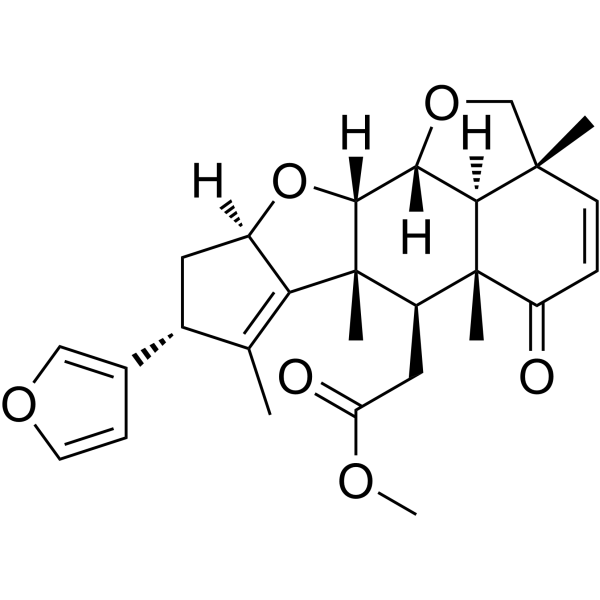
Physicochemical Properties
| Molecular Formula | C27H32O6 |
| Molecular Weight | 452.53938 |
| Exact Mass | 452.219 |
| CAS # | 126005-94-5 |
| PubChem CID | 14467538 |
| Appearance | Typically exists as solid at room temperature |
| Density | 1.3±0.1 g/cm3 |
| Boiling Point | 554.2±50.0 °C at 760 mmHg |
| Flash Point | 289.0±30.1 °C |
| Vapour Pressure | 0.0±1.5 mmHg at 25°C |
| Index of Refraction | 1.589 |
| LogP | 3.64 |
| Hydrogen Bond Donor Count | 0 |
| Hydrogen Bond Acceptor Count | 6 |
| Rotatable Bond Count | 4 |
| Heavy Atom Count | 33 |
| Complexity | 968 |
| Defined Atom Stereocenter Count | 9 |
| SMILES | CC1=C2[C@@H](C[C@H]1C3=COC=C3)O[C@@H]4[C@H]5[C@H]6[C@@](C)(C=CC(=O)[C@]6(C)[C@@H](CC(=O)OC)[C@]24C)CO5 |
| InChi Key | CWGBIWRWBCYASK-LMHNVORZSA-N |
| InChi Code | InChI=1S/C27H32O6/c1-14-16(15-7-9-31-12-15)10-17-21(14)27(4)18(11-20(29)30-5)26(3)19(28)6-8-25(2)13-32-22(23(25)26)24(27)33-17/h6-9,12,16-18,22-24H,10-11,13H2,1-5H3/t16-,17-,18-,22-,23+,24-,25+,26+,27-/m1/s1 |
| Chemical Name | methyl 2-[(1R,2S,4R,6R,9R,10S,11R,15R,18S)-6-(furan-3-yl)-7,9,11,15-tetramethyl-12-oxo-3,17-dioxapentacyclo[9.6.1.02,9.04,8.015,18]octadeca-7,13-dien-10-yl]acetate |
| HS Tariff Code | 2934.99.9001 |
| Storage |
Powder-20°C 3 years 4°C 2 years In solvent -80°C 6 months -20°C 1 month |
| Shipping Condition | Room temperature (This product is stable at ambient temperature for a few days during ordinary shipping and time spent in Customs) |
Biological Activity
| Targets | Caspase-8 Caspase-9 Caspase-3 |
| ln Vitro | 28–Deoxonimbolide (1–100 μM, 48 hours) exhibits efficacy against melanoma (CRL1579), lung cancer A549, stomach cancer AZ521, breast cancer SK-BR-3, and normal lymphocytes RPMI1788. tremendous cytotoxicity [1]. 28-Deoxonimbolide (30 μM, 0–24 h) causes HL60 cells to undergo apoptosis[1]. Levels of cleaved caspases-8, -9, and -3 are increased by 28-Deoxonimbolide (30 μM, 0-24 h) [1]. |
| Cell Assay |
Cell Cytotoxicity Assay[1] Cell Types: HL60, A549, AZ521, SK-BR-3, CRL1579 cells, RPMI1788 Tested Concentrations: 1-100 μM Incubation Duration: 48 h Experimental Results: demonstrated potent cytotoxic activity against HL60 (leukemia), A549 (lung), AZ521 (stomach), SK-BR-3 (breast), and CRL1579 (melanoma) cells, with IC50 values of 2.7 μM, 9.3 μM, 2.4 μM, 1.7 μM, 14.2 μM, and 2.7 μM, respectively. Apoptosis Analysis[1] Cell Types: HL60 cells Tested Concentrations: 30 μM Incubation Duration: 8 and 24 h Experimental Results: Induced early apoptosis in HL60 cells. The ratio of early apoptotic cells was increased after 8 h (10.9% vs 6.1% of negative control) and 24 h (18.7% vs 3.5% of negative control), and that of late apoptotic cells (upper right) was increased after 24 h (28.1% vs 2.9% of negative control). Western Blot Analysis[1] Cell Types: HL60 cells Tested Concentrations: 30 μM Incubation Duration: 8 and 24 h Experimental Results: Diminished the levels of procaspases-8, -9, and - 3, and then increased the levels of cleaved caspases-8, -9, and -3. |
| References |
[1]. Cytotoxic and apoptosis-inducing activities of limonoids from the seeds of Azadirachta indica (neem). J Nat Prod. 2011 Apr 25;74(4):866-70. |
| Additional Infomation |
28-deoxonimbolide is a limonoid isolated from Azadirachta indica. It has a role as an antineoplastic agent and a plant metabolite. It is an organic heteropentacyclic compound, a cyclic terpene ketone, an enone, a member of furans, a limonoid and a methyl ester. 28-Deoxonimbolide has been reported in Azadirachta indica with data available. |
Solubility Data
| Solubility (In Vivo) |
Note: Listed below are some common formulations that may be used to formulate products with low water solubility (e.g. < 1 mg/mL), you may test these formulations using a minute amount of products to avoid loss of samples. Injection Formulations (e.g. IP/IV/IM/SC) Injection Formulation 1: DMSO : Tween 80: Saline = 10 : 5 : 85 (i.e. 100 μL DMSO stock solution → 50 μL Tween 80 → 850 μL Saline) *Preparation of saline: Dissolve 0.9 g of sodium chloride in 100 mL ddH ₂ O to obtain a clear solution. Injection Formulation 2: DMSO : PEG300 :Tween 80 : Saline = 10 : 40 : 5 : 45 (i.e. 100 μL DMSO → 400 μLPEG300 → 50 μL Tween 80 → 450 μL Saline) Injection Formulation 3: DMSO : Corn oil = 10 : 90 (i.e. 100 μL DMSO → 900 μL Corn oil) Example: Take the Injection Formulation 3 (DMSO : Corn oil = 10 : 90) as an example, if 1 mL of 2.5 mg/mL working solution is to be prepared, you can take 100 μL 25 mg/mL DMSO stock solution and add to 900 μL corn oil, mix well to obtain a clear or suspension solution (2.5 mg/mL, ready for use in animals). Injection Formulation 4: DMSO : 20% SBE-β-CD in saline = 10 : 90 [i.e. 100 μL DMSO → 900 μL (20% SBE-β-CD in saline)] *Preparation of 20% SBE-β-CD in Saline (4°C,1 week): Dissolve 2 g SBE-β-CD in 10 mL saline to obtain a clear solution. Injection Formulation 5: 2-Hydroxypropyl-β-cyclodextrin : Saline = 50 : 50 (i.e. 500 μL 2-Hydroxypropyl-β-cyclodextrin → 500 μL Saline) Injection Formulation 6: DMSO : PEG300 : castor oil : Saline = 5 : 10 : 20 : 65 (i.e. 50 μL DMSO → 100 μLPEG300 → 200 μL castor oil → 650 μL Saline) Injection Formulation 7: Ethanol : Cremophor : Saline = 10: 10 : 80 (i.e. 100 μL Ethanol → 100 μL Cremophor → 800 μL Saline) Injection Formulation 8: Dissolve in Cremophor/Ethanol (50 : 50), then diluted by Saline Injection Formulation 9: EtOH : Corn oil = 10 : 90 (i.e. 100 μL EtOH → 900 μL Corn oil) Injection Formulation 10: EtOH : PEG300:Tween 80 : Saline = 10 : 40 : 5 : 45 (i.e. 100 μL EtOH → 400 μLPEG300 → 50 μL Tween 80 → 450 μL Saline) Oral Formulations Oral Formulation 1: Suspend in 0.5% CMC Na (carboxymethylcellulose sodium) Oral Formulation 2: Suspend in 0.5% Carboxymethyl cellulose Example: Take the Oral Formulation 1 (Suspend in 0.5% CMC Na) as an example, if 100 mL of 2.5 mg/mL working solution is to be prepared, you can first prepare 0.5% CMC Na solution by measuring 0.5 g CMC Na and dissolve it in 100 mL ddH2O to obtain a clear solution; then add 250 mg of the product to 100 mL 0.5% CMC Na solution, to make the suspension solution (2.5 mg/mL, ready for use in animals). Oral Formulation 3: Dissolved in PEG400 Oral Formulation 4: Suspend in 0.2% Carboxymethyl cellulose Oral Formulation 5: Dissolve in 0.25% Tween 80 and 0.5% Carboxymethyl cellulose Oral Formulation 6: Mixing with food powders Note: Please be aware that the above formulations are for reference only. InvivoChem strongly recommends customers to read literature methods/protocols carefully before determining which formulation you should use for in vivo studies, as different compounds have different solubility properties and have to be formulated differently. (Please use freshly prepared in vivo formulations for optimal results.) |
| Preparing Stock Solutions | 1 mg | 5 mg | 10 mg | |
| 1 mM | 2.2097 mL | 11.0487 mL | 22.0975 mL | |
| 5 mM | 0.4419 mL | 2.2097 mL | 4.4195 mL | |
| 10 mM | 0.2210 mL | 1.1049 mL | 2.2097 mL |