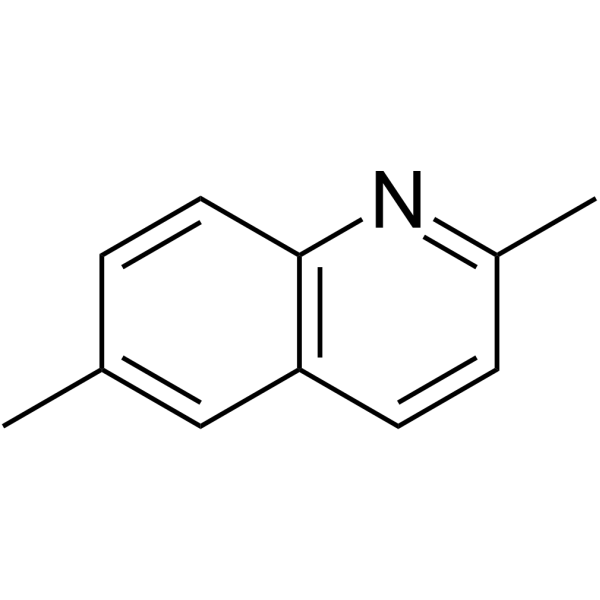
Physicochemical Properties
| Molecular Formula | C11H11N |
| Molecular Weight | 157.22 |
| Exact Mass | 157.089 |
| CAS # | 877-43-0 |
| PubChem CID | 13414 |
| Appearance | Light yellow to brown solid powder |
| Density | 1.1±0.1 g/cm3 |
| Boiling Point | 266.5±0.0 °C at 760 mmHg |
| Melting Point | 57-59 °C(lit.) |
| Flash Point | 106.5±11.3 °C |
| Vapour Pressure | 0.0±0.5 mmHg at 25°C |
| Index of Refraction | 1.611 |
| LogP | 3 |
| Hydrogen Bond Donor Count | 0 |
| Hydrogen Bond Acceptor Count | 1 |
| Rotatable Bond Count | 0 |
| Heavy Atom Count | 12 |
| Complexity | 155 |
| Defined Atom Stereocenter Count | 0 |
| InChi Key | JJPSZKIOGBRMHK-UHFFFAOYSA-N |
| InChi Code | InChI=1S/C11H11N/c1-8-3-6-11-10(7-8)5-4-9(2)12-11/h3-7H,1-2H3 |
| Chemical Name | 2,6-dimethylquinoline |
| HS Tariff Code | 2934.99.9001 |
| Storage |
Powder-20°C 3 years 4°C 2 years In solvent -80°C 6 months -20°C 1 month |
| Shipping Condition | Room temperature (This product is stable at ambient temperature for a few days during ordinary shipping and time spent in Customs) |
Biological Activity
| Targets | CYP1A2 3.3 μM (IC50) CYP2B6 480 μM (IC50) |
| References |
[1]. Predictive three-dimensional quantitative structure-activity relationship of cytochrome P450 1A2 inhibitors. J Med Chem. 2005 Jun 2;48(11):3808-15. [2]. New potent and selective cytochrome P450 2B6 (CYP2B6) inhibitors based on three-dimensional quantitative structure-activity relationship (3D-QSAR) analysis. Br J Pharmacol. 2007 Apr;150(7):932-42. [3]. Studies on chemical constituents from roots of Peucedanum praeruptorum II. Zhongguo Zhong Yao Za Zhi. 2006 Aug;31(16):1333-5. |
Solubility Data
| Solubility (In Vitro) | DMSO: 100 mg/mL (636.05 mM) |
| Solubility (In Vivo) |
Solubility in Formulation 1: ≥ 2.5 mg/mL (15.90 mM) (saturation unknown) in 10% DMSO + 40% PEG300 + 5% Tween80 + 45% Saline (add these co-solvents sequentially from left to right, and one by one), clear solution. For example, if 1 mL of working solution is to be prepared, you can add 100 μL of 25.0 mg/mL clear DMSO stock solution to 400 μL PEG300 and mix evenly; then add 50 μL Tween-80 to the above solution and mix evenly; then add 450 μL normal saline to adjust the volume to 1 mL. Preparation of saline: Dissolve 0.9 g of sodium chloride in 100 mL ddH₂ O to obtain a clear solution. Solubility in Formulation 2: ≥ 2.5 mg/mL (15.90 mM) (saturation unknown) in 10% DMSO + 90% (20% SBE-β-CD in Saline) (add these co-solvents sequentially from left to right, and one by one), clear solution. For example, if 1 mL of working solution is to be prepared, you can add 100 μL of 25.0 mg/mL clear DMSO stock solution to 900 μL of 20% SBE-β-CD physiological saline solution and mix evenly. Preparation of 20% SBE-β-CD in Saline (4°C,1 week): Dissolve 2 g SBE-β-CD in 10 mL saline to obtain a clear solution. Solubility in Formulation 3: ≥ 2.5 mg/mL (15.90 mM) (saturation unknown) in 10% DMSO + 90% Corn Oil (add these co-solvents sequentially from left to right, and one by one), clear solution. For example, if 1 mL of working solution is to be prepared, you can add 100 μL of 25.0 mg/mL clear DMSO stock solution to 900 μL of corn oil and mix evenly. (Please use freshly prepared in vivo formulations for optimal results.) |
| Preparing Stock Solutions | 1 mg | 5 mg | 10 mg | |
| 1 mM | 6.3605 mL | 31.8026 mL | 63.6051 mL | |
| 5 mM | 1.2721 mL | 6.3605 mL | 12.7210 mL | |
| 10 mM | 0.6361 mL | 3.1803 mL | 6.3605 mL |