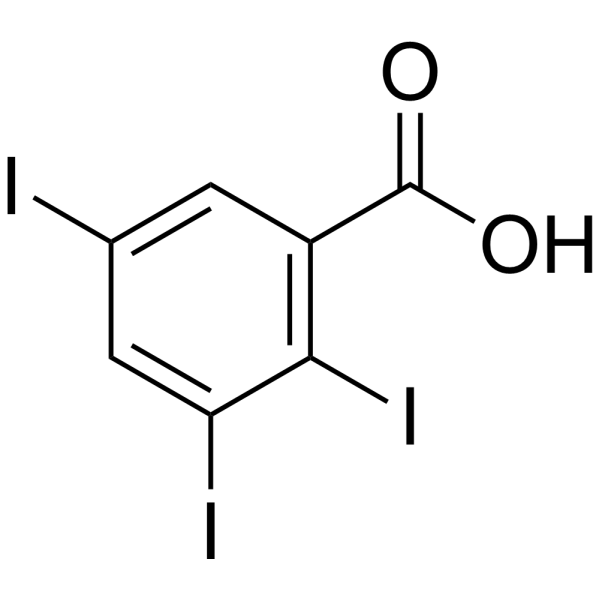
Physicochemical Properties
| Molecular Formula | C7H3I3O2 |
| Molecular Weight | 499.81 |
| Exact Mass | 499.726 |
| CAS # | 88-82-4 |
| Related CAS # | 17274-12-3 (hydrochloride salt) |
| PubChem CID | 6948 |
| Appearance |
White to off-white amorphous powder Prisms from alcohol |
| Density | 3.0±0.1 g/cm3 |
| Boiling Point | 456.7±45.0 °C at 760 mmHg |
| Melting Point | 220-222 °C(lit.) |
| Flash Point | 230.0±28.7 °C |
| Vapour Pressure | 0.0±1.2 mmHg at 25°C |
| Index of Refraction | 1.800 |
| LogP | 3.87 |
| Hydrogen Bond Donor Count | 1 |
| Hydrogen Bond Acceptor Count | 2 |
| Rotatable Bond Count | 1 |
| Heavy Atom Count | 12 |
| Complexity | 186 |
| Defined Atom Stereocenter Count | 0 |
| SMILES | O=C(C1C(I)=C(I)C=C(I)C=1)O |
| InChi Key | ZMZGFLUUZLELNE-UHFFFAOYSA-N |
| InChi Code | InChI=1S/C7H3I3O2/c8-3-1-4(7(11)12)6(10)5(9)2-3/h1-2H,(H,11,12) |
| Chemical Name | 2,3,5-triiodobenzoic acid |
| HS Tariff Code | 2934.99.9001 |
| Storage |
Powder-20°C 3 years 4°C 2 years In solvent -80°C 6 months -20°C 1 month Note: This product requires protection from light (avoid light exposure) during transportation and storage. |
| Shipping Condition | Room temperature (This product is stable at ambient temperature for a few days during ordinary shipping and time spent in Customs) |
Biological Activity
| ln Vitro | inhibitor of auxin transport. |
| ADME/Pharmacokinetics |
Absorption, Distribution and Excretion The placental transfer of 2, 3, 5-triiodobenzoic acid and/or metabolites was studied using 14C-labeled 2, 3, 5-triiodobenzoic acid. Placental transfer of 2, 3, 5-triiodobenzoic acid and/or metabolites occurred in both cold-stressed and control rats. The maternal blood of cold-stressed and control rats contained significantly higher concentrations of 2, 3, 5-triiodobenzoic acid and/or metabolites than the blood of respective fetal rats. However, cold stress did not significantly alter either placental transfer or the level of 2, 3, 5-triiodobenzoic acid and/or metabolites in the maternal and fetal tissue. Cold stress had no apparent effect upon the plasma level of either 2, 3, 5-triiodobenzoic acid, 2, 5-diiodobenzoic acid, or 3, 5-diiodobenzoic acid in maternal or fetal animals. While nonpregnant rats acclimated to cold stress, pregnant rats did not, indicating cold stress and pregnancy may act synergistically. Rats receiving oral doses of C14-carboxyl or 2,3( 125-I),5(125-I)-triiodobenzoic acid excreted 72-75% of the radioactivity in urine and 24-28% in feces during the 4 days following drug administration. Peak levels of carbon-14 were observed in brain, thyroid, liver, lungs, heart, spleen, kidneys, and carcass 4 or 8 hr after dosing and rapidly decreased thereafter. Levels of iodine-125 were significantly higher than carbon-14 levels in the brain and thyroid. Iodine-125 in thyroid increased with time. ... Metabolism / Metabolites Rats receiving oral doses of C14-carboxyl or 2,3( 125-I),5(126-I)-triiodobenzoic acid excreted 72-75 % of the radioactivity in urine and 24-28% in feces during the 4 days following drug administration... . Thin-layer chromatograms of ether extracts of urine (50-80% of the radioactivity was extracted) revealed the presence of: 2,5-diiodobenzoic acid, as the free acid and a conjugate, accounting for 66% of the extractable radioactivity (39.6% of dose); unchanged TIBA, 9.5% (5.7% of dose); 2-hydroxy-3,5-diiodobenzoic acid, 2.3% (1.4% of dose); and 3,5-diiodobenzoic acid, 0.7% (0.4% of dose). Thin-layer chromatograms of feces extracts revealed a metabolic pattern similar io urine. The whole body retention, excretion, distribution, thyroid uptake, and metabolism of 2(131I),3,5-triiodobenzoic acid (TIBA) were studied in goats and a cow. A single oral dose of TIBA exhibited a two-component whole body radioactivity retention curve and was excreted primarily in the urine. TIBA plus nine metabolites, four of which were identified, were found in the urine. The major metabolite was 2,5-diiodobenzoic acid (2,5-DIBA). Trace amounts of 2,3-diiodobenzoic acid (2,3-DIBA), orthoiodobenzoic acid (OIBA), and iodide ion were found. TIBA was metabolized by deiodination. Iodide ion was concentrated in the thyroid and excreted by way of milk and urine. The metabolites of 2,3,5-triiodobenzoic acid in cow's milk resulting from acute administration of the compound (1.197 g) were determined using electron capture gas-chromatograph procedures. The parent compound plus seven suspected metabolites were detected; of these, four were identified, and one quantitated. The primary metabolite was 2-OHI-3,5-diiodobenzoic acid. Occurring in trace amounts were mono-iodobenzoic acids, 2-0H-5 iodobenzoic acid, and 3,5-diiodobenzoic acid. The maximum concentration of 2,3,5-triiodobenzoic acid in raw milk was found in the 30-hr milk sample at the 0.79 mg/kilogram level and of 2-OH-3,5-diiodobenzoic acid in the 42-hr milk at the 0.27 mg/kilogram level. |
| Toxicity/Toxicokinetics |
Non-Human Toxicity Values LD50 Rat oral 813 mg/kg LD50 Mouse oral 700 mg/kg LD50 Mouse ip 562 mg/kg |
| Additional Infomation | 2,3,5-triiodobenzoic acid is a member of the class of benzoic acids that is benzoic acid in which the hydrogens at positions 2, 3 and 5 are replaced by iodine atoms. It is an auxin polar transport inhibitor. It has a role as a member of antiauxins. It is an organoiodine compound and a member of benzoic acids. |
Solubility Data
| Solubility (In Vitro) | May dissolve in DMSO (in most cases), if not, try other solvents such as H2O, Ethanol, or DMF with a minute amount of products to avoid loss of samples |
| Solubility (In Vivo) |
Note: Listed below are some common formulations that may be used to formulate products with low water solubility (e.g. < 1 mg/mL), you may test these formulations using a minute amount of products to avoid loss of samples. Injection Formulations (e.g. IP/IV/IM/SC) Injection Formulation 1: DMSO : Tween 80: Saline = 10 : 5 : 85 (i.e. 100 μL DMSO stock solution → 50 μL Tween 80 → 850 μL Saline) *Preparation of saline: Dissolve 0.9 g of sodium chloride in 100 mL ddH ₂ O to obtain a clear solution. Injection Formulation 2: DMSO : PEG300 :Tween 80 : Saline = 10 : 40 : 5 : 45 (i.e. 100 μL DMSO → 400 μLPEG300 → 50 μL Tween 80 → 450 μL Saline) Injection Formulation 3: DMSO : Corn oil = 10 : 90 (i.e. 100 μL DMSO → 900 μL Corn oil) Example: Take the Injection Formulation 3 (DMSO : Corn oil = 10 : 90) as an example, if 1 mL of 2.5 mg/mL working solution is to be prepared, you can take 100 μL 25 mg/mL DMSO stock solution and add to 900 μL corn oil, mix well to obtain a clear or suspension solution (2.5 mg/mL, ready for use in animals). Injection Formulation 4: DMSO : 20% SBE-β-CD in saline = 10 : 90 [i.e. 100 μL DMSO → 900 μL (20% SBE-β-CD in saline)] *Preparation of 20% SBE-β-CD in Saline (4°C,1 week): Dissolve 2 g SBE-β-CD in 10 mL saline to obtain a clear solution. Injection Formulation 5: 2-Hydroxypropyl-β-cyclodextrin : Saline = 50 : 50 (i.e. 500 μL 2-Hydroxypropyl-β-cyclodextrin → 500 μL Saline) Injection Formulation 6: DMSO : PEG300 : castor oil : Saline = 5 : 10 : 20 : 65 (i.e. 50 μL DMSO → 100 μLPEG300 → 200 μL castor oil → 650 μL Saline) Injection Formulation 7: Ethanol : Cremophor : Saline = 10: 10 : 80 (i.e. 100 μL Ethanol → 100 μL Cremophor → 800 μL Saline) Injection Formulation 8: Dissolve in Cremophor/Ethanol (50 : 50), then diluted by Saline Injection Formulation 9: EtOH : Corn oil = 10 : 90 (i.e. 100 μL EtOH → 900 μL Corn oil) Injection Formulation 10: EtOH : PEG300:Tween 80 : Saline = 10 : 40 : 5 : 45 (i.e. 100 μL EtOH → 400 μLPEG300 → 50 μL Tween 80 → 450 μL Saline) Oral Formulations Oral Formulation 1: Suspend in 0.5% CMC Na (carboxymethylcellulose sodium) Oral Formulation 2: Suspend in 0.5% Carboxymethyl cellulose Example: Take the Oral Formulation 1 (Suspend in 0.5% CMC Na) as an example, if 100 mL of 2.5 mg/mL working solution is to be prepared, you can first prepare 0.5% CMC Na solution by measuring 0.5 g CMC Na and dissolve it in 100 mL ddH2O to obtain a clear solution; then add 250 mg of the product to 100 mL 0.5% CMC Na solution, to make the suspension solution (2.5 mg/mL, ready for use in animals). Oral Formulation 3: Dissolved in PEG400 Oral Formulation 4: Suspend in 0.2% Carboxymethyl cellulose Oral Formulation 5: Dissolve in 0.25% Tween 80 and 0.5% Carboxymethyl cellulose Oral Formulation 6: Mixing with food powders Note: Please be aware that the above formulations are for reference only. InvivoChem strongly recommends customers to read literature methods/protocols carefully before determining which formulation you should use for in vivo studies, as different compounds have different solubility properties and have to be formulated differently. (Please use freshly prepared in vivo formulations for optimal results.) |
| Preparing Stock Solutions | 1 mg | 5 mg | 10 mg | |
| 1 mM | 2.0008 mL | 10.0038 mL | 20.0076 mL | |
| 5 mM | 0.4002 mL | 2.0008 mL | 4.0015 mL | |
| 10 mM | 0.2001 mL | 1.0004 mL | 2.0008 mL |