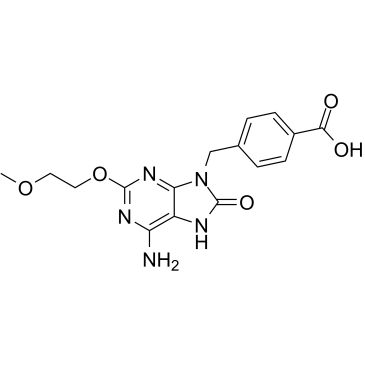
1V209 is a novel and potent Toll-like receptor 7 (TLR7) agonistwith anti-tumor activity. It can be conjugated with various polysaccharides to improve its water solubility.
Physicochemical Properties
| Molecular Formula | C16H17N5O5 |
| Molecular Weight | 359.336683034897 |
| Exact Mass | 359.12 |
| Elemental Analysis | C, 53.48; H, 4.77; N, 19.49; O, 22.26 |
| CAS # | 1062444-54-5 |
| Related CAS # | 1062444-54-5; |
| PubChem CID | 58019867 |
| Appearance | Off-white to yellow solid powder |
| LogP | 0.2 |
| Hydrogen Bond Donor Count | 3 |
| Hydrogen Bond Acceptor Count | 8 |
| Rotatable Bond Count | 7 |
| Heavy Atom Count | 26 |
| Complexity | 513 |
| Defined Atom Stereocenter Count | 0 |
| InChi Key | ATISKRYGYNSRNP-UHFFFAOYSA-N |
| InChi Code | InChI=1S/C16H17N5O5/c1-25-6-7-26-15-19-12(17)11-13(20-15)21(16(24)18-11)8-9-2-4-10(5-3-9)14(22)23/h2-5H,6-8H2,1H3,(H,18,24)(H,22,23)(H2,17,19,20) |
| Chemical Name | 4-[[6-amino-2-(2-methoxyethoxy)-8-oxo-7H-purin-9-yl]methyl]benzoic acid |
| Synonyms | 1V209 1V-209 |
| HS Tariff Code | 2934.99.9001 |
| Storage |
Powder-20°C 3 years 4°C 2 years In solvent -80°C 6 months -20°C 1 month |
| Shipping Condition | Room temperature (This product is stable at ambient temperature for a few days during ordinary shipping and time spent in Customs) |
Biological Activity
| ln Vitro | Treatment with 1V209 (0.1–10 μM) dramatically increases TNFα production in RAW246.7 cells[1]. Treatment with 1V209 (18 hours) enhances IL-6 production in dendritic cells generated from bone marrow[1]. |
| ln Vivo | When the formulation is given intravenously (IV) to mice with 4T1 breast cancer tumors, the animals exhibit less primary tumor development, an accumulation of nanoparticles in the tumors, and an inhibition of lung metastases when compared to the saline-treated mice. At two hours after intravenous injection, mice given 1V209 had significantly higher plasma levels of the proinflammatory cytokines IL-6, IP-10, and MCP-1[1]. |
| References |
[1]. Delivery of Immunotherapeutic Nanoparticles to Tumors via Enzyme-Directed Assembly. Adv Healthc Mater. 2019 Dec;8(23):e1901105. [2]. Enhancement of the Immunostimulatory Activity of a TLR7 Ligand by Conjugation to Polysaccharides. Bioconjug Chem. 2015 Aug 19;26(8):1713-23. |
Solubility Data
| Solubility (In Vitro) | DMSO : ~83.33 mg/mL (~231.90 mM) |
| Solubility (In Vivo) |
Solubility in Formulation 1: ≥ 2.08 mg/mL (5.79 mM) (saturation unknown) in 10% DMSO + 40% PEG300 + 5% Tween80 + 45% Saline (add these co-solvents sequentially from left to right, and one by one), clear solution. For example, if 1 mL of working solution is to be prepared, you can add 100 μL of 20.8 mg/mL clear DMSO stock solution to 400 μL PEG300 and mix evenly; then add 50 μL Tween-80 to the above solution and mix evenly; then add 450 μL normal saline to adjust the volume to 1 mL. Preparation of saline: Dissolve 0.9 g of sodium chloride in 100 mL ddH₂ O to obtain a clear solution. Solubility in Formulation 2: ≥ 2.08 mg/mL (5.79 mM) (saturation unknown) in 10% DMSO + 90% Corn Oil (add these co-solvents sequentially from left to right, and one by one), clear solution. For example, if 1 mL of working solution is to be prepared, you can add 100 μL of 20.8 mg/mL clear DMSO stock solution to 900 μL of corn oil and mix evenly. (Please use freshly prepared in vivo formulations for optimal results.) |
| Preparing Stock Solutions | 1 mg | 5 mg | 10 mg | |
| 1 mM | 2.7829 mL | 13.9144 mL | 27.8288 mL | |
| 5 mM | 0.5566 mL | 2.7829 mL | 5.5658 mL | |
| 10 mM | 0.2783 mL | 1.3914 mL | 2.7829 mL |