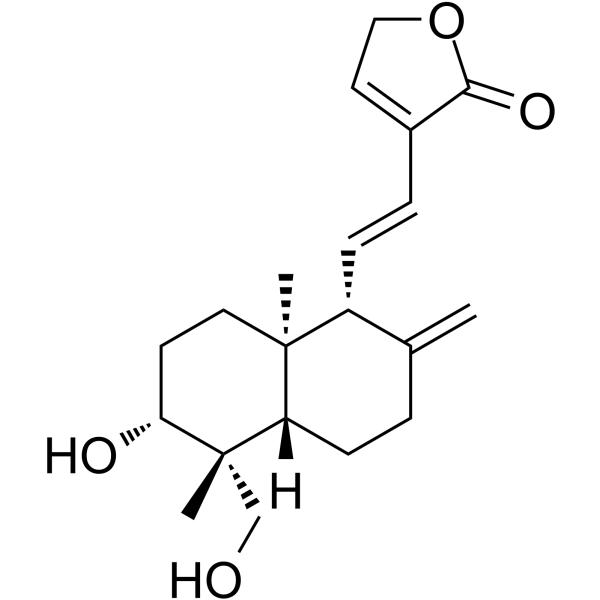
Physicochemical Properties
| Molecular Formula | C20H28O4 |
| Molecular Weight | 332.4339 |
| Exact Mass | 332.198 |
| CAS # | 42895-58-9 |
| PubChem CID | 5708351 |
| Appearance | White to off-white solid powder |
| Density | 1.2±0.1 g/cm3 |
| Boiling Point | 519.6±50.0 °C at 760 mmHg |
| Melting Point | 204-205ºC |
| Flash Point | 182.4±23.6 °C |
| Vapour Pressure | 0.0±3.1 mmHg at 25°C |
| Index of Refraction | 1.567 |
| LogP | 1.89 |
| Hydrogen Bond Donor Count | 2 |
| Hydrogen Bond Acceptor Count | 4 |
| Rotatable Bond Count | 3 |
| Heavy Atom Count | 24 |
| Complexity | 605 |
| Defined Atom Stereocenter Count | 5 |
| HS Tariff Code | 2934.99.9001 |
| Storage |
Powder-20°C 3 years 4°C 2 years In solvent -80°C 6 months -20°C 1 month |
| Shipping Condition | Room temperature (This product is stable at ambient temperature for a few days during ordinary shipping and time spent in Customs) |
Biological Activity
| ln Vitro |
In a mouse asthma model, 14-deoxy-11,12-didehydroandrographolide, a naturally occurring noncytotoxic analogue of andrographolide, effectively reduces the following: pulmonary eosinophilia, mucus hypersecretion, mast cell degranulation, airway hyper-responsiveness (AHR), IL-4, IL-5, IL-13, and eotaxin production, serum IgE synthesis[1]. This is likely due to its inhibition of NF-κB activity. - Effect on cytokine production in RAW264.7 cells: Treatment with 14-Deoxy-11,12-didehydroandrographolide (5, 10, 20 μM) significantly inhibited lipopolysaccharide (LPS)-induced nitric oxide (NO) production in RAW264.7 macrophages. At 20 μM, the inhibition rate of NO was 65.2% compared to the LPS-treated control. The compound also reduced LPS-induced tumor necrosis factor-α (TNF-α) secretion; at 20 μM, TNF-α levels decreased from 856 ± 42 pg/mL (LPS control) to 321 ± 28 pg/mL[1] - Effect on T cell cytokine balance in splenocytes: In ovalbumin (OVA)-stimulated mouse splenocytes, 14-Deoxy-11,12-didehydroandrographolide (10, 20 μM) dose-dependently decreased Th2 cytokine levels (interleukin-4 [IL-4], interleukin-5 [IL-5]) and increased Th1 cytokine (interferon-γ [IFN-γ]) levels. At 20 μM, IL-4 levels dropped from 489 ± 35 pg/mL to 192 ± 21 pg/mL, IL-5 from 326 ± 29 pg/mL to 128 ± 18 pg/mL, and IFN-γ increased from 215 ± 22 pg/mL to 543 ± 38 pg/mL[1] - Effect on allergic inflammation-related cells: In OVA-induced bronchoalveolar lavage fluid (BALF) cells (in vitro culture), 14-Deoxy-11,12-didehydroandrographolide (20 μM) reduced the number of eosinophils by 45.3% and suppressed the expression of chemokine eotaxin-1 by 52.1% compared to the OVA control[1] |
| ln Vivo |
In OVA-challenged mice, 14-deoxy-11,12-didehydroandrographolide (1 mg/kg) significantly lowers resistance (Rl) and recovers Cdyn in response to methacholine[1]. - Effect on OVA-induced allergic airway hyperresponsiveness (AHR): In OVA-sensitized and challenged BALB/c mice, oral administration of 14-Deoxy-11,12-didehydroandrographolide (20, 40 mg/kg/day) for 7 days (during OVA challenge) significantly reduced AHR. The airway resistance (Rn) at 40 mg/kg was 1.8 ± 0.3 cm H₂O·s/mL, which was 42.5% lower than the OVA control group (3.1 ± 0.4 cm H₂O·s/mL)[1] - Effect on pulmonary inflammation cell infiltration: 14-Deoxy-11,12-didehydroandrographolide (40 mg/kg) decreased the total number of inflammatory cells in BALF from 12.6 ± 1.5 × 10⁵ cells/mL (OVA control) to 5.8 ± 0.8 × 10⁵ cells/mL. Specifically, eosinophils were reduced by 58.3% (from 5.2 ± 0.7 × 10⁵ to 2.2 ± 0.4 × 10⁵ cells/mL), and neutrophils by 41.2%[1] - Effect on cytokine and chemokine levels in vivo: In mouse lung tissue homogenates, 14-Deoxy-11,12-didehydroandrographolide (40 mg/kg) reduced IL-4 (from 386 ± 32 pg/mg protein to 152 ± 24 pg/mg protein) and IL-5 (from 298 ± 28 pg/mg protein to 116 ± 19 pg/mg protein) levels, while increasing IFN-γ (from 185 ± 21 pg/mg protein to 423 ± 35 pg/mg protein) levels. It also suppressed eotaxin-1 expression by 49.6% in lung tissue[1] - Effect on mucus hypersecretion: Histological analysis showed that 14-Deoxy-11,12-didehydroandrographolide (40 mg/kg) reduced goblet cell hyperplasia in mouse bronchial epithelium; the mucus score (0-4 scale) decreased from 3.2 ± 0.3 (OVA control) to 1.1 ± 0.2[1] |
| Cell Assay |
- RAW264.7 cell NO detection assay: RAW264.7 cells were seeded in 96-well plates at a density of 5 × 10⁴ cells/well and cultured overnight. Cells were then treated with different concentrations of 14-Deoxy-11,12-didehydroandrographolide (5, 10, 20 μM) for 1 h, followed by stimulation with LPS (1 μg/mL) for 24 h. After incubation, 100 μL of cell supernatant was mixed with an equal volume of Griess reagent, and the absorbance was measured at 540 nm to calculate NO production[1] - Splenocyte cytokine detection assay: Spleens were isolated from BALB/c mice, and single-cell suspensions were prepared by grinding and filtering. Splenocytes (2 × 10⁶ cells/mL) were cultured in 24-well plates and treated with 14-Deoxy-11,12-didehydroandrographolide (10, 20 μM) plus OVA (100 μg/mL) for 72 h. The supernatant was collected, and IL-4, IL-5, and IFN-γ levels were measured using enzyme-linked immunosorbent assay (ELISA) kits[1] - BALF cell culture and analysis assay: BALF was collected from OVA-challenged mice, and cells were centrifuged (1500 rpm, 5 min) and resuspended in RPMI 1640 medium. Cells were treated with 14-Deoxy-11,12-didehydroandrographolide (20 μM) for 24 h, then centrifuged again, and the pellet was smeared on slides, stained with Wright-Giemsa, and the number of eosinophils, neutrophils, and lymphocytes was counted under a microscope[1] |
| Animal Protocol |
- OVA-induced allergic asthma mouse model establishment: Female BALB/c mice (6-8 weeks old) were sensitized on day 0 and day 7 by intraperitoneal injection of 20 μg OVA emulsified with 2 mg aluminum hydroxide in 200 μL normal saline. From day 14 to day 20, mice were challenged with 1% OVA solution via nebulization for 30 min per day to induce allergic airway inflammation[1] - Drug administration protocol: 14-Deoxy-11,12-didehydroandrographolide was dissolved in 0.5% carboxymethyl cellulose sodium (CMC-Na) solution. Mice in the drug treatment groups received oral gavage of the compound at doses of 20 mg/kg or 40 mg/kg once daily from day 14 to day 20 (concurrent with OVA challenge). The control groups received oral gavage of 0.5% CMC-Na solution at the same volume[1] - Sample collection protocol: On day 21, mice were anesthetized with pentobarbital sodium. BALF was collected by instilling and retrieving normal saline (0.8 mL × 3 times) into the trachea. After BALF collection, mice were sacrificed, and lung tissues were excised for histological analysis and cytokine detection; spleens were also isolated for splenocyte culture[1] |
| Toxicity/Toxicokinetics |
- In vitro cytotoxicity: 14-Deoxy-11,12-didehydroandrographolide showed no significant cytotoxicity to RAW264.7 cells or mouse splenocytes at concentrations up to 20 μM. The cell viability (measured by MTT assay) was >90% compared to the untreated control group[1] - In vivo toxicity: In BALB/c mice treated with 14-Deoxy-11,12-didehydroandrographolide (40 mg/kg/day for 7 days), no obvious signs of toxicity (such as weight loss, abnormal behavior, or organ damage) were observed. The body weight of drug-treated mice was 22.3 ± 1.2 g, which was not significantly different from the control group (21.8 ± 1.1 g). Serum levels of alanine transaminase (ALT) and aspartate transaminase (AST) (indicators of liver function) and creatinine (indicator of kidney function) were within the normal range[1] |
| References |
[1]. Protective role of 14-deoxy-11,12-didehydroandrographolide, a noncytotoxic analogue ofandrographolide, in allergic airway inflammation. J Nat Prod. 2011 Jun 24;74(6):1484-90. |
| Additional Infomation |
14-Deoxy-11,12-didehydroandrographolide is a diterpene lactone. It has a role as a metabolite. 14-Deoxy-11,12-didehydroandrographolide has been reported in Aphis affinis, Andrographis affinis, and other organisms with data available. - 14-Deoxy-11,12-didehydroandrographolide is a noncytotoxic analog of andrographolide, a natural compound isolated from the herb Andrographis paniculata[1] - The protective mechanism of 14-Deoxy-11,12-didehydroandrographolide in allergic airway inflammation involves the regulation of Th1/Th2 immune balance (promoting Th1 responses and inhibiting Th2 responses) and the suppression of NF-κB signaling pathway activation (reducing the expression of pro-inflammatory cytokines and chemokines)[1] - Compared to its parent compound andrographolide, 14-Deoxy-11,12-didehydroandrographolide exhibits lower cytotoxicity while maintaining comparable anti-allergic inflammatory activity, making it a potential candidate for the treatment of allergic asthma[1] |
Solubility Data
| Solubility (In Vitro) |
DMSO : ~110 mg/mL (~330.90 mM) DMF : 100 mg/mL (~300.82 mM) |
| Solubility (In Vivo) |
Solubility in Formulation 1: ≥ 2.75 mg/mL (8.27 mM) (saturation unknown) in 10% DMSO + 40% PEG300 + 5% Tween80 + 45% Saline (add these co-solvents sequentially from left to right, and one by one), clear solution. For example, if 1 mL of working solution is to be prepared, you can add 100 μL of 27.5 mg/mL clear DMSO stock solution to 400 μL PEG300 and mix evenly; then add 50 μL Tween-80 to the above solution and mix evenly; then add 450 μL normal saline to adjust the volume to 1 mL. Preparation of saline: Dissolve 0.9 g of sodium chloride in 100 mL ddH₂ O to obtain a clear solution. Solubility in Formulation 2: ≥ 2.75 mg/mL (8.27 mM) (saturation unknown) in 10% DMSO + 90% (20% SBE-β-CD in Saline) (add these co-solvents sequentially from left to right, and one by one), clear solution. For example, if 1 mL of working solution is to be prepared, you can add 100 μL of 27.5 mg/mL clear DMSO stock solution to 900 μL of 20% SBE-β-CD physiological saline solution and mix evenly. Preparation of 20% SBE-β-CD in Saline (4°C,1 week): Dissolve 2 g SBE-β-CD in 10 mL saline to obtain a clear solution. Solubility in Formulation 3: ≥ 2.75 mg/mL (8.27 mM) (saturation unknown) in 10% DMSO + 90% Corn Oil (add these co-solvents sequentially from left to right, and one by one), clear solution. For example, if 1 mL of working solution is to be prepared, you can add 100 μL of 27.5 mg/mL clear DMSO stock solution to 900 μL of corn oil and mix evenly. (Please use freshly prepared in vivo formulations for optimal results.) |
| Preparing Stock Solutions | 1 mg | 5 mg | 10 mg | |
| 1 mM | 3.0082 mL | 15.0408 mL | 30.0815 mL | |
| 5 mM | 0.6016 mL | 3.0082 mL | 6.0163 mL | |
| 10 mM | 0.3008 mL | 1.5041 mL | 3.0082 mL |