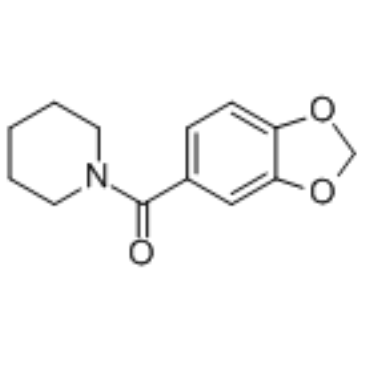
Physicochemical Properties
| Molecular Formula | C13H15NO3 |
| Molecular Weight | 233.26300 |
| Exact Mass | 233.105 |
| CAS # | 34023-62-6 |
| PubChem CID | 1370 |
| Appearance | White to off-white solid powder |
| Density | 1.256g/cm3 |
| Boiling Point | 406.9ºC at 760mmHg |
| Flash Point | 199.9ºC |
| Index of Refraction | 1.587 |
| LogP | 1.979 |
| Hydrogen Bond Donor Count | 0 |
| Hydrogen Bond Acceptor Count | 3 |
| Rotatable Bond Count | 1 |
| Heavy Atom Count | 17 |
| Complexity | 288 |
| Defined Atom Stereocenter Count | 0 |
| InChi Key | BXBNADAPIHHXJQ-UHFFFAOYSA-N |
| InChi Code | InChI=1S/C13H15NO3/c15-13(14-6-2-1-3-7-14)10-4-5-11-12(8-10)17-9-16-11/h4-5,8H,1-3,6-7,9H2 |
| Chemical Name | 1,3-benzodioxol-5-yl(piperidin-1-yl)methanone |
| HS Tariff Code | 2934.99.9001 |
| Storage |
Powder-20°C 3 years 4°C 2 years In solvent -80°C 6 months -20°C 1 month |
| Shipping Condition | Room temperature (This product is stable at ambient temperature for a few days during ordinary shipping and time spent in Customs) |
Biological Activity
| Targets | AMPA receptor (α-amino-3-hydroxy-5-methyl-4-isoxazolepropionic acid receptor) [1][2] |
| ln Vitro |
- 1-BCP is a centrally active modulator of AMPA receptor-gated currents. In voltage-clamped rat hippocampal neurons, 1-BCP (10, 30 μM) dose-dependently potentiated AMPA-induced inward currents, increasing the peak current amplitude by ~35% (10 μM) and ~60% (30 μM) compared with the control group (detected by patch-clamp technique) [1] - 1-BCP (1, 10, 100 μM) selectively potentiated AMPA-induced [³H]-norepinephrine release in rat hippocampal slices. At 10 μM, it increased the release by ~40% without affecting kainate or NMDA-induced neurotransmitter release (detected by radioligand assay) [2] - 1-BCP did not alter the affinity of AMPA for its receptor but prolonged the decay time of AMPA receptor-gated currents, indicating a modulatory effect on receptor desensitization or deactivation [1] |
| ln Vivo | - 1-BCP exhibited memory-enhancing activity in rats. Behavioral tests (passive avoidance task) showed that intraperitoneal injection of 1-BCP (5, 10 mg/kg) significantly prolonged retention latency compared with the control group, indicating improved memory consolidation [2] |
| Enzyme Assay |
- AMPA receptor-gated current recording: Rat hippocampal neurons were cultured for 7-14 days and voltage-clamped at -60 mV using the whole-cell patch-clamp technique. 1-BCP (10, 30 μM) was preincubated with neurons for 5 minutes, followed by application of AMPA (10 μM). Inward currents were recorded, and peak amplitude and decay time were analyzed [1] - Neurotransmitter release assay: Rat hippocampal slices were prepared and preincubated with [³H]-norepinephrine for 60 minutes. Slices were then treated with 1-BCP (1-100 μM) and stimulated with AMPA (50 μM). The released [³H]-norepinephrine in the supernatant was quantified by liquid scintillation counting [2] |
| Cell Assay |
- Hippocampal neuron culture and patch-clamp assay: Hippocampi were dissected from neonatal rats, dissociated into single neurons, and seeded on poly-L-lysine-coated coverslips. After 7-14 days of culture, neurons were used for patch-clamp recording. 1-BCP was applied to the bath solution, and AMPA-induced currents were measured to evaluate the modulatory effect [1] - Hippocampal slice neurotransmitter release assay: Rat brains were rapidly removed, and hippocampal slices (400 μm) were prepared. Slices were incubated in oxygenated Krebs-Ringer buffer, loaded with [³H]-norepinephrine, and treated with 1-BCP and AMPA. Radioactivity in the supernatant was counted to determine neurotransmitter release level [2] |
| Animal Protocol | - Memory enhancement model: Adult rats were randomly divided into control and 1-BCP treatment groups (5, 10 mg/kg). 1-BCP was dissolved in sterile saline and administered via intraperitoneal injection 30 minutes before the training phase of the passive avoidance task. Twenty-four hours after training, the retention test was performed, and retention latency was recorded to assess memory function [2] |
| References |
[1]. A centrally active drug that modulates AMPA receptor gated currents. Brain Res. 1994 Feb 28;638(1-2):343-6. [2]. 1-BCP, a memory-enhancing agent, selectively potentiates AMPA-induced release in rat hippocampal slices. Neuropharmacology. 1995 Feb;34(2):141-7. |
| Additional Infomation |
1,3-benzodioxol-5-yl(1-piperidinyl)methanone is a N-acylpiperidine. - 1-BCP is a synthetic small-molecule compound with central nervous system activity [1][2] - Its core mechanism involves selective modulation of AMPA receptors: potentiating AMPA receptor-gated currents and enhancing AMPA-induced neurotransmitter release in the hippocampus, which contributes to its memory-enhancing effect [1][2] - 1-BCP shows selectivity for AMPA receptors without affecting other glutamate receptor subtypes (kainate, NMDA), suggesting potential as a research tool for studying AMPA receptor function and a candidate for memory-related neurological disorders [1][2] |
Solubility Data
| Solubility (In Vitro) | DMSO : ~100 mg/mL (~428.71 mM) |
| Solubility (In Vivo) |
Solubility in Formulation 1: ≥ 2.5 mg/mL (10.72 mM) (saturation unknown) in 10% DMSO + 40% PEG300 + 5% Tween80 + 45% Saline (add these co-solvents sequentially from left to right, and one by one), clear solution. For example, if 1 mL of working solution is to be prepared, you can add 100 μL of 25.0 mg/mL clear DMSO stock solution to 400 μL PEG300 and mix evenly; then add 50 μL Tween-80 to the above solution and mix evenly; then add 450 μL normal saline to adjust the volume to 1 mL. Preparation of saline: Dissolve 0.9 g of sodium chloride in 100 mL ddH₂ O to obtain a clear solution. Solubility in Formulation 2: ≥ 2.5 mg/mL (10.72 mM) (saturation unknown) in 10% DMSO + 90% (20% SBE-β-CD in Saline) (add these co-solvents sequentially from left to right, and one by one), clear solution. For example, if 1 mL of working solution is to be prepared, you can add 100 μL of 25.0 mg/mL clear DMSO stock solution to 900 μL of 20% SBE-β-CD physiological saline solution and mix evenly. Preparation of 20% SBE-β-CD in Saline (4°C,1 week): Dissolve 2 g SBE-β-CD in 10 mL saline to obtain a clear solution. Solubility in Formulation 3: ≥ 2.5 mg/mL (10.72 mM) (saturation unknown) in 10% DMSO + 90% Corn Oil (add these co-solvents sequentially from left to right, and one by one), clear solution. For example, if 1 mL of working solution is to be prepared, you can add 100 μL of 25.0 mg/mL clear DMSO stock solution to 900 μL of corn oil and mix evenly. (Please use freshly prepared in vivo formulations for optimal results.) |
| Preparing Stock Solutions | 1 mg | 5 mg | 10 mg | |
| 1 mM | 4.2871 mL | 21.4353 mL | 42.8706 mL | |
| 5 mM | 0.8574 mL | 4.2871 mL | 8.5741 mL | |
| 10 mM | 0.4287 mL | 2.1435 mL | 4.2871 mL |