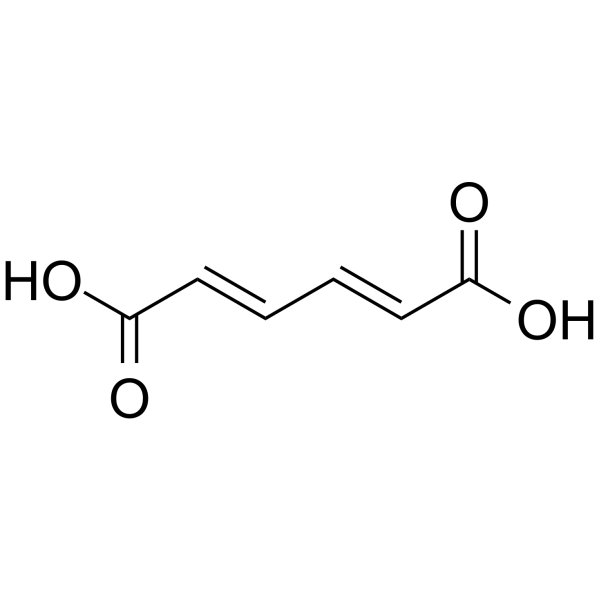
Physicochemical Properties
| Molecular Formula | C6H6O4 |
| Molecular Weight | 142.1094 |
| Exact Mass | 142.026 |
| CAS # | 3588-17-8 |
| Related CAS # | Muconic acid-d4;1185239-59-1;trans-trans-Muconic acid-d4;1955496-83-9 |
| PubChem CID | 5356793 |
| Appearance | White to off-white solid powder |
| Density | 1.4±0.1 g/cm3 |
| Boiling Point | 345.4±15.0 °C at 760 mmHg |
| Melting Point | 290 °C (dec.)(lit.) |
| Flash Point | 176.9±16.9 °C |
| Vapour Pressure | 0.0±1.6 mmHg at 25°C |
| Index of Refraction | 1.549 |
| LogP | -0.21 |
| Hydrogen Bond Donor Count | 2 |
| Hydrogen Bond Acceptor Count | 4 |
| Rotatable Bond Count | 3 |
| Heavy Atom Count | 10 |
| Complexity | 168 |
| Defined Atom Stereocenter Count | 0 |
| SMILES | C(=C/C(=O)O)\C=C\C(=O)O |
| InChi Key | TXXHDPDFNKHHGW-ZPUQHVIOSA-N |
| InChi Code | InChI=1S/C6H6O4/c7-5(8)3-1-2-4-6(9)10/h1-4H,(H,7,8)(H,9,10)/b3-1+,4-2+ |
| Chemical Name | (2E,4E)-hexa-2,4-dienedioic acid |
| HS Tariff Code | 2934.99.9001 |
| Storage |
Powder-20°C 3 years 4°C 2 years In solvent -80°C 6 months -20°C 1 month |
| Shipping Condition | Room temperature (This product is stable at ambient temperature for a few days during ordinary shipping and time spent in Customs) |
Biological Activity
| Enzyme Assay |
1. High-performance liquid chromatography (HPLC) assay for quantitation in urine: Urine samples were first pretreated (including centrifugation to remove precipitates and adjustment of pH to a suitable range). The pretreated samples were then injected into an HPLC system equipped with a reverse-phase column. The mobile phase was a mixture of aqueous solution and organic solvent (specific ratio optimized for separation), and the detection was performed using a UV detector at a wavelength of 254 nm. The concentration of trans-trans-Muconic acid in urine was calculated by comparing the peak area of the sample with that of standard solutions of known concentrations [1] 2. Gas chromatography (GC) assay for identification and quantitation: Urine samples were subjected to derivatization (to improve volatility of the compound) using a suitable derivatizing agent. The derivatized samples were injected into a GC system with a capillary column, and the column temperature was programmed to separate trans-trans-Muconic acid from other urinary components. A flame ionization detector (FID) was used for detection, and the compound was identified by comparing its retention time with that of the standard; quantitation was achieved via the external standard method [1] |
| ADME/Pharmacokinetics |
- trans-trans-Muconic acid is a urinary metabolite of benzene; after benzene is metabolized in the human body, this compound is excreted primarily through urine, making urine the main excretion matrix for this metabolite [1] |
| References |
[1]. Evaluation of assays for the identification and quantitation of muconic acid, a benzene metabolite in human urine. J Toxicol Environ Health. 1994 Jul;42(3):245-58. |
| Additional Infomation |
Muconic acid is a hexadienedioic acid with unsaturation at positions 2 and 4. It has a role as a human xenobiotic metabolite. It is a dicarboxylic fatty acid and a hexadienedioic acid. It is a conjugate acid of a 5-carboxypenta-2,4-dienoate. t,t-Muconic Acid is an all trans dicarboxylic acid that is a metabolite of benzene and is used as a marker for occupational or environmental exposure to benzene. See also: cis,cis-Muconic acid (annotation moved to). - trans-trans-Muconic acid is a specific metabolite of benzene, and its presence and concentration in human urine are widely used as a biological marker to assess occupational or environmental benzene exposure [1] - The article compared the performance of different assays (including HPLC and GC) for trans-trans-Muconic acid detection in urine, evaluating parameters such as linearity, precision, accuracy, and detection limit. The HPLC assay showed better precision (relative standard deviation < 5%) and lower detection limit (0.05 μg/mL) compared to the GC assay in this study [1] |
Solubility Data
| Solubility (In Vitro) | DMSO : ~33.33 mg/mL (~234.54 mM) |
| Solubility (In Vivo) |
Solubility in Formulation 1: ≥ 2.5 mg/mL (17.59 mM) (saturation unknown) in 10% DMSO + 40% PEG300 + 5% Tween80 + 45% Saline (add these co-solvents sequentially from left to right, and one by one), clear solution. For example, if 1 mL of working solution is to be prepared, you can add 100 μL of 25.0 mg/mL clear DMSO stock solution to 400 μL PEG300 and mix evenly; then add 50 μL Tween-80 to the above solution and mix evenly; then add 450 μL normal saline to adjust the volume to 1 mL. Preparation of saline: Dissolve 0.9 g of sodium chloride in 100 mL ddH₂ O to obtain a clear solution. Solubility in Formulation 2: ≥ 2.5 mg/mL (17.59 mM) (saturation unknown) in 10% DMSO + 90% Corn Oil (add these co-solvents sequentially from left to right, and one by one), clear solution. For example, if 1 mL of working solution is to be prepared, you can add 100 μL of 25.0 mg/mL clear DMSO stock solution to 900 μL of corn oil and mix evenly. (Please use freshly prepared in vivo formulations for optimal results.) |
| Preparing Stock Solutions | 1 mg | 5 mg | 10 mg | |
| 1 mM | 7.0368 mL | 35.1840 mL | 70.3680 mL | |
| 5 mM | 1.4074 mL | 7.0368 mL | 14.0736 mL | |
| 10 mM | 0.7037 mL | 3.5184 mL | 7.0368 mL |