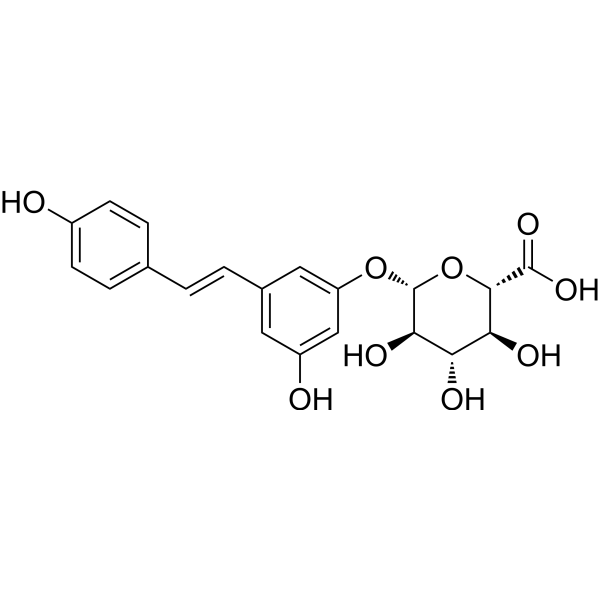
Physicochemical Properties
| Molecular Formula | C20H20O9 |
| Molecular Weight | 404.37 |
| Exact Mass | 404.11073 |
| CAS # | 387372-17-0 |
| PubChem CID | 5273285 |
| Appearance | Typically exists as Off-white to light yellow solids at room temperature |
| Density | 1.6±0.1 g/cm3 |
| Boiling Point | 758.1±60.0 °C at 760 mmHg |
| Flash Point | 271.6±26.4 °C |
| Vapour Pressure | 0.0±2.7 mmHg at 25°C |
| Index of Refraction | 1.76 |
| LogP | 1.6 |
| Hydrogen Bond Donor Count | 6 |
| Hydrogen Bond Acceptor Count | 9 |
| Rotatable Bond Count | 5 |
| Heavy Atom Count | 29 |
| Complexity | 574 |
| Defined Atom Stereocenter Count | 5 |
| InChi Key | QWSAYEBSTMCFKY-OTPOQTMVSA-N |
| InChi Code | InChI=1S/C20H20O9/c21-12-5-3-10(4-6-12)1-2-11-7-13(22)9-14(8-11)28-20-17(25)15(23)16(24)18(29-20)19(26)27/h1-9,15-18,20-25H,(H,26,27)/b2-1+/t15-,16-,17+,18-,20+/m0/s1 |
| Chemical Name | (2S,3S,4S,5R,6S)-3,4,5-trihydroxy-6-[3-hydroxy-5-[(E)-2-(4-hydroxyphenyl)ethenyl]phenoxy]oxane-2-carboxylic acid |
| Synonyms | 387372-17-0; trans-Resveratrol 3-O-glucuronide; Trans-Resveratrol-3-O-glucuronide; Resveratrol 3-O-Glucuronide; LNK7Z424CK; trans-Resveratrol 3-glucuronide; (2S,3S,4S,5R,6S)-3,4,5-trihydroxy-6-[3-hydroxy-5-[(E)-2-(4-hydroxyphenyl)ethenyl]phenoxy]oxane-2-carboxylic acid; UNII-LNK7Z424CK; |
| HS Tariff Code | 2934.99.9001 |
| Storage |
Powder-20°C 3 years 4°C 2 years In solvent -80°C 6 months -20°C 1 month |
| Shipping Condition | Room temperature (This product is stable at ambient temperature for a few days during ordinary shipping and time spent in Customs) |
Biological Activity
| Targets | Metabolite of trans-resveratro |
| ln Vitro | trans-Resveratrol-3-O-β-D-Glucuronide (48 h) inhibits the proliferation of CCL-228, Caco-2 and HCT-116 cells with IC50 values of 15.8 μM, 16.5 μM and 10.1 μM, respectively[2]. trans-Resveratrol-3-O-β-D-Glucuronide (30 μM, 48 h) induces S phase arrest in CCL-228, Caco-2 and HCT-116 cells[2]. trans-Resveratrol-3-O-β-D-Glucuronide (200 μM, 10 minutes) increases the production of pyruvate in the liver of rats with complete Freund's adjuvant-induced arthritis model[3]. |
| ln Vivo | Resveratrol inhibited glycogen catabolism when infused at concentrations above 50 μM and gluconeogenesis even at 10 μM in both healthy and arthritic rat livers, but more sensitive in these latter. Resveratrol above 100 μM inhibited ADP-stimulated respiration and the activities of NADH- and succinate-oxidases in mitochondria, which were partially responsible for gluconeogenesis inhibition. Pyruvate carboxylase activity was inhibited by 25 μM resveratrol and should inhibit gluconeogenesis already at low concentrations. Resveratrol was significantly metabolized to R3G in healthy rat livers, however, R3G formation was lower in arthritic rat livers. The latter must be in part a consequence of a lower glucose disposal for glucuronidation. When compared to resveratrol, R3G inhibited gluconeogenesis in a lower extension and glycogen catabolism in a higher extension. Significance: the effects of resveratrol and R3G tended to be transitory and existed only when the resveratrol is present in the organ, however, they should be considered because significant serum concentrations of both are found after oral ingestion of resveratrol.[3] |
| Enzyme Assay | In this study we developed a sensitive method using high performance liquid chromatography (HPLC) coupled to electrospray ionization (ESI) with high resolution time of flight (TOF) mass spectrometry (MS) for the determination of naturally occurring antioxidant trans-resveratrol (3,5,4'-trihydroxy-trans-stilbene, RES). This method enabled an investigation of a relationship between tumor growth in rats and concentration of RES and its primary metabolites, trans-resveratrol-3-O-sulfate-3-O-sulfate (R3S) and trans-resveratrol-3-O-β-d-glucuronide (R3G), in rat serum after RES exposure (5 or 25mg/kg/day). RES levels in rat serum were near the limit of detection, showing concentrations of 4±1 and 12±4ng/mL for low and high-dose exposure, respectively. Compared to RES, higher concentrations were found for its metabolites (R3G:4.8±0.3 and 6.8±0.3μg/mL; R3S:0.27±0.09 and 0.34±0.04μg/mL, respectively). Using TOF, for the first time, we measured the matrix affected limits of detection (LODs) in plasma (3.7, 82.4, and 4.7ng/mL for RES, R3G, and R3S, respectively), which were comparable to those reported in previous work using HPLC tandem mass spectrometry, but with a benefit of a full mass spectral profile. The ability to acquire data in full scan mode also revealed other isomers of R3S. The additional novelty of our study is in synthesis and application of deuterated recovery standards enabling accurate and precise quantification. In order to develop a robust method, the ESI conditions were optimized using a multilevel full factorial design of experiments.[1] |
| Cell Assay |
Cell Viability Assay[2] Cell Types: CCL-228, Caco-2 and HCT-116 Tested Concentrations: 0 to 100 μM Incubation Duration: 48 h Experimental Results: Inhibited cell growth with the IC50 valus of 15.8 μM, 16.5 μM and 10.1 μM against CCL-228, Caco-2 and HCT-116 cells, respectively. Cell Cycle Analysis[2] Cell Types: CCL-228, Caco-2 and HCT-116 Tested Concentrations: 30 μM Incubation Duration: 48 h Experimental Results: Induced S phase arrest. The growth of Caco-2, HCT-116, and CCL-228 cells was measured using the neutral red and MTT assays. Resveratrol and each metabolite inhibited cell growth with IC50 values of 9.8–31 μM. Resveratrol caused S phase arrest in all three cell lines. Resveratrol 3-O-D-glucuronide and resveratrol 4-O-D-glucuronide caused G1 arrest in CCL-228 and Caco-2 cells. Resveratrol 3-O-D-sulfate had no effect on cell cycle. Growth inhibition was reversed by an inhibitor of AMP-activated protein kinase (compound C) or an adenosine A3 receptor antagonist (MRS1191). The A3 receptor agonist 2Cl-IB-MECA inhibited growth and A3 receptors were detected in all cell lines. The resveratrol glucuronides also reduced cyclin D1 levels but at higher concentrations than in growth experiments and generally did not increase phosphorylated AMP-activated protein kinase. Conclusion: Resveratrol glucuronides inhibit cell growth by G1 arrest and cyclin D1 depletion, and our results strongly suggest a role for A3 adenosine receptors in this inhibition.[1] |
| Animal Protocol | Aims: to investigate the effects of resveratrol on glycogen catabolism and gluconeogenesis in perfused livers of healthy and arthritic rats. The actions of resveratrol-3-O-glucuronide (R3G) and the biotransformation of resveratrol into R3G was further evaluated in the livers. Main methods: arthritis was induced with Freund's adjuvant. Resveratrol at concentrations of 10, 25, 50, 100 and 200 μM and 200 μM R3G were introduced in perfused livers. Resveratrol and metabolites were measured in the outflowing perfusate. Respiration of isolated mitochondria and activity of gluconeogenic enzymes were also evaluated in the livers.[3] |
| ADME/Pharmacokinetics | Metabolism / Metabolites: Resveratrol 3-O-glucuronide is a known human metabolite of Resveratrol. |
| References |
[1]. Determination of trans-resveratrol and its metabolites in rat serum using liquid chromatography with high-resolution time of flight mass spectrometry. J Chromatogr B Analyt Technol Biomed Life Sci. 2016;1039:35-43. [2]. Resveratrol 3-O-D-glucuronide and resveratrol 4'-O-D-glucuronide inhibit colon cancer cell growth: evidence for a role of A3 adenosine receptors, cyclin D1 depletion, and G1 cell cycle arrest. Mol Nutr Food Res. 2013;57(10):1708-1717. [3]. Resveratrol biotransformation and actions on the liver metabolism of healthy and arthritic rats. Life Sci. 2022;310:120991. |
| Additional Infomation | Trans-Resveratrol 3-O-glucuronide is a stilbenoid and a glycoside. |
Solubility Data
| Solubility (In Vitro) | May dissolve in DMSO (in most cases), if not, try other solvents such as H2O, Ethanol, or DMF with a minute amount of products to avoid loss of samples |
| Solubility (In Vivo) |
Note: Listed below are some common formulations that may be used to formulate products with low water solubility (e.g. < 1 mg/mL), you may test these formulations using a minute amount of products to avoid loss of samples. Injection Formulations (e.g. IP/IV/IM/SC) Injection Formulation 1: DMSO : Tween 80: Saline = 10 : 5 : 85 (i.e. 100 μL DMSO stock solution → 50 μL Tween 80 → 850 μL Saline) *Preparation of saline: Dissolve 0.9 g of sodium chloride in 100 mL ddH ₂ O to obtain a clear solution. Injection Formulation 2: DMSO : PEG300 :Tween 80 : Saline = 10 : 40 : 5 : 45 (i.e. 100 μL DMSO → 400 μLPEG300 → 50 μL Tween 80 → 450 μL Saline) Injection Formulation 3: DMSO : Corn oil = 10 : 90 (i.e. 100 μL DMSO → 900 μL Corn oil) Example: Take the Injection Formulation 3 (DMSO : Corn oil = 10 : 90) as an example, if 1 mL of 2.5 mg/mL working solution is to be prepared, you can take 100 μL 25 mg/mL DMSO stock solution and add to 900 μL corn oil, mix well to obtain a clear or suspension solution (2.5 mg/mL, ready for use in animals). Injection Formulation 4: DMSO : 20% SBE-β-CD in saline = 10 : 90 [i.e. 100 μL DMSO → 900 μL (20% SBE-β-CD in saline)] *Preparation of 20% SBE-β-CD in Saline (4°C,1 week): Dissolve 2 g SBE-β-CD in 10 mL saline to obtain a clear solution. Injection Formulation 5: 2-Hydroxypropyl-β-cyclodextrin : Saline = 50 : 50 (i.e. 500 μL 2-Hydroxypropyl-β-cyclodextrin → 500 μL Saline) Injection Formulation 6: DMSO : PEG300 : castor oil : Saline = 5 : 10 : 20 : 65 (i.e. 50 μL DMSO → 100 μLPEG300 → 200 μL castor oil → 650 μL Saline) Injection Formulation 7: Ethanol : Cremophor : Saline = 10: 10 : 80 (i.e. 100 μL Ethanol → 100 μL Cremophor → 800 μL Saline) Injection Formulation 8: Dissolve in Cremophor/Ethanol (50 : 50), then diluted by Saline Injection Formulation 9: EtOH : Corn oil = 10 : 90 (i.e. 100 μL EtOH → 900 μL Corn oil) Injection Formulation 10: EtOH : PEG300:Tween 80 : Saline = 10 : 40 : 5 : 45 (i.e. 100 μL EtOH → 400 μLPEG300 → 50 μL Tween 80 → 450 μL Saline) Oral Formulations Oral Formulation 1: Suspend in 0.5% CMC Na (carboxymethylcellulose sodium) Oral Formulation 2: Suspend in 0.5% Carboxymethyl cellulose Example: Take the Oral Formulation 1 (Suspend in 0.5% CMC Na) as an example, if 100 mL of 2.5 mg/mL working solution is to be prepared, you can first prepare 0.5% CMC Na solution by measuring 0.5 g CMC Na and dissolve it in 100 mL ddH2O to obtain a clear solution; then add 250 mg of the product to 100 mL 0.5% CMC Na solution, to make the suspension solution (2.5 mg/mL, ready for use in animals). Oral Formulation 3: Dissolved in PEG400 Oral Formulation 4: Suspend in 0.2% Carboxymethyl cellulose Oral Formulation 5: Dissolve in 0.25% Tween 80 and 0.5% Carboxymethyl cellulose Oral Formulation 6: Mixing with food powders Note: Please be aware that the above formulations are for reference only. InvivoChem strongly recommends customers to read literature methods/protocols carefully before determining which formulation you should use for in vivo studies, as different compounds have different solubility properties and have to be formulated differently. (Please use freshly prepared in vivo formulations for optimal results.) |
| Preparing Stock Solutions | 1 mg | 5 mg | 10 mg | |
| 1 mM | 2.4730 mL | 12.3649 mL | 24.7298 mL | |
| 5 mM | 0.4946 mL | 2.4730 mL | 4.9460 mL | |
| 10 mM | 0.2473 mL | 1.2365 mL | 2.4730 mL |