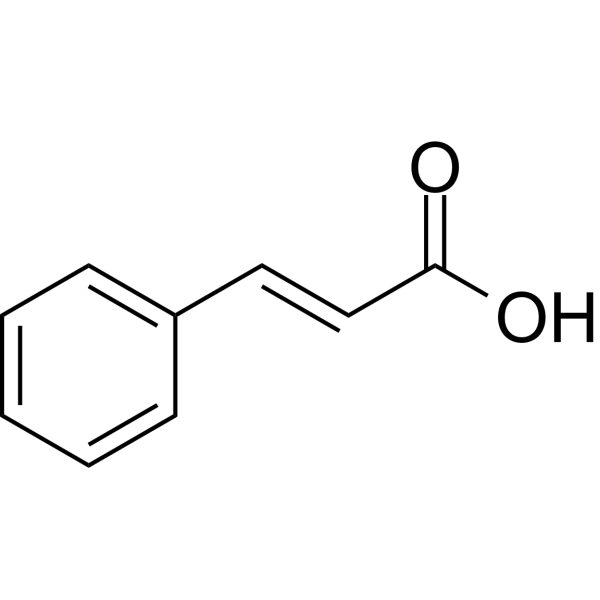
Physicochemical Properties
| Molecular Formula | C9H8O2 |
| Molecular Weight | 148.1586 |
| Exact Mass | 148.052 |
| CAS # | 140-10-3 |
| Related CAS # | trans-Cinnamic acid-d5;352431-48-2;trans-Cinnamic acid-d7;343338-31-8 |
| PubChem CID | 444539 |
| Appearance | White to off-white solid powder |
| Density | 1.2±0.1 g/cm3 |
| Boiling Point | 265.0±0.0 °C at 760 mmHg |
| Melting Point | 133 °C(lit.) |
| Flash Point | 189.5±9.6 °C |
| Vapour Pressure | 0.0±0.5 mmHg at 25°C |
| Index of Refraction | 1.616 |
| LogP | 2.41 |
| Hydrogen Bond Donor Count | 1 |
| Hydrogen Bond Acceptor Count | 2 |
| Rotatable Bond Count | 2 |
| Heavy Atom Count | 11 |
| Complexity | 155 |
| Defined Atom Stereocenter Count | 0 |
| SMILES | C1=CC=C(C=C1)/C=C/C(=O)O |
| InChi Key | WBYWAXJHAXSJNI-VOTSOKGWSA-N |
| InChi Code | InChI=1S/C9H8O2/c10-9(11)7-6-8-4-2-1-3-5-8/h1-7H,(H,10,11)/b7-6+ |
| Chemical Name | (E)-3-phenylprop-2-enoic acid |
| HS Tariff Code | 2934.99.9001 |
| Storage |
Powder-20°C 3 years 4°C 2 years In solvent -80°C 6 months -20°C 1 month |
| Shipping Condition | Room temperature (This product is stable at ambient temperature for a few days during ordinary shipping and time spent in Customs) |
Biological Activity
| ln Vitro |
Trans-cinnamic acid exhibits antibacterial activity against fish pathogen A, with a minimum inhibitory concentration (MIC) of 250 μg/mL. equilibrium, SY-AS1. Impact of trans-cinnamic acid on intestinal isolates A of rainbow trout. SY-AS3 sobria and S. baltica, gill isolate F, SY-S145. salmon infections A and Spartansii SY-FS1. L24, V. crassostreae SY-VC10, and Y demonstrated moderately inhibitory effects, as did salmon ATCC 33658, Listonella anguillarum, and SY. E42 ruckeri. Because trans-cinnamic acid doesn't neutralize the pH of the culture medium, it is more effective against bacteria [1]. The antibacterial activity of trans-cinnamic acid was tested against 32 bacterial strains (including fish pathogens, non-pathogenic intestinal isolates, and collection strains) using disc diffusion and microdilution methods. trans-Cinnamic acid exhibited a potent inhibitory effect (22 mm inhibition zone) against the fish pathogen Aeromonas sobria SY-AS1. [1] A moderate inhibitory effect (inhibition zones of 12-18 mm) was observed against the fish pathogens Aeromonas salmonicida ATCC 33658, Vibrio anguillarum SY-L24, Vibrio crassostreae SY-VC10, Yersinia ruckeri E42, the intestinal isolate Aeromonas sobria SY-AS3, the intestinal isolate Shewanella baltica SY-S145, and the gill isolate Flavobacterium spartansii SY-FS1. [1] The majority of Gram-positive bacteria (e.g., Bacillus spp., Lactobacillus plantarum, Lactococcus garvieae) and several Gram-negative bacteria (e.g., Escherichia coli, Citrobacter spp., Klebsiella pneumoniae) were resistant to trans-cinnamic acid at the tested concentration (2 mg/disc). [1] The Minimum Inhibitory Concentration (MIC) values varied among susceptible strains. For the highly susceptible A. sobria SY-AS1, the MIC was 250 µg/mL in non-pH-neutralized media. MICs for other susceptible pathogens ranged from 500 to 1000 µg/mL in non-pH-neutralized media. MIC values were generally higher (>1000 to >2500 µg/mL) when the culture media pH was neutralized. [1] |
| ln Vivo |
The current study [1] is an in vitro investigation. It references a separate, recent in vivo study by the authors (Yilmaz and Ergün, 2018) where dietary trans-cinnamic acid increased the survival rate of rainbow trout against Yersinia ruckeri. [1] |
| Cell Assay |
No mammalian cell-based assays (e.g., antiproliferative, western blot, apoptosis) were conducted in this study. The "Cell Assay" here refers to antimicrobial susceptibility testing using bacterial cultures. [1] Disc Diffusion Assay: Bacterial inoculum was adjusted to 0.5 McFarland standard and spread on agar plates. Sterile discs were impregnated with 20 µL of diluted trans-cinnamic acid (equivalent to 2 mg/disc) and placed on the inoculated agar. Plates were incubated at optimal temperatures for 24 hours. Inhibition zone diameters were measured. Zones ≥20 mm were considered strongly inhibitory, 12-20 mm moderately/mildly inhibitory, and <12 mm non-inhibitory. [1] Minimum Inhibitory Concentration (MIC) Assay: The broth microdilution method was used. Two-fold serial dilutions of trans-cinnamic acid (ranging from 1.95/2.44 to 5000/2000 µg/mL, with and without pH neutralization) were prepared in culture broth in a 96-well plate. Each well was inoculated with a bacterial suspension (final concentration ~10^5 CFU/mL). Plates were incubated for 24 hours. The MIC was defined as the lowest concentration that completely inhibited visible growth. [1] |
| References |
[1]. Antimicrobial activity of trans-cinnamic acid and commonly used antibiotics against important fish pathogens and nonpathogenic isolates. J Appl Microbiol. 2018 Sep 4. |
| Additional Infomation |
Cinnamic acid is a monocarboxylic acid that consists of acrylic acid bearing a phenyl substituent at the 3-position. It is found in Cinnamomum cassia. It has a role as a plant metabolite. It is a member of styrenes and a member of cinnamic acids. It is a conjugate acid of a cinnamate. trans-Cinnamic acid is a metabolite found in or produced by Escherichia coli (strain K12, MG1655). Cinnamic acid is a metabolite found in or produced by Escherichia coli (strain K12, MG1655). Cinnamic acid has been reported in Ipomoea leptophylla, Camellia sinensis, and other organisms with data available. Cinnamic acid has the formula C6H5CHCHCOOH and is an odorless white crystalline acid, which is slightly soluble in water. It has a melting point of 133 degree centigrade and a boiling point of 300 degree centigrade. Cinnamic acid is a metabolite found in or produced by Saccharomyces cerevisiae. See also: Cinnamon (part of); Sodium cinnamate (is active moiety of); Chinese Cinnamon (part of) ... View More ... trans-Cinnamic acid is a phenolic organic acid found in various plants like cinnamon and basil. [1] It is proposed as an environmentally friendly alternative to antibiotics in aquaculture to combat specific fish pathogens, primarily Aeromonas sobria, and also A. salmonicida, V. anguillarum, V. crassostreae, and Y. ruckeri. [1] A significant finding is that trans-cinnamic acid did not inhibit several non-pathogenic or potentially probiotic intestinal bacteria (e.g., Bacillus spp., Lactobacillus plantarum), suggesting it may be selective against pathogens while sparing beneficial gut flora. [1] Its antimicrobial activity is enhanced in an acidic environment (non-neutralized pH), consistent with the mechanism of action of organic acids. [1] |
Solubility Data
| Solubility (In Vitro) | DMSO : ~100 mg/mL (~674.95 mM) |
| Solubility (In Vivo) |
Solubility in Formulation 1: ≥ 2.5 mg/mL (16.87 mM) (saturation unknown) in 10% DMSO + 40% PEG300 + 5% Tween80 + 45% Saline (add these co-solvents sequentially from left to right, and one by one), clear solution. For example, if 1 mL of working solution is to be prepared, you can add 100 μL of 25.0 mg/mL clear DMSO stock solution to 400 μL PEG300 and mix evenly; then add 50 μL Tween-80 to the above solution and mix evenly; then add 450 μL normal saline to adjust the volume to 1 mL. Preparation of saline: Dissolve 0.9 g of sodium chloride in 100 mL ddH₂ O to obtain a clear solution. Solubility in Formulation 2: ≥ 2.5 mg/mL (16.87 mM) (saturation unknown) in 10% DMSO + 90% (20% SBE-β-CD in Saline) (add these co-solvents sequentially from left to right, and one by one), clear solution. For example, if 1 mL of working solution is to be prepared, you can add 100 μL of 25.0 mg/mL clear DMSO stock solution to 900 μL of 20% SBE-β-CD physiological saline solution and mix evenly. Preparation of 20% SBE-β-CD in Saline (4°C,1 week): Dissolve 2 g SBE-β-CD in 10 mL saline to obtain a clear solution. Solubility in Formulation 3: ≥ 2.5 mg/mL (16.87 mM) (saturation unknown) in 10% DMSO + 90% Corn Oil (add these co-solvents sequentially from left to right, and one by one), clear solution. For example, if 1 mL of working solution is to be prepared, you can add 100 μL of 25.0 mg/mL clear DMSO stock solution to 900 μL of corn oil and mix evenly. (Please use freshly prepared in vivo formulations for optimal results.) |
| Preparing Stock Solutions | 1 mg | 5 mg | 10 mg | |
| 1 mM | 6.7495 mL | 33.7473 mL | 67.4946 mL | |
| 5 mM | 1.3499 mL | 6.7495 mL | 13.4989 mL | |
| 10 mM | 0.6749 mL | 3.3747 mL | 6.7495 mL |