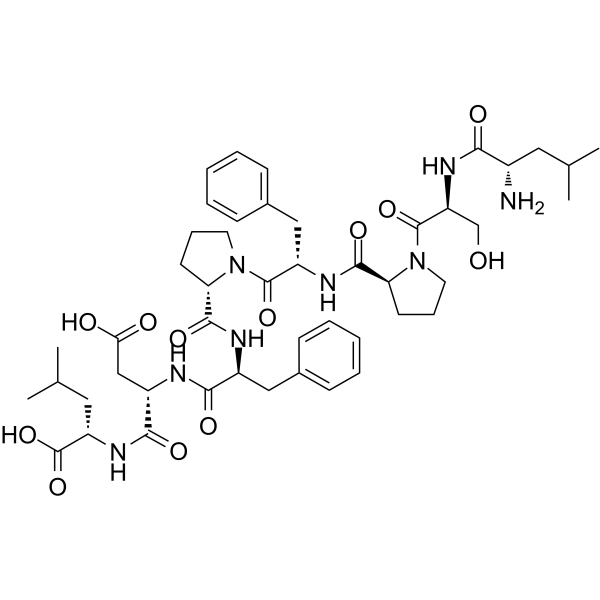
Physicochemical Properties
| Molecular Formula | C47H66N8O12 |
| Molecular Weight | 935.08 |
| Exact Mass | 934.48 |
| CAS # | 142606-55-1 |
| PubChem CID | 132457 |
| Appearance | Typically exists as solid at room temperature |
| Density | 1.298g/cm3 |
| Boiling Point | 1307.2ºC at 760mmHg |
| Flash Point | 744.4ºC |
| Vapour Pressure | 0mmHg at 25°C |
| Index of Refraction | 1.586 |
| LogP | 4.626 |
| Hydrogen Bond Donor Count | 9 |
| Hydrogen Bond Acceptor Count | 13 |
| Rotatable Bond Count | 24 |
| Heavy Atom Count | 67 |
| Complexity | 1730 |
| Defined Atom Stereocenter Count | 8 |
| SMILES | CC(CC(C(NC(C(N1CCCC1C(NC(C(N1CCCC1C(NC(C(NC(C(NC(C(=O)O)CC(C)C)=O)CC(=O)O)=O)CC1C=CC=CC=1)=O)=O)CC1C=CC=CC=1)=O)=O)CO)=O)N)C |
| InChi Key | RLTLDVPHEYUGFZ-QSVFAHTRSA-N |
| InChi Code | InChI=1S/C47H66N8O12/c1-27(2)21-31(48)40(59)53-36(26-56)46(65)55-20-12-18-38(55)44(63)51-34(24-30-15-9-6-10-16-30)45(64)54-19-11-17-37(54)43(62)50-32(23-29-13-7-5-8-14-29)41(60)49-33(25-39(57)58)42(61)52-35(47(66)67)22-28(3)4/h5-10,13-16,27-28,31-38,56H,11-12,17-26,48H2,1-4H3,(H,49,60)(H,50,62)(H,51,63)(H,52,61)(H,53,59)(H,57,58)(H,66,67)/t31-,32-,33-,34-,35-,36-,37-,38-/m0/s1 |
| Chemical Name | (2S)-2-[[(2S)-2-[[(2S)-2-[[(2S)-1-[(2S)-2-[[(2S)-1-[(2S)-2-[[(2S)-2-amino-4-methylpentanoyl]amino]-3-hydroxypropanoyl]pyrrolidine-2-carbonyl]amino]-3-phenylpropanoyl]pyrrolidine-2-carbonyl]amino]-3-phenylpropanoyl]amino]-3-carboxypropanoyl]amino]-4-methylpentanoic acid |
| Synonyms | p2Ca-Y4; Lspfpfdl; p2Ca Peptide |
| HS Tariff Code | 2934.99.9001 |
| Storage |
Powder-20°C 3 years 4°C 2 years In solvent -80°C 6 months -20°C 1 month |
| Shipping Condition | Room temperature (This product is stable at ambient temperature for a few days during ordinary shipping and time spent in Customs) |
Biological Activity
| ln Vitro | When linked to Ld, the p2Ca and QL9 peptides adopt distinct conformations and exhibit flexible peptide binding within the MHC class I cleft. Because it lacks proline at position 2, the 8-mer Ld antigenic peptide p2Ca (LSPFFDL) employs a different amino-terminal anchor. The Ld alloreactive T cell clone 2C was exposed to the p2Ca octamer, which was discovered to be a ligand that was naturally processed[1]. When it comes to allorecognition of the mouse MHC class I molecule H-2Ld, p2Ca is immunodominant. Peptide cross-reactivity is not the cause of the immunological advantage of the majority of Ld alloreactive T-cell clones, which are specific for Ld-p2Ca [2]. An autopeptide that is widely expressed is called p2Ca. The mouse mitochondrial enzyme alpha-ketoglutarate dehydrogenase is the source of p2Ca. Every tissue from BALB/c mice that was investigated, including the thymus and spleen, had p2Ca. Additionally, mouse tumor cell lines such mastocytoma P815 express it. CTL produced in vitro are able to identify the p2Ca/L d complex with specificity and mainly utilize the Vβ8 region. Target cells are lysed by cultured cells at a lower p2Ca level than by induced cells. This finding implies that peptide at high concentrations can be used to stimulate CTL that respond to peptide/class I complex endogenous levels [3]. |
| ln Vivo | When exogenous p2Ca and allogeneic BALB/c myeloma are injected simultaneously into BALB/c mice, the tumors can be rejected. As a result, the p2Ca/L d system can offer a model for assessing the parameters of successful tumor-associated peptide immunotherapy [3]. |
| References |
[1]. Peptide length variants p2Ca and QL9 present distinct conformations to L(d)-specific T cells. J Immunol. 2001 Oct 15;167(8):4207-14. [2]. The peptide p2Ca is immunodominant in allorecognition of Ld by beta chain variable region V beta 8+ but not V beta 8- strains. Proc Natl Acad Sci U S A. 1994 Nov 22;91(24):11482-6. [3]. Generation of cytotoxic T-lymphocytes to a self-peptide/class I complex: a model for peptide-mediated tumor rejection. Cancer Res. 1994 Jan 1;54(1):204-8. |
Solubility Data
| Solubility (In Vitro) | May dissolve in DMSO (in most cases), if not, try other solvents such as H2O, Ethanol, or DMF with a minute amount of products to avoid loss of samples |
| Solubility (In Vivo) |
Note: Listed below are some common formulations that may be used to formulate products with low water solubility (e.g. < 1 mg/mL), you may test these formulations using a minute amount of products to avoid loss of samples. Injection Formulations (e.g. IP/IV/IM/SC) Injection Formulation 1: DMSO : Tween 80: Saline = 10 : 5 : 85 (i.e. 100 μL DMSO stock solution → 50 μL Tween 80 → 850 μL Saline) *Preparation of saline: Dissolve 0.9 g of sodium chloride in 100 mL ddH ₂ O to obtain a clear solution. Injection Formulation 2: DMSO : PEG300 :Tween 80 : Saline = 10 : 40 : 5 : 45 (i.e. 100 μL DMSO → 400 μLPEG300 → 50 μL Tween 80 → 450 μL Saline) Injection Formulation 3: DMSO : Corn oil = 10 : 90 (i.e. 100 μL DMSO → 900 μL Corn oil) Example: Take the Injection Formulation 3 (DMSO : Corn oil = 10 : 90) as an example, if 1 mL of 2.5 mg/mL working solution is to be prepared, you can take 100 μL 25 mg/mL DMSO stock solution and add to 900 μL corn oil, mix well to obtain a clear or suspension solution (2.5 mg/mL, ready for use in animals). Injection Formulation 4: DMSO : 20% SBE-β-CD in saline = 10 : 90 [i.e. 100 μL DMSO → 900 μL (20% SBE-β-CD in saline)] *Preparation of 20% SBE-β-CD in Saline (4°C,1 week): Dissolve 2 g SBE-β-CD in 10 mL saline to obtain a clear solution. Injection Formulation 5: 2-Hydroxypropyl-β-cyclodextrin : Saline = 50 : 50 (i.e. 500 μL 2-Hydroxypropyl-β-cyclodextrin → 500 μL Saline) Injection Formulation 6: DMSO : PEG300 : castor oil : Saline = 5 : 10 : 20 : 65 (i.e. 50 μL DMSO → 100 μLPEG300 → 200 μL castor oil → 650 μL Saline) Injection Formulation 7: Ethanol : Cremophor : Saline = 10: 10 : 80 (i.e. 100 μL Ethanol → 100 μL Cremophor → 800 μL Saline) Injection Formulation 8: Dissolve in Cremophor/Ethanol (50 : 50), then diluted by Saline Injection Formulation 9: EtOH : Corn oil = 10 : 90 (i.e. 100 μL EtOH → 900 μL Corn oil) Injection Formulation 10: EtOH : PEG300:Tween 80 : Saline = 10 : 40 : 5 : 45 (i.e. 100 μL EtOH → 400 μLPEG300 → 50 μL Tween 80 → 450 μL Saline) Oral Formulations Oral Formulation 1: Suspend in 0.5% CMC Na (carboxymethylcellulose sodium) Oral Formulation 2: Suspend in 0.5% Carboxymethyl cellulose Example: Take the Oral Formulation 1 (Suspend in 0.5% CMC Na) as an example, if 100 mL of 2.5 mg/mL working solution is to be prepared, you can first prepare 0.5% CMC Na solution by measuring 0.5 g CMC Na and dissolve it in 100 mL ddH2O to obtain a clear solution; then add 250 mg of the product to 100 mL 0.5% CMC Na solution, to make the suspension solution (2.5 mg/mL, ready for use in animals). Oral Formulation 3: Dissolved in PEG400 Oral Formulation 4: Suspend in 0.2% Carboxymethyl cellulose Oral Formulation 5: Dissolve in 0.25% Tween 80 and 0.5% Carboxymethyl cellulose Oral Formulation 6: Mixing with food powders Note: Please be aware that the above formulations are for reference only. InvivoChem strongly recommends customers to read literature methods/protocols carefully before determining which formulation you should use for in vivo studies, as different compounds have different solubility properties and have to be formulated differently. (Please use freshly prepared in vivo formulations for optimal results.) |
| Preparing Stock Solutions | 1 mg | 5 mg | 10 mg | |
| 1 mM | 1.0694 mL | 5.3471 mL | 10.6943 mL | |
| 5 mM | 0.2139 mL | 1.0694 mL | 2.1389 mL | |
| 10 mM | 0.1069 mL | 0.5347 mL | 1.0694 mL |