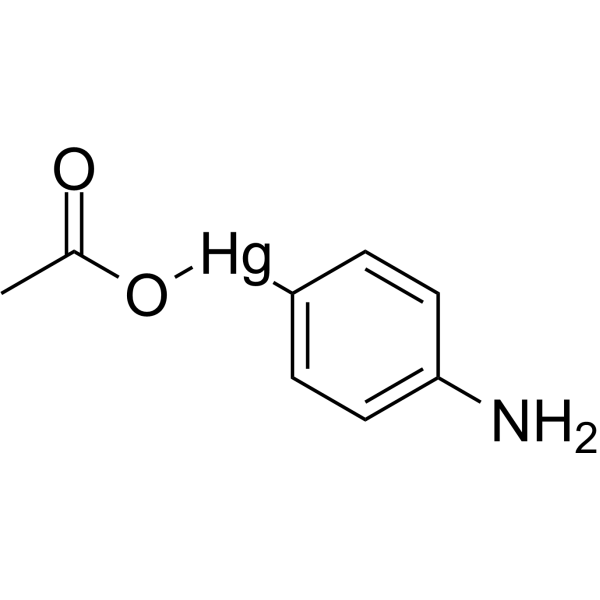
Physicochemical Properties
| Molecular Formula | C8H9HGNO2 |
| Molecular Weight | 351.75 |
| Exact Mass | 353.034 |
| CAS # | 6283-24-5 |
| PubChem CID | 16682983 |
| Appearance | White to yellow solid powder |
| Melting Point | 163-165 °C(lit.) |
| LogP | 1.035 |
| Hydrogen Bond Donor Count | 1 |
| Hydrogen Bond Acceptor Count | 3 |
| Rotatable Bond Count | 3 |
| Heavy Atom Count | 12 |
| Complexity | 155 |
| Defined Atom Stereocenter Count | 0 |
| InChi Key | RXSUFCOOZSGWSW-UHFFFAOYSA-M |
| InChi Code | InChI=1S/C6H6N.C2H4O2.Hg/c7-6-4-2-1-3-5-6;1-2(3)4;/h2-5H,7H2;1H3,(H,3,4);/q;;+1/p-1 |
| Chemical Name | acetyloxy-(4-aminophenyl)mercury |
| HS Tariff Code | 2934.99.9001 |
| Storage |
Powder-20°C 3 years 4°C 2 years In solvent -80°C 6 months -20°C 1 month |
| Shipping Condition | Room temperature (This product is stable at ambient temperature for a few days during ordinary shipping and time spent in Customs) |
Biological Activity
| ln Vitro | Rat brain homogenates treated with p-Aminophenylmercuric acetate (APMA) (0-30 µM; 20 min) exhibit a decrease in the quantity of dihydromorphine binding sites and an increase in agonist sensitivity to sodium binding inhibition [2]. Matrix metalloproteinases 2 and 9 are activated by 0.5 mM; 30 min; p-Aminophenylmercuric acetate [3]. |
| References |
[1]. ADAM10 mediates ectodomain shedding of the betacellulin precursor activated by p-aminophenylmercuric acetate and extracellular calcium influx. Journal of Biological Chemistry, 2005, 280(3): 1826-1837. [2]. Differential effects of protein-modifying reagents on receptor binding of opiate agonists and antagonists. Molecular Pharmacology, 1975, 11(3): 340-351. [3]. Inhibition of the activities of matrix metalloproteinases 2, 8, and 9 by chlorhexidine. Clinical Diagnostic Laboratory Immunology, 1999, 6(3): 437-439. |
Solubility Data
| Solubility (In Vitro) | DMSO: 125 mg/mL (355.37 mM) |
| Solubility (In Vivo) |
Solubility in Formulation 1: ≥ 2.08 mg/mL (5.91 mM) (saturation unknown) in 10% DMSO + 40% PEG300 + 5% Tween80 + 45% Saline (add these co-solvents sequentially from left to right, and one by one), clear solution. For example, if 1 mL of working solution is to be prepared, you can add 100 μL of 20.8 mg/mL clear DMSO stock solution to 400 μL PEG300 and mix evenly; then add 50 μL Tween-80 to the above solution and mix evenly; then add 450 μL normal saline to adjust the volume to 1 mL. Preparation of saline: Dissolve 0.9 g of sodium chloride in 100 mL ddH₂ O to obtain a clear solution. Solubility in Formulation 2: ≥ 2.08 mg/mL (5.91 mM) (saturation unknown) in 10% DMSO + 90% Corn Oil (add these co-solvents sequentially from left to right, and one by one), clear solution. For example, if 1 mL of working solution is to be prepared, you can add 100 μL of 20.8 mg/mL clear DMSO stock solution to 900 μL of corn oil and mix evenly. (Please use freshly prepared in vivo formulations for optimal results.) |
| Preparing Stock Solutions | 1 mg | 5 mg | 10 mg | |
| 1 mM | 2.8429 mL | 14.2146 mL | 28.4293 mL | |
| 5 mM | 0.5686 mL | 2.8429 mL | 5.6859 mL | |
| 10 mM | 0.2843 mL | 1.4215 mL | 2.8429 mL |