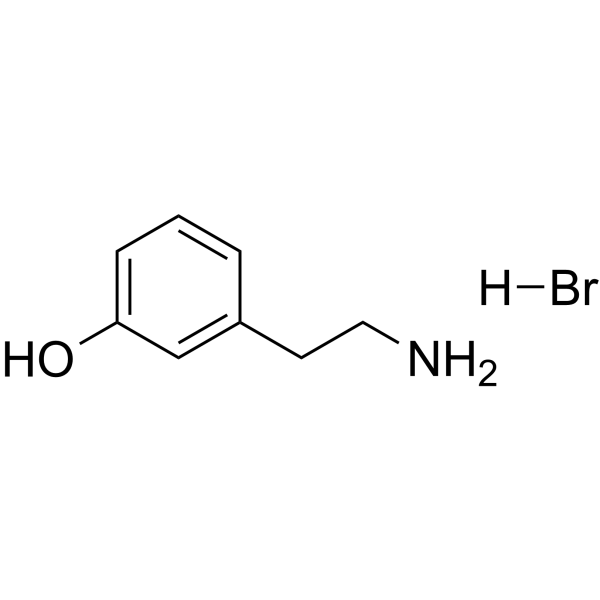
Physicochemical Properties
| Molecular Formula | C8H11NO.HBR |
| Molecular Weight | 218.09098 |
| Exact Mass | 217.01 |
| CAS # | 38449-59-1 |
| Related CAS # | m-Tyramine;588-05-6 |
| PubChem CID | 22717856 |
| Appearance | Light yellow to yellow solid powder |
| LogP | 2.551 |
| Hydrogen Bond Donor Count | 3 |
| Hydrogen Bond Acceptor Count | 2 |
| Rotatable Bond Count | 2 |
| Heavy Atom Count | 11 |
| Complexity | 95.3 |
| Defined Atom Stereocenter Count | 0 |
| InChi Key | RAMQGDMHEGTVQU-UHFFFAOYSA-N |
| InChi Code | InChI=1S/C8H11NO.BrH/c9-5-4-7-2-1-3-8(10)6-7;/h1-3,6,10H,4-5,9H2;1H |
| Chemical Name | 3-(2-aminoethyl)phenol;hydrobromide |
| HS Tariff Code | 2934.99.9001 |
| Storage |
Powder-20°C 3 years 4°C 2 years In solvent -80°C 6 months -20°C 1 month Note: Please store this product in a sealed and protected environment, avoid exposure to moisture. |
| Shipping Condition | Room temperature (This product is stable at ambient temperature for a few days during ordinary shipping and time spent in Customs) |
Biological Activity
| References |
[1]. The role of catecholamines, 5-hydroxytryptamine and m-tyramine in the behavioural effects of m-tyrosine in the rat. Eur J Pharmacol. 1982 Oct 22;84(3-4):139-49. [2]. Interactions between p-tyramine, m-tyramine, or beta-phenylethylamine and dopamine on single neurones in the cortex and caudate nucleus of the rat. Can J Physiol Pharmacol. 1980 Feb;58(2):222-7. |
Solubility Data
| Solubility (In Vitro) | DMSO : ~125 mg/mL (~573.16 mM) |
| Solubility (In Vivo) |
Solubility in Formulation 1: ≥ 2.08 mg/mL (9.54 mM) (saturation unknown) in 10% DMSO + 40% PEG300 + 5% Tween80 + 45% Saline (add these co-solvents sequentially from left to right, and one by one), clear solution. For example, if 1 mL of working solution is to be prepared, you can add 100 μL of 20.8 mg/mL clear DMSO stock solution to 400 μL PEG300 and mix evenly; then add 50 μL Tween-80 to the above solution and mix evenly; then add 450 μL normal saline to adjust the volume to 1 mL. Preparation of saline: Dissolve 0.9 g of sodium chloride in 100 mL ddH₂ O to obtain a clear solution. Solubility in Formulation 2: ≥ 2.08 mg/mL (9.54 mM) (saturation unknown) in 10% DMSO + 90% (20% SBE-β-CD in Saline) (add these co-solvents sequentially from left to right, and one by one), clear solution. For example, if 1 mL of working solution is to be prepared, you can add 100 μL of 20.8 mg/mL clear DMSO stock solution to 900 μL of 20% SBE-β-CD physiological saline solution and mix evenly. Preparation of 20% SBE-β-CD in Saline (4°C,1 week): Dissolve 2 g SBE-β-CD in 10 mL saline to obtain a clear solution. Solubility in Formulation 3: ≥ 2.08 mg/mL (9.54 mM) (saturation unknown) in 10% DMSO + 90% Corn Oil (add these co-solvents sequentially from left to right, and one by one), clear solution. For example, if 1 mL of working solution is to be prepared, you can add 100 μL of 20.8 mg/mL clear DMSO stock solution to 900 μL of corn oil and mix evenly. (Please use freshly prepared in vivo formulations for optimal results.) |
| Preparing Stock Solutions | 1 mg | 5 mg | 10 mg | |
| 1 mM | 4.5853 mL | 22.9263 mL | 45.8526 mL | |
| 5 mM | 0.9171 mL | 4.5853 mL | 9.1705 mL | |
| 10 mM | 0.4585 mL | 2.2926 mL | 4.5853 mL |