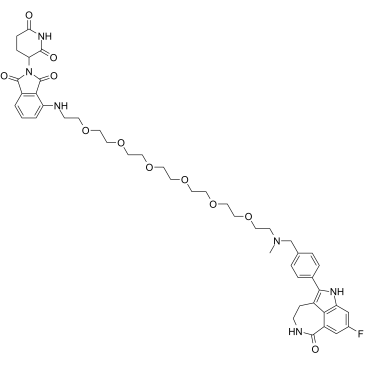
iRucaparib-AP6 is a novel and potent PARP1 degrader based on PROTAC (Proteolysis-targeting chimera) technology. It is composed of Rucaparib as the warhead to bind PARP1 and pomalidomide to recruit the E3 ligase. iRucaparib-AP6 blocks the enzymatic activity of PARP1 in vitro, and PARP1-mediated poly-ADP-ribosylation signaling in intact cells. This strategy mimics PARP1 genetic depletion, which enables the pharmacological decoupling of PARP1 inhibition from PARP1 trapping. Finally, by depleting PARP1, iRucaparib-AP6 protects muscle cells and primary cardiomyocytes from DNA-damage-induced energy crisis and cell death.
Physicochemical Properties
| Molecular Formula | C46H55FN6O11 |
| Molecular Weight | 886.9609 |
| Exact Mass | 886.391 |
| CAS # | 2410557-00-3 |
| PubChem CID | 138857977 |
| Appearance | Light yellow to yellow solid powder |
| LogP | 2.5 |
| Hydrogen Bond Donor Count | 4 |
| Hydrogen Bond Acceptor Count | 14 |
| Rotatable Bond Count | 26 |
| Heavy Atom Count | 64 |
| Complexity | 1540 |
| Defined Atom Stereocenter Count | 0 |
| SMILES | FC1=C([H])C2C(N([H])C([H])([H])C([H])([H])C3=C(C4C([H])=C([H])C(C([H])([H])N(C([H])([H])[H])C([H])([H])C([H])([H])OC([H])([H])C([H])([H])OC([H])([H])C([H])([H])OC([H])([H])C([H])([H])OC([H])([H])C([H])([H])OC([H])([H])C([H])([H])OC([H])([H])C([H])([H])N([H])C5=C([H])C([H])=C([H])C6C(N(C(C=65)=O)C5([H])C(N([H])C(C([H])([H])C5([H])[H])=O)=O)=O)=C([H])C=4[H])N([H])C(=C1[H])C3=2)=O |
| InChi Key | YHMDCINUVWULST-UHFFFAOYSA-N |
| InChi Code | InChI=1S/C46H55FN6O11/c1-52(29-30-5-7-31(8-6-30)42-33-11-12-49-43(55)35-27-32(47)28-37(50-42)40(33)35)14-16-60-18-20-62-22-24-64-26-25-63-23-21-61-19-17-59-15-13-48-36-4-2-3-34-41(36)46(58)53(45(34)57)38-9-10-39(54)51-44(38)56/h2-8,27-28,38,48,50H,9-26,29H2,1H3,(H,49,55)(H,51,54,56) |
| Chemical Name | 2-(2,6-dioxopiperidin-3-yl)-4-[2-[2-[2-[2-[2-[2-[2-[[4-(6-fluoro-9-oxo-3,10-diazatricyclo[6.4.1.04,13]trideca-1,4,6,8(13)-tetraen-2-yl)phenyl]methyl-methylamino]ethoxy]ethoxy]ethoxy]ethoxy]ethoxy]ethoxy]ethylamino]isoindole-1,3-dione |
| HS Tariff Code | 2934.99.9001 |
| Storage |
Powder-20°C 3 years 4°C 2 years In solvent -80°C 6 months -20°C 1 month Note: Please store this product in a sealed and protected environment (e.g. under nitrogen), avoid exposure to moisture. |
| Shipping Condition | Room temperature (This product is stable at ambient temperature for a few days during ordinary shipping and time spent in Customs) |
Biological Activity
| ln Vitro | In a time-dependent manner, iRucaparib-AP6 (0-10 μM; 24 hours) lowers PARP-1 levels, with a half-maximal degradation concentration (DC50 = 92%) of 82 nM (Dmax) [1]. |
| Cell Assay |
Cell Viability Assay[1] Cell Types: Primary rat neonatal cardiomyocytes ( Tested Concentrations: 0.001 μM; 0 -20 μM; 24 hrs (hours)) induces PARP1 degradation at low concentrations[1]. 0.01μM; 0.1μM; 1μM; 10 μM Incubation Duration: 24 hrs (hours) Experimental Results: PARP-1 levels were diminished in primary rat neonatal cardiomyocytes. Western Blot Analysis [1] Cell Types: Primary rat neonatal cardiomyocytes Tested Concentrations: 0.05 μM; 0.1 μM; 0.2 μM; 0.5 μM; 1 μM; 2 μM; 5 μM; 10 μM; 20 μM Incubation Duration: 24 hrs (hours) Experimental Results: Concentrations as low as Strong degradation of PARP1 is induced at 50 nM. |
| References |
[1]. Uncoupling of PARP1 trapping and inhibition using selective PARP1 degradation.Nat Chem Biol. 2019 Dec;15(12):1223-1231. |
Solubility Data
| Solubility (In Vitro) | DMSO : ~50 mg/mL (~56.37 mM) |
| Solubility (In Vivo) |
Solubility in Formulation 1: ≥ 2.5 mg/mL (2.82 mM) (saturation unknown) in 10% DMSO + 40% PEG300 +5% Tween-80 + 45% Saline (add these co-solvents sequentially from left to right, and one by one), clear solution. For example, if 1 mL of working solution is to be prepared, you can add 100 μL of 25.0 mg/mL clear DMSO stock solution to 400 μL PEG300 and mix evenly; then add 50 μL Tween-80 + to the above solution and mix evenly; then add 450 μL normal saline to adjust the volume to 1 mL. Preparation of saline: Dissolve 0.9 g of sodium chloride in 100 mL ddH₂ O to obtain a clear solution. (Please use freshly prepared in vivo formulations for optimal results.) |
| Preparing Stock Solutions | 1 mg | 5 mg | 10 mg | |
| 1 mM | 1.1274 mL | 5.6372 mL | 11.2745 mL | |
| 5 mM | 0.2255 mL | 1.1274 mL | 2.2549 mL | |
| 10 mM | 0.1127 mL | 0.5637 mL | 1.1274 mL |