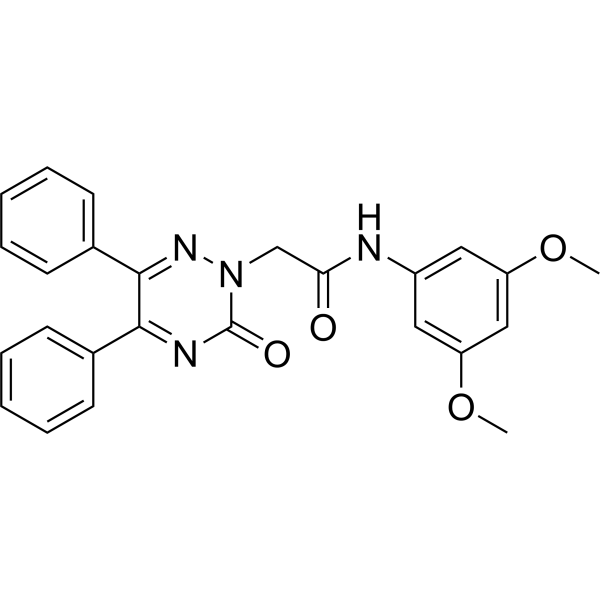
Physicochemical Properties
| Molecular Formula | C25H22N4O4 |
| Molecular Weight | 442.47 |
| Appearance | Typically exists as solid at room temperature |
| HS Tariff Code | 2934.99.9001 |
| Storage |
Powder-20°C 3 years 4°C 2 years In solvent -80°C 6 months -20°C 1 month |
| Shipping Condition | Room temperature (This product is stable at ambient temperature for a few days during ordinary shipping and time spent in Customs) |
Biological Activity
| Targets | hBCHE 0.542 μM (IC50) DYRK1A >10 μM (IC50) hAChE 0.486 μM (IC50) |
| ln Vitro | hAChE-IN- 8 (10-80 μM; 72 h) was non-toxic to SH-SY5Y neural cells at high concentrations[1]. hAChE-IN- 8 (40 μM; 72 h) significantly increased the survival rate of SH-SY5Y cells in the oxidative stress caused by Aβ1-42, and the cell morphology returned to normal[1]. hAChE-IN- 8 (5-20 μM; 48 h) showed significant anti-Aβ aggregation activity[1]. |
| ln Vivo | hAChE-IN-8 (500,1000 mg/kg; po; single dose) At high doses, all rats did not show any toxicity or abnormal reactions during the 14-day observation period [1]. hAChE-IN-8 (2.5-10 mg/kg; po; single dose) dose-dependently improved scopolamine (HY-N0296)-induced memory loss. Exhibits antioxidant potential in scopolamine-induced oxidative stress and can restore ACh and AChE levels [1]. hAChE-IN-8 (10 mg/kg; po; once daily for 9 days) showed significant cognitive improvement in Aβ1-42-induced AD model. Significantly reduces AD-related protein levels [1]. hAChE-IN-8 (10-200 μM) is added to the culture medium of fruit flies and has no obvious toxicity to fruit flies at lower concentrations, but it shows some toxicity at high concentrations [1]. hAChE-IN-8 (10-20 μM) effectively restored Aβ42-induced ocular phenotypic changes in the Drosophila AD model, showing significant neuroprotective effects [1]. hAChE-IN-8 (5-50 μM) has a high survival rate for larval cells at lower concentrations, but the cell survival rate decreases significantly at high concentrations, showing a certain degree of cytotoxicity [1]. |
| Animal Protocol |
Animal/Disease Models:Wistar rats[1] Doses: 500,1000 mg/kg Route of Administration: p.o.; single dose Experimental Results: At the maximum dose of 1000 mg/kg, the histology of organs (kidney, liver, brain and heart) was normal in rats after 14 days. |
| References |
[1]. Design, synthesis, and biological evaluation of some 2-(3-oxo-5,6-diphenyl-1,2,4-triazin-2(3H)-yl)-N-phenylacetamide hybrids as MTDLs for Alzheimer's disease therapy. Eur J Med Chem. 2024 May 5;271:116409. |
Solubility Data
| Solubility (In Vitro) | May dissolve in DMSO (in most cases), if not, try other solvents such as H2O, Ethanol, or DMF with a minute amount of products to avoid loss of samples |
| Solubility (In Vivo) |
Note: Listed below are some common formulations that may be used to formulate products with low water solubility (e.g. < 1 mg/mL), you may test these formulations using a minute amount of products to avoid loss of samples. Injection Formulations (e.g. IP/IV/IM/SC) Injection Formulation 1: DMSO : Tween 80: Saline = 10 : 5 : 85 (i.e. 100 μL DMSO stock solution → 50 μL Tween 80 → 850 μL Saline) *Preparation of saline: Dissolve 0.9 g of sodium chloride in 100 mL ddH ₂ O to obtain a clear solution. Injection Formulation 2: DMSO : PEG300 :Tween 80 : Saline = 10 : 40 : 5 : 45 (i.e. 100 μL DMSO → 400 μLPEG300 → 50 μL Tween 80 → 450 μL Saline) Injection Formulation 3: DMSO : Corn oil = 10 : 90 (i.e. 100 μL DMSO → 900 μL Corn oil) Example: Take the Injection Formulation 3 (DMSO : Corn oil = 10 : 90) as an example, if 1 mL of 2.5 mg/mL working solution is to be prepared, you can take 100 μL 25 mg/mL DMSO stock solution and add to 900 μL corn oil, mix well to obtain a clear or suspension solution (2.5 mg/mL, ready for use in animals). Injection Formulation 4: DMSO : 20% SBE-β-CD in saline = 10 : 90 [i.e. 100 μL DMSO → 900 μL (20% SBE-β-CD in saline)] *Preparation of 20% SBE-β-CD in Saline (4°C,1 week): Dissolve 2 g SBE-β-CD in 10 mL saline to obtain a clear solution. Injection Formulation 5: 2-Hydroxypropyl-β-cyclodextrin : Saline = 50 : 50 (i.e. 500 μL 2-Hydroxypropyl-β-cyclodextrin → 500 μL Saline) Injection Formulation 6: DMSO : PEG300 : castor oil : Saline = 5 : 10 : 20 : 65 (i.e. 50 μL DMSO → 100 μLPEG300 → 200 μL castor oil → 650 μL Saline) Injection Formulation 7: Ethanol : Cremophor : Saline = 10: 10 : 80 (i.e. 100 μL Ethanol → 100 μL Cremophor → 800 μL Saline) Injection Formulation 8: Dissolve in Cremophor/Ethanol (50 : 50), then diluted by Saline Injection Formulation 9: EtOH : Corn oil = 10 : 90 (i.e. 100 μL EtOH → 900 μL Corn oil) Injection Formulation 10: EtOH : PEG300:Tween 80 : Saline = 10 : 40 : 5 : 45 (i.e. 100 μL EtOH → 400 μLPEG300 → 50 μL Tween 80 → 450 μL Saline) Oral Formulations Oral Formulation 1: Suspend in 0.5% CMC Na (carboxymethylcellulose sodium) Oral Formulation 2: Suspend in 0.5% Carboxymethyl cellulose Example: Take the Oral Formulation 1 (Suspend in 0.5% CMC Na) as an example, if 100 mL of 2.5 mg/mL working solution is to be prepared, you can first prepare 0.5% CMC Na solution by measuring 0.5 g CMC Na and dissolve it in 100 mL ddH2O to obtain a clear solution; then add 250 mg of the product to 100 mL 0.5% CMC Na solution, to make the suspension solution (2.5 mg/mL, ready for use in animals). Oral Formulation 3: Dissolved in PEG400 Oral Formulation 4: Suspend in 0.2% Carboxymethyl cellulose Oral Formulation 5: Dissolve in 0.25% Tween 80 and 0.5% Carboxymethyl cellulose Oral Formulation 6: Mixing with food powders Note: Please be aware that the above formulations are for reference only. InvivoChem strongly recommends customers to read literature methods/protocols carefully before determining which formulation you should use for in vivo studies, as different compounds have different solubility properties and have to be formulated differently. (Please use freshly prepared in vivo formulations for optimal results.) |
| Preparing Stock Solutions | 1 mg | 5 mg | 10 mg | |
| 1 mM | 2.2600 mL | 11.3002 mL | 22.6004 mL | |
| 5 mM | 0.4520 mL | 2.2600 mL | 4.5201 mL | |
| 10 mM | 0.2260 mL | 1.1300 mL | 2.2600 mL |