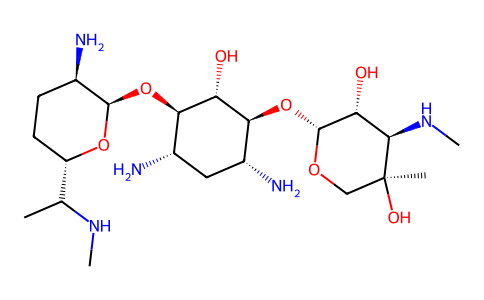
Physicochemical Properties
| Molecular Formula | C21H43N5O7 |
| Exact Mass | 477.316 |
| CAS # | 25876-10-2 |
| PubChem CID | 72395 |
| Appearance | Typically exists as solid at room temperature |
| Density | 1.3g/cm3 |
| Boiling Point | 669.4ºC at 760 mmHg |
| Melting Point | 125-130°C |
| Flash Point | 358.6ºC |
| Vapour Pressure | 8.85E-21mmHg at 25°C |
| Index of Refraction | 1.583 |
| LogP | -4.1 |
| Hydrogen Bond Donor Count | 8 |
| Hydrogen Bond Acceptor Count | 12 |
| Rotatable Bond Count | 7 |
| Heavy Atom Count | 33 |
| Complexity | 636 |
| Defined Atom Stereocenter Count | 13 |
| SMILES | CNC([C@@H]1CC[C@@H](N)[C@@H](O[C@@H]2[C@@H](N)C[C@@H](N)[C@H](O[C@H]3OC[C@](C)(O)[C@H](NC)[C@H]3O)[C@H]2O)O1)C |
| InChi Key | CEAZRRDELHUEMR-CAMVTXANSA-N |
| InChi Code | InChI=1S/C21H43N5O7/c1-9(25-3)13-6-5-10(22)19(31-13)32-16-11(23)7-12(24)17(14(16)27)33-20-15(28)18(26-4)21(2,29)8-30-20/h9-20,25-29H,5-8,22-24H2,1-4H3/t9-,10-,11+,12-,13+,14+,15-,16-,17+,18-,19-,20-,21+/m1/s1 |
| Chemical Name | (2R,3R,4R,5R)-2-[(1S,2S,3R,4S,6R)-4,6-diamino-3-[(2R,3R,6S)-3-amino-6-[(1R)-1-(methylamino)ethyl]oxan-2-yl]oxy-2-hydroxycyclohexyl]oxy-5-methyl-4-(methylamino)oxane-3,5-diol |
| HS Tariff Code | 2934.99.9001 |
| Storage |
Powder-20°C 3 years 4°C 2 years In solvent -80°C 6 months -20°C 1 month |
| Shipping Condition | Room temperature (This product is stable at ambient temperature for a few days during ordinary shipping and time spent in Customs) |
Biological Activity
| Toxicity/Toxicokinetics |
Effects During Pregnancy and Lactation ◉ Summary of Use during Lactation Gentamicin is poorly excreted into breastmilk. Newborn infants apparently absorb small amounts of gentamicin, but their serum levels with three times daily dosages are far below those attained when treating newborn infections and systemic effects of gentamicin are unlikely. Older infants would be expected to absorb even less gentamicin. Because there is little variability in the milk gentamicin levels during multiple daily dose regimens, timing breastfeeding with respect to the dose is of little or no benefit in reducing infant exposure. Data are not available with single daily dose regimens. Monitor the infant for possible effects on the gastrointestinal flora, such as diarrhea, candidiasis (e.g., thrush, diaper rash) or rarely, blood in the stool indicating possible antibiotic-associated colitis. Maternal use of an ear drop or eye drop that contains gentamicin presents little or no risk for the nursing infant. ◉ Effects in Breastfed Infants Bloody stools in one 5-day-old infant were possibly caused by concurrent maternal administration of clindamycin and gentamicin. A 2-month-old infant breastfed since birth. His mother had taken many medications during pregnancy, but she did not recall their identity. She developed mastitis and was treated with amoxicillin-clavulanic acid 1 gram orally every 12 hours and gentamicin 160 mg intramuscularly once daily. The infant was breastfed for 10 minutes starting 15 minutes after the first dose of both drugs. About 20 minutes later, the infant developed a generalized urticaria which disappeared after 30 minutes. A few hours later, the infant breastfed again and the urticaria reappeared after 15 minutes and disappeared after an hour. After switching to formula feeding and no further infant exposure to penicillins, the reaction did not reappear with follow-up to 16 months of age. The adverse reaction was probably caused by the antibiotics in breastmilk. The drug that caused the reaction cannot be determined, but it was most likely the amoxicillin-clavulanic acid. ◉ Effects on Lactation and Breastmilk Relevant published information was not found as of the revision date. |
| Additional Infomation |
Gentamicin is an antibacterial prescription medicine approved by the U.S. Food and Drug Administration (FDA) for the treatment of several infections caused by certain types of bacteria, such as meningitis, infection of the blood, and serious urinary tract infections. Some bacterial infections can be opportunistic infections (OIs) of HIV. Gentamicin C1 has been reported in Liquidambar formosana with data available. Gentamicin C1 is one of the major components of the gentamicin complex. Gentamicin C1 has a methyl group in the 6' position of the 2-amino-hexose ring and is N methylated at the same position. See also: Gentamicin (annotation moved to); Gentamicin Sulfate (annotation moved to). |
Solubility Data
| Solubility (In Vitro) | May dissolve in DMSO (in most cases), if not, try other solvents such as H2O, Ethanol, or DMF with a minute amount of products to avoid loss of samples |
| Solubility (In Vivo) |
Note: Listed below are some common formulations that may be used to formulate products with low water solubility (e.g. < 1 mg/mL), you may test these formulations using a minute amount of products to avoid loss of samples. Injection Formulations (e.g. IP/IV/IM/SC) Injection Formulation 1: DMSO : Tween 80: Saline = 10 : 5 : 85 (i.e. 100 μL DMSO stock solution → 50 μL Tween 80 → 850 μL Saline) *Preparation of saline: Dissolve 0.9 g of sodium chloride in 100 mL ddH ₂ O to obtain a clear solution. Injection Formulation 2: DMSO : PEG300 :Tween 80 : Saline = 10 : 40 : 5 : 45 (i.e. 100 μL DMSO → 400 μLPEG300 → 50 μL Tween 80 → 450 μL Saline) Injection Formulation 3: DMSO : Corn oil = 10 : 90 (i.e. 100 μL DMSO → 900 μL Corn oil) Example: Take the Injection Formulation 3 (DMSO : Corn oil = 10 : 90) as an example, if 1 mL of 2.5 mg/mL working solution is to be prepared, you can take 100 μL 25 mg/mL DMSO stock solution and add to 900 μL corn oil, mix well to obtain a clear or suspension solution (2.5 mg/mL, ready for use in animals). Injection Formulation 4: DMSO : 20% SBE-β-CD in saline = 10 : 90 [i.e. 100 μL DMSO → 900 μL (20% SBE-β-CD in saline)] *Preparation of 20% SBE-β-CD in Saline (4°C,1 week): Dissolve 2 g SBE-β-CD in 10 mL saline to obtain a clear solution. Injection Formulation 5: 2-Hydroxypropyl-β-cyclodextrin : Saline = 50 : 50 (i.e. 500 μL 2-Hydroxypropyl-β-cyclodextrin → 500 μL Saline) Injection Formulation 6: DMSO : PEG300 : castor oil : Saline = 5 : 10 : 20 : 65 (i.e. 50 μL DMSO → 100 μLPEG300 → 200 μL castor oil → 650 μL Saline) Injection Formulation 7: Ethanol : Cremophor : Saline = 10: 10 : 80 (i.e. 100 μL Ethanol → 100 μL Cremophor → 800 μL Saline) Injection Formulation 8: Dissolve in Cremophor/Ethanol (50 : 50), then diluted by Saline Injection Formulation 9: EtOH : Corn oil = 10 : 90 (i.e. 100 μL EtOH → 900 μL Corn oil) Injection Formulation 10: EtOH : PEG300:Tween 80 : Saline = 10 : 40 : 5 : 45 (i.e. 100 μL EtOH → 400 μLPEG300 → 50 μL Tween 80 → 450 μL Saline) Oral Formulations Oral Formulation 1: Suspend in 0.5% CMC Na (carboxymethylcellulose sodium) Oral Formulation 2: Suspend in 0.5% Carboxymethyl cellulose Example: Take the Oral Formulation 1 (Suspend in 0.5% CMC Na) as an example, if 100 mL of 2.5 mg/mL working solution is to be prepared, you can first prepare 0.5% CMC Na solution by measuring 0.5 g CMC Na and dissolve it in 100 mL ddH2O to obtain a clear solution; then add 250 mg of the product to 100 mL 0.5% CMC Na solution, to make the suspension solution (2.5 mg/mL, ready for use in animals). Oral Formulation 3: Dissolved in PEG400 Oral Formulation 4: Suspend in 0.2% Carboxymethyl cellulose Oral Formulation 5: Dissolve in 0.25% Tween 80 and 0.5% Carboxymethyl cellulose Oral Formulation 6: Mixing with food powders Note: Please be aware that the above formulations are for reference only. InvivoChem strongly recommends customers to read literature methods/protocols carefully before determining which formulation you should use for in vivo studies, as different compounds have different solubility properties and have to be formulated differently. (Please use freshly prepared in vivo formulations for optimal results.) |