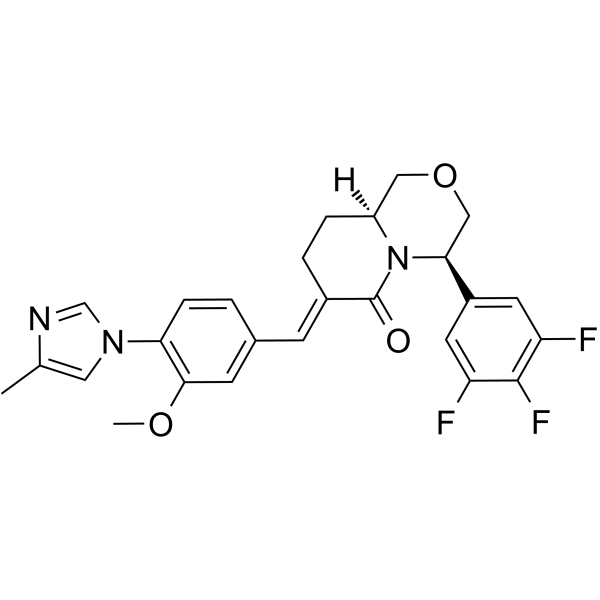
Physicochemical Properties
| Molecular Formula | C26H24N3O3F3 |
| Molecular Weight | 483.48226 |
| Exact Mass | 483.177 |
| CAS # | 937812-80-1 |
| PubChem CID | 24781184 |
| Appearance | White to off-white solid powder |
| Density | 1.37g/cm3 |
| LogP | 4.69 |
| Hydrogen Bond Donor Count | 0 |
| Hydrogen Bond Acceptor Count | 7 |
| Rotatable Bond Count | 4 |
| Heavy Atom Count | 35 |
| Complexity | 789 |
| Defined Atom Stereocenter Count | 2 |
| HS Tariff Code | 2934.99.9001 |
| Storage |
Powder-20°C 3 years 4°C 2 years In solvent -80°C 6 months -20°C 1 month Note: Please store this product in a sealed and protected environment (e.g. under nitrogen), avoid exposure to moisture. |
| Shipping Condition | Room temperature (This product is stable at ambient temperature for a few days during ordinary shipping and time spent in Customs) |
Biological Activity
| References |
[1]. Watahiki H, Yagishita S, Futai E, Ishiura S.CTF1-51, a truncated carboxyl-terminal fragment of amyloid precursor protein, suppresses the effects of Aβ42-lowering γ-secretase modulators.Neurosci Lett. 2012 Sep 27;526(2):96-9. Epub 2012 Aug 23. [2]. Wanngren J, Ottervald J, Parpal S, Portelius E, Str?mberg K, Borgeg?rd T, Klintenberg R, Juréus A, Blomqvist J, Blennow K, Zetterberg H, Lundkvist J, Rosqvist S, Karlstr?m H.Second generation γ-secretase modulators exhibit different modulation of Notch β. [3]. Wagner SL, Tanzi RE, Mobley WC, Galasko D.Potential Use of γ-Secretase Modulators in the Treatment of Alzheimer Disease.Arch Neurol. 2012 Jul 16:1-4. [4]. Bulic B, Ness J, Hahn S, Rennhack A, Jumpertz T, Weggen S.Chemical Biology, Molecular Mechanism and Clinical Perspective of γ-Secretase Modulators in Alzheimer's Disease.Curr Neuropharmacol. 2011 Dec;9(4):598-622. [5]. Kretner, Benedikt; Fukumori, Akio; Gutsmiedl, Amelie; Page, Richard M.; Luebbers, Thomas; Galley, Guido; Baumann, Karlheinz; Haass, Christian; Steiner, Harald. Attenuated A.beta.42 Responses to Low Potency .gamma.-Secretase Modulators Can Be Overcome for. |
Solubility Data
| Solubility (In Vitro) | DMSO : ≥ 100 mg/mL (~206.83 mM) |
| Solubility (In Vivo) |
Solubility in Formulation 1: ≥ 2.5 mg/mL (5.17 mM) (saturation unknown) in 10% DMSO + 40% PEG300 + 5% Tween80 + 45% Saline (add these co-solvents sequentially from left to right, and one by one), clear solution. For example, if 1 mL of working solution is to be prepared, you can add 100 μL of 25.0 mg/mL clear DMSO stock solution to 400 μL PEG300 and mix evenly; then add 50 μL Tween-80 to the above solution and mix evenly; then add 450 μL normal saline to adjust the volume to 1 mL. Preparation of saline: Dissolve 0.9 g of sodium chloride in 100 mL ddH₂ O to obtain a clear solution. Solubility in Formulation 2: ≥ 2.5 mg/mL (5.17 mM) (saturation unknown) in 10% DMSO + 90% (20% SBE-β-CD in Saline) (add these co-solvents sequentially from left to right, and one by one), clear solution. For example, if 1 mL of working solution is to be prepared, you can add 100 μL of 25.0 mg/mL clear DMSO stock solution to 900 μL of 20% SBE-β-CD physiological saline solution and mix evenly. Preparation of 20% SBE-β-CD in Saline (4°C,1 week): Dissolve 2 g SBE-β-CD in 10 mL saline to obtain a clear solution. Solubility in Formulation 3: ≥ 2.5 mg/mL (5.17 mM) (saturation unknown) in 10% DMSO + 90% Corn Oil (add these co-solvents sequentially from left to right, and one by one), clear solution. For example, if 1 mL of working solution is to be prepared, you can add 100 μL of 25.0 mg/mL clear DMSO stock solution to 900 μL of corn oil and mix evenly. (Please use freshly prepared in vivo formulations for optimal results.) |
| Preparing Stock Solutions | 1 mg | 5 mg | 10 mg | |
| 1 mM | 2.0683 mL | 10.3417 mL | 20.6834 mL | |
| 5 mM | 0.4137 mL | 2.0683 mL | 4.1367 mL | |
| 10 mM | 0.2068 mL | 1.0342 mL | 2.0683 mL |