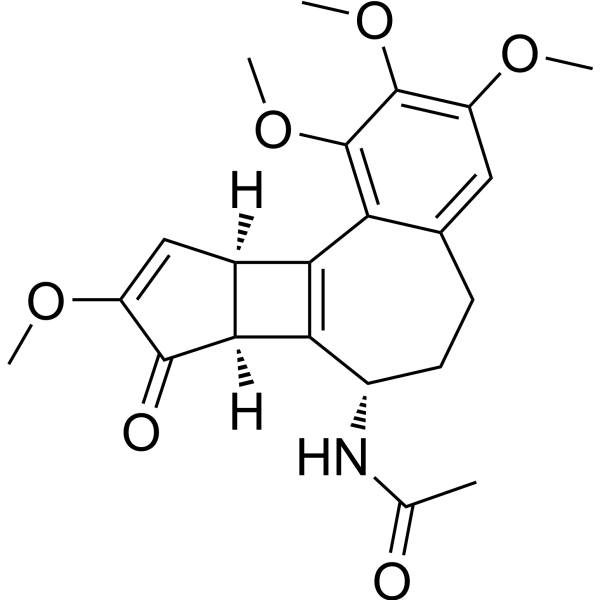
Physicochemical Properties
| Molecular Formula | C22H25NO6 |
| Molecular Weight | 399.437 |
| Exact Mass | 399.168 |
| Elemental Analysis | C, 66.15; H, 6.31; N, 3.51; O, 24.03 |
| CAS # | 6901-14-0 |
| Related CAS # | 6901-13-9; 6901-14-0 |
| PubChem CID | 244898 |
| Appearance | White to off-white solid powder |
| Density | 1.3g/cm3 |
| Boiling Point | 623.2ºC at 760 mmHg |
| Melting Point | 268ºC |
| Flash Point | 330.7ºC |
| Index of Refraction | 1.596 |
| LogP | 2.666 |
| Hydrogen Bond Donor Count | 1 |
| Hydrogen Bond Acceptor Count | 6 |
| Rotatable Bond Count | 5 |
| Heavy Atom Count | 29 |
| Complexity | 758 |
| Defined Atom Stereocenter Count | 3 |
| SMILES | CC(=O)NC1CCC2=CC(=C(C(=C2C3=C1C4C3C=C(C4=O)OC)OC)OC)OC |
| InChi Key | VKPVZFOUXUQJMW-FHSNZYRGSA-N |
| InChi Code | InChI=1S/C22H25NO6/c1-10(24)23-13-7-6-11-8-15(27-3)21(28-4)22(29-5)16(11)17-12-9-14(26-2)20(25)18(12)19(13)17/h8-9,12-13,18H,6-7H2,1-5H3,(H,23,24)/t12-,13+,18-/m1/s1 |
| Chemical Name | N-[(10S,12R,16S)-3,4,5,14-tetramethoxy-13-oxo-10-tetracyclo[9.5.0.02,7.012,16]hexadeca-1(11),2,4,6,14-pentaenyl]acetamide |
| Synonyms | gamma-Lumicolchicine; 6901-14-0; EINECS 230-009-7; N-(3,4,5,14-tetramethoxy-13-oxo-10-tetracyclo[9.5.0.02,7.012,16]hexadeca-1(11),2,4,6,14-pentaenyl)acetamide; 490-24-4; Lumicolchicines; gamma Lumicolchicine; N-(3,4,5,14-tetramethoxy-13-oxo-10-tetracyclo(9.5.0.02,7.012,16)hexadeca-1(11),2,4,6,14-pentaenyl)acetamide; |
| HS Tariff Code | 2934.99.9001 |
| Storage |
Powder-20°C 3 years 4°C 2 years In solvent -80°C 6 months -20°C 1 month |
| Shipping Condition | Room temperature (This product is stable at ambient temperature for a few days during ordinary shipping and time spent in Customs) |
Biological Activity
| Targets | Inactive form of Colchicine |
| ln Vitro | As an additional control, γ-lumicolchicine, an inactive analog of colchicine, was also used to treat α2β-expressing HEK cells (Fig 4A). These brief treatments had no obvious effect on the survival of untransfected cells. There was a trend for colchicine treatment to reduce the overall current density at 300 μM glycine, 56.7 ± 9.1 pA/pF in control cells (n = 8), 41.2 ± 2.3 pA/pF in colchicine-treated cells (n = 10), and 50.1 ± 9.9 pA/pF (n = 6) in γ-lumicolchicine-treated cells; however, this was not significant (p > 0.05, ANOVA) and was probably not related to any direct action of colchicine given that the glycine current density was also slightly reduced in α2β-expressing cells exposed to γ-lumicolchicine compared to controls. However, the efficacy of both taurine (p < 0.01, One-way ANOVA) and β-alanine (p < 0.05, ANOVA) were significantly decreased by colchicine but not γ-lumicolchicine treatment. Taurine efficacy was 33 ± 6% of glycine in controls, 13 ± 3% following colchicine, and 28 ± 3% following γ-lumicolchicine. Similarly, β-alanine efficacy was 70 ± 7% of glycine in controls, 49 ± 6% following colchicine, and 72 ± 7% following γ-lumicolchicine. Similar treatment of α2-expressing HEK cells with colchicine (Fig. 4B) did not reveal any significant effect on glycine current density (54 ± 14 pA/pF in controls, 60 ± 15 pA/pF in treated), on taurine efficacy (34 ± 16% in controls vs. 38 ± 10% in treated), or on β-alanine efficacy (71 ± 12% in controls vs. 86 ± 8% in treated). Cholchicine treatment also significantly reduced β-alanine efficacy in L-cells expressing GlyRα2β (23 ± 2% in controls vs. 12 ± 3% in treated, P < 0.05, t-test) but not in GlyRα2-expressing L-cells (Fig. 4C). We did not attempt to examine taurine in L-cells treated with colchicine given the exceptionally low efficacy of receptors expressed in this cell line [1]. |
| References | [1]. Extrinsic factors regulate partial agonist efficacy of strychnine-sensitive glycine receptors. BMC Pharmacol. 2004 Aug 9;4:16. |
| Additional Infomation |
LSM-4236 is a carbotricyclic compound, a member of acetamides and an alkaloid. beta-Lumicolchicine has been reported in Colchicum arenarium, Colchicum autumnale, and other organisms with data available. Three, alpha, beta, and gamma isomers of ultraviolet degradation products of colchicine that lack many of the physiological actions of the parent; used as experimental control for colchicine actions. See also: gamma-Lumicolchicine (annotation moved to). Background: Strychnine-sensitive glycine receptors in many adult forebrain regions consist of alpha2 + beta heteromeric channels. This subunit composition is distinct from the alpha1 + beta channels found throughout the adult spinal cord. Unfortunately, the pharmacology of forebrain alpha2beta receptors are poorly defined compared to 'neonatal' alpha2 homomeric channels or 'spinal' alpha1beta heteromers. In addition, the pharmacologic properties of native alpha2beta glycine receptors have been generally distinct from receptors produced by heterologous expression. To identify subtype-specific pharmacologic tools for the forebrain alpha2beta receptors, it is important to identify a heterologous expression system that closely resembles these native glycine-gated chloride channels. Results: While exploring pharmacological properties of alpha2beta glycine receptors compared to alpha2-homomers, we found that distinct heterologous expression systems appeared to differentially influence partial agonist pharmacology. The beta-amino acid taurine possessed 30-50% efficacy for alpha2-containing receptor isoforms when expressed in HEK 293 cells. However, taurine efficacy was dramatically reduced in L-cell fibroblasts. Similar results were obtained for beta-alanine. The efficacy of these partial agonists was also strongly reduced by the beta subunit. There were no significant differences in apparent strychnine affinity values calculated from concentration-response data between expression systems or subunit combinations. Nor did relative levels of expression correlate with partial agonist efficacy when compared within or between several different expression systems. Finally, disruption of the tubulin cytoskeleton reduced the efficacy of partial agonists in a subunit-dependent, but system-independent, fashion. Conclusions: Our results suggest that different heterologous expression systems can dramatically influence the agonist pharmacology of strychnine-sensitive glycine receptors. In the systems examine here, these effects are independent of both absolute expression level and any system-related alterations in the agonist binding site. We conclude that complex interactions between receptor composition and extrinsic factors may play a significant role in determining strychnine-sensitive glycine receptor partial agonist pharmacology.[1] |
Solubility Data
| Solubility (In Vitro) | May dissolve in DMSO (in most cases), if not, try other solvents such as H2O, Ethanol, or DMF with a minute amount of products to avoid loss of samples |
| Solubility (In Vivo) |
Note: Listed below are some common formulations that may be used to formulate products with low water solubility (e.g. < 1 mg/mL), you may test these formulations using a minute amount of products to avoid loss of samples. Injection Formulations (e.g. IP/IV/IM/SC) Injection Formulation 1: DMSO : Tween 80: Saline = 10 : 5 : 85 (i.e. 100 μL DMSO stock solution → 50 μL Tween 80 → 850 μL Saline) *Preparation of saline: Dissolve 0.9 g of sodium chloride in 100 mL ddH ₂ O to obtain a clear solution. Injection Formulation 2: DMSO : PEG300 :Tween 80 : Saline = 10 : 40 : 5 : 45 (i.e. 100 μL DMSO → 400 μLPEG300 → 50 μL Tween 80 → 450 μL Saline) Injection Formulation 3: DMSO : Corn oil = 10 : 90 (i.e. 100 μL DMSO → 900 μL Corn oil) Example: Take the Injection Formulation 3 (DMSO : Corn oil = 10 : 90) as an example, if 1 mL of 2.5 mg/mL working solution is to be prepared, you can take 100 μL 25 mg/mL DMSO stock solution and add to 900 μL corn oil, mix well to obtain a clear or suspension solution (2.5 mg/mL, ready for use in animals). Injection Formulation 4: DMSO : 20% SBE-β-CD in saline = 10 : 90 [i.e. 100 μL DMSO → 900 μL (20% SBE-β-CD in saline)] *Preparation of 20% SBE-β-CD in Saline (4°C,1 week): Dissolve 2 g SBE-β-CD in 10 mL saline to obtain a clear solution. Injection Formulation 5: 2-Hydroxypropyl-β-cyclodextrin : Saline = 50 : 50 (i.e. 500 μL 2-Hydroxypropyl-β-cyclodextrin → 500 μL Saline) Injection Formulation 6: DMSO : PEG300 : castor oil : Saline = 5 : 10 : 20 : 65 (i.e. 50 μL DMSO → 100 μLPEG300 → 200 μL castor oil → 650 μL Saline) Injection Formulation 7: Ethanol : Cremophor : Saline = 10: 10 : 80 (i.e. 100 μL Ethanol → 100 μL Cremophor → 800 μL Saline) Injection Formulation 8: Dissolve in Cremophor/Ethanol (50 : 50), then diluted by Saline Injection Formulation 9: EtOH : Corn oil = 10 : 90 (i.e. 100 μL EtOH → 900 μL Corn oil) Injection Formulation 10: EtOH : PEG300:Tween 80 : Saline = 10 : 40 : 5 : 45 (i.e. 100 μL EtOH → 400 μLPEG300 → 50 μL Tween 80 → 450 μL Saline) Oral Formulations Oral Formulation 1: Suspend in 0.5% CMC Na (carboxymethylcellulose sodium) Oral Formulation 2: Suspend in 0.5% Carboxymethyl cellulose Example: Take the Oral Formulation 1 (Suspend in 0.5% CMC Na) as an example, if 100 mL of 2.5 mg/mL working solution is to be prepared, you can first prepare 0.5% CMC Na solution by measuring 0.5 g CMC Na and dissolve it in 100 mL ddH2O to obtain a clear solution; then add 250 mg of the product to 100 mL 0.5% CMC Na solution, to make the suspension solution (2.5 mg/mL, ready for use in animals). Oral Formulation 3: Dissolved in PEG400 Oral Formulation 4: Suspend in 0.2% Carboxymethyl cellulose Oral Formulation 5: Dissolve in 0.25% Tween 80 and 0.5% Carboxymethyl cellulose Oral Formulation 6: Mixing with food powders Note: Please be aware that the above formulations are for reference only. InvivoChem strongly recommends customers to read literature methods/protocols carefully before determining which formulation you should use for in vivo studies, as different compounds have different solubility properties and have to be formulated differently. (Please use freshly prepared in vivo formulations for optimal results.) |
| Preparing Stock Solutions | 1 mg | 5 mg | 10 mg | |
| 1 mM | 2.5035 mL | 12.5175 mL | 25.0350 mL | |
| 5 mM | 0.5007 mL | 2.5035 mL | 5.0070 mL | |
| 10 mM | 0.2504 mL | 1.2518 mL | 2.5035 mL |