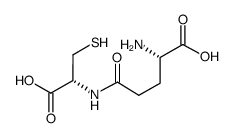
Gamma-glutamylcysteine (amma-Glu-Cys) is a substrate for biosynthesis of L-glutathione by glutathione synthetase. It is a dipeptide acting as an essential cofactor for the antioxidant enzyme glutathione peroxidase (GPx). It can also increase anti-inflammatory cytokines such as IL-10 and reduce pro-inflammatory cytokines (TNF-α, IL-6, and IL-1β).
Physicochemical Properties
| Molecular Formula | C8H14N2O5S |
| Molecular Weight | 250.2722 |
| Exact Mass | 250.062 |
| CAS # | 636-58-8 |
| PubChem CID | 123938 |
| Appearance | White to off-white solid powder |
| Density | 1.436g/cm3 |
| Boiling Point | 592.4ºC at 760 mmHg |
| Melting Point | 167℃ |
| Flash Point | 312.1ºC |
| Index of Refraction | 1.57 |
| LogP | -3.8 |
| Hydrogen Bond Donor Count | 5 |
| Hydrogen Bond Acceptor Count | 7 |
| Rotatable Bond Count | 7 |
| Heavy Atom Count | 16 |
| Complexity | 284 |
| Defined Atom Stereocenter Count | 2 |
| SMILES | S([H])C([H])([H])[C@@]([H])(C(=O)O[H])N([H])C(C([H])([H])C([H])([H])[C@@]([H])(C(=O)O[H])N([H])[H])=O |
| InChi Key | RITKHVBHSGLULN-WHFBIAKZSA-N |
| InChi Code | InChI=1S/C8H14N2O5S/c9-4(7(12)13)1-2-6(11)10-5(3-16)8(14)15/h4-5,16H,1-3,9H2,(H,10,11)(H,12,13)(H,14,15)/t4-,5-/m0/s1 |
| Chemical Name | (2S)-2-amino-5-[[(1R)-1-carboxy-2-sulfanylethyl]amino]-5-oxopentanoic acid |
| HS Tariff Code | 2934.99.9001 |
| Storage |
Powder-20°C 3 years 4°C 2 years In solvent -80°C 6 months -20°C 1 month |
| Shipping Condition | Room temperature (This product is stable at ambient temperature for a few days during ordinary shipping and time spent in Customs) |
Biological Activity
| ln Vitro | The antioxidant enzymes superoxide dismutase (SOD) and glutathione peroxidase (GPx) were activated when 200 μM gamma-glutamylcysteine was co-treated with Aβ40 oligomers. This also led to a considerable rise in total antioxidant levels (TAC) and GSH, as well as a decrease in the GSSG/GSH ratio. Additionally, gamma-glutamylcysteine reduces the levels of pro-inflammatory cytokines (TNF-α, IL-6, and IL-1β), increases the anti-inflammatory cytokine IL-10, and attenuates alterations in metalloproteinase activity in astrocytes treated with oligomeric Aβ40[1]. |
| References |
[1]. The Precursor to Glutathione (GSH), γ-Glutamylcysteine (GGC), Can Ameliorate Oxidative Damage and Neuroinflammation Induced by Aβ40 Oligomers in Human Astrocytes. Front Aging Neurosci. 2019 Aug 8;11:177. |
| Additional Infomation |
L-gamma-glutamyl-L-cysteine is a molecular entity formed when L-cysteine amino group binds to the gamma-carbonyl of L-glutamic acid. It has a role as a human metabolite, a Saccharomyces cerevisiae metabolite, an Escherichia coli metabolite and a mouse metabolite. It is functionally related to a L-glutamic acid and a L-cysteine. It is a conjugate acid of a L-gamma-glutamyl-L-cysteinate(1-). gamma-Glutamylcysteine is a metabolite found in or produced by Escherichia coli (strain K12, MG1655). gamma-Glutamylcysteine has been reported in Homo sapiens, Vitis vinifera, and other organisms with data available. Gamma-Glutamylcysteine is a metabolite found in or produced by Saccharomyces cerevisiae. |
Solubility Data
| Solubility (In Vitro) | H2O : ~100 mg/mL (~399.57 mM) |
| Solubility (In Vivo) |
Solubility in Formulation 1: 100 mg/mL (399.57 mM) in PBS (add these co-solvents sequentially from left to right, and one by one), clear solution; with sonication. (Please use freshly prepared in vivo formulations for optimal results.) |
| Preparing Stock Solutions | 1 mg | 5 mg | 10 mg | |
| 1 mM | 3.9957 mL | 19.9784 mL | 39.9568 mL | |
| 5 mM | 0.7991 mL | 3.9957 mL | 7.9914 mL | |
| 10 mM | 0.3996 mL | 1.9978 mL | 3.9957 mL |