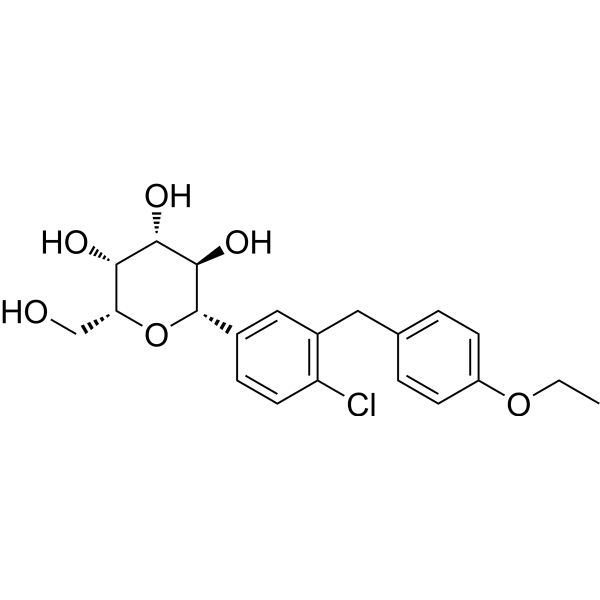
Physicochemical Properties
| Molecular Formula | C21H25CLO6 |
| Molecular Weight | 408.87 |
| Exact Mass | 408.133 |
| CAS # | 1408245-02-2 |
| PubChem CID | 124583070 |
| Appearance | Typically exists as solid at room temperature |
| Density | 1.3±0.1 g/cm3 |
| Boiling Point | 609.0±55.0 °C at 760 mmHg |
| Flash Point | 322.1±31.5 °C |
| Vapour Pressure | 0.0±1.8 mmHg at 25°C |
| Index of Refraction | 1.614 |
| LogP | 4.42 |
| Hydrogen Bond Donor Count | 4 |
| Hydrogen Bond Acceptor Count | 6 |
| Rotatable Bond Count | 6 |
| Heavy Atom Count | 28 |
| Complexity | 472 |
| Defined Atom Stereocenter Count | 5 |
| SMILES | CCOC1=CC=C(C=C1)CC2=C(C=CC(=C2)[C@H]3[C@@H]([C@H]([C@H]([C@H](O3)CO)O)O)O)Cl |
| InChi Key | JVHXJTBJCFBINQ-IFLJBQAJSA-N |
| InChi Code | InChI=1S/C21H25ClO6/c1-2-27-15-6-3-12(4-7-15)9-14-10-13(5-8-16(14)22)21-20(26)19(25)18(24)17(11-23)28-21/h3-8,10,17-21,23-26H,2,9,11H2,1H3/t17-,18+,19+,20-,21+/m1/s1 |
| Chemical Name | (2S,3R,4R,5R,6R)-2-[4-chloro-3-[(4-ethoxyphenyl)methyl]phenyl]-6-(hydroxymethyl)oxane-3,4,5-triol |
| Synonyms | galacto-Dapagliflozin; 1408245-02-2; (1S)-1,5-anhydro-1-C-[4-chloro-3-[(4-ethoxyphenyl)methyl]phenyl]-D-galactitol; (2S,3R,4R,5R,6R)-2-[4-chloro-3-[(4-ethoxyphenyl)methyl]phenyl]-6-(hydroxymethyl)oxane-3,4,5-triol; HY-137145; CS-0136767; (2S,3R,4R,5R,6R)-2-(4-Chloro-3-(4-ethoxybenzyl)phenyl)-6-(hydroxymethyl)tetrahydro-2H-pyran-3,4,5-triol |
| HS Tariff Code | 2934.99.9001 |
| Storage |
Powder-20°C 3 years 4°C 2 years In solvent -80°C 6 months -20°C 1 month |
| Shipping Condition | Room temperature (This product is stable at ambient temperature for a few days during ordinary shipping and time spent in Customs) |
Biological Activity
| Targets | hSGLT2 25 nM (Ki) hSGLT1 25000 nM (Ki) |
| ln Vitro | Human Na(+)-D-glucose cotransporter (hSGLT) inhibitors constitute the newest class of diabetes drugs, blocking up to 50% of renal glucose reabsorption in vivo. These drugs have potential for widespread use in the diabetes epidemic, but how they work at a molecular level is poorly understood. Here, we use electrophysiological methods to assess how they block Na(+)-D-glucose cotransporter SGLT1 and SGLT2 expressed in human embryonic kidney 293T (HEK-293T) cells and compared them to the classic SGLT inhibitor phlorizin. Dapagliflozin [(1S)-1,5,5-anhydro-1-C-{4-chloro-3-[(4-ethoxyphenyl)methyl]phenyl}-D-glucitol], two structural analogs, and the aglycones of phlorizin and dapagliflozin were investigated in detail. Dapagliflozin and fluoro-dapagliflozin [(1S)-1,5-anhydro-1-C-{4-chloro-3-[(4-ethoxyphenyl)methyl]phenyl}-4-F-4-deoxy-D-glucitol] blocked glucose transport and glucose-coupled currents with ≈100-fold specificity for hSGLT2 (K(i) = 6 nM) over hSGLT1 (K(i) = 400 nM). As galactose is a poor substrate for SGLT2, it was surprising that galacto-dapagliflozin [(1S)-1,5-anhydro-1-C-{4-chloro-3-[(4-ethoxyphenyl)methyl]phenyl}-D-galactitol] was a selective inhibitor of hSGLT2, but was less potent than dapagliflozin for both transporters (hSGLT2 K(i) = 25 nM, hSGLT1 K(i) = 25,000 nM). Phlorizin and galacto-dapagliflozin rapidly dissociated from SGLT2 [half-time off rate (t(1/2,Off)) ≈ 20-30 s], while dapagliflozin and fluoro-dapagliflozin dissociated from hSGLT2 at a rate 10-fold slower (t(1/2,Off) ≥ 180 s). Phlorizin was unable to exchange with dapagliflozin bound to hSGLT2. In contrast, dapagliflozin, fluoro-dapagliflozin, and galacto-dapagliflozin dissociated quickly from hSGLT1 (t(1/2,Off) = 1-2 s), and phlorizin readily exchanged with dapagliflozin bound to hSGLT1. The aglycones of phlorizin and dapagliflozin were poor inhibitors of both hSGLT2 and hSGLT1 with K(i) values > 100 μM. These results show that inhibitor binding to SGLTs is composed of two synergistic forces: sugar binding to the glucose site, which is not rigid, and so different sugars will change the orientation of the aglycone in the access vestibule; and the binding of the aglycone affects the binding affinity of the entire inhibitor. Therefore, the pharmacophore must include variations in both the structure of the sugar and the aglycone [1]. |
| Enzyme Assay |
Radioactive Tracer Determinations [1] [14C]α-methyl-d-glucopyranoside (α-MDG) uptakes into COS-1 cells expressing hSGLT2 or hSGLT1 were measured as described. Cells were incubated in sodium buffer with 50 μM [14C]α-MDG at 37°C for 1–40 min in the presence or absence of inhibitors: 100 μM phlorizin and 10 nM or 1 μM of each hSGLT2 inhibitor (dapagliflozin, fluoro-dapagliflozin, or galacto-dapagliflozin). Uptakes were expressed as picomoles per minute per microgram total protein, mean ± SE (Fig. 1). [14C]α-MDG uptakes were linear for 15 min for hSGLT2 and 2 min for hSGLT1, and so the effects of inhibitors on initial rates of uptake were determined at 10 min for hSGLT2 and 1 min for hSGLT1. Electrophysiological Experiments Whole cell patch-clamp recordings were performed on HEK-293T cells 2 days posttransfection. The extracellular solution contained (in mM) 150 NaCl, 1 CaCl2, 1 MgCl2, 10 HEPES, pH 7.4 (“Na+ buffer”), or 150 choline chloride, 1 CaCl2, 1 MgCl2, pH 7.4 (“choline+” buffer). For experiments at 37°C, mannitol (100 mM) was added to the external solution to reduce noise and increase the stability of the whole cell recordings. The pipette (internal) solution contained (in mM) 145 CsCl, 5 NaCl, 11 EGTA, and 10 HEPES. Membrane potential was held at −60 mV. For hSGLT2, all experiments were performed at 37°C, and for hSGLT1, at 37 or 22°C. Inhibitor Kinetics [1] Our general approach to the interaction of inhibitors with the SGLTs followed that used previously by Oulianova et al. to investigate phlorizin binding to SGLTs in rabbit renal brush-border membranes, but here we measure binding to specific human SGLTs using electrophysiological assays. Inhibition of steady-state, glucose-induced hSGLT current was measured as a function of external inhibitor concentration to determine the inhibition constant Ki. As described previously, when the glucose concentration is equal to the sugar half-maximal inhibition constant (K0.5), the concentration of the inhibitor producing 50% inhibition (IC50) is twice the Ki. The hSGLT2 d-glucose K0.5 was 5 mM at 37°C and for hSGLT1 it was 2 mM at 37°C and 0.5 mM at 22°C. [1] The sequence of each experiment was as follows. Current was induced by the K0.5 concentration of d-glucose. The solution was changed to d-glucose plus inhibitor. Once a new steady-state current was achieved, the cell was washed with d-glucose and Na+-free (choline+) buffer for ≥3 min to remove the inhibitor. This protocol was repeated at multiple inhibitor concentrations to estimate the Ki. [1] Some of the hSGLT1 galacto-dapagliflozin Ki determinations were performed using the two-electrode voltage clamp on Xenopus laevis oocytes expressing hSGLT1 to minimize the quantity of the inhibitor needed to complete the experiments. Oocyte isolation, preparation, injections, and electrophysiological methods were performed as described previously |
| References |
[1]. Structural selectivity of human SGLT inhibitors. Am J Physiol Cell Physiol. 2012 Jan 15;302(2):C373-82. |
| Additional Infomation |
Aside from dapagliflozin, there currently is a paucity of published data on other hSGLT2 inhibitors. In only one study has the major functional differences between dapagliflozin and canagliflozin been reported: whereas the potency and specificity of canagliflozin in vitro are very similar to dapagliflozin, hSGLT2 Ki = 2 nM, hSGLT1 Ki = 1,000 nM , significantly higher oral doses of canagliflozin than dapagliflozin are required to produce equivalent effects on renal glucose excretion. Kinetic specificity for hSGLT2 vs. SGLT1 alone cannot explain this discrepancy at this time, and so other pharmacokinetic factors must be in play.[1] In summary, the high affinity of dapagliflozin for hSGLT2 is the result of its tight binding, reflected by its surprisingly slow dissociation from the transporter, and this is the biophysical basis for the difference in dapagliflozin affinity between hSGLT1 and hSGLT2. Inhibitor affinity is the result of a synergistic relationship between binding sites for sugar and the aglycone, with alterations in the sugar resulting in surprising differences in selectivity. The sugar moiety has an important role in determining inhibitor specificity and is likely essential for positioning of the aglycone for interaction with residues in the sugar pathway, and the aglycone also influences the inhibitor interaction in ways we have yet to determine.[1] |
Solubility Data
| Solubility (In Vitro) | May dissolve in DMSO (in most cases), if not, try other solvents such as H2O, Ethanol, or DMF with a minute amount of products to avoid loss of samples |
| Solubility (In Vivo) |
Note: Listed below are some common formulations that may be used to formulate products with low water solubility (e.g. < 1 mg/mL), you may test these formulations using a minute amount of products to avoid loss of samples. Injection Formulations (e.g. IP/IV/IM/SC) Injection Formulation 1: DMSO : Tween 80: Saline = 10 : 5 : 85 (i.e. 100 μL DMSO stock solution → 50 μL Tween 80 → 850 μL Saline) *Preparation of saline: Dissolve 0.9 g of sodium chloride in 100 mL ddH ₂ O to obtain a clear solution. Injection Formulation 2: DMSO : PEG300 :Tween 80 : Saline = 10 : 40 : 5 : 45 (i.e. 100 μL DMSO → 400 μLPEG300 → 50 μL Tween 80 → 450 μL Saline) Injection Formulation 3: DMSO : Corn oil = 10 : 90 (i.e. 100 μL DMSO → 900 μL Corn oil) Example: Take the Injection Formulation 3 (DMSO : Corn oil = 10 : 90) as an example, if 1 mL of 2.5 mg/mL working solution is to be prepared, you can take 100 μL 25 mg/mL DMSO stock solution and add to 900 μL corn oil, mix well to obtain a clear or suspension solution (2.5 mg/mL, ready for use in animals). Injection Formulation 4: DMSO : 20% SBE-β-CD in saline = 10 : 90 [i.e. 100 μL DMSO → 900 μL (20% SBE-β-CD in saline)] *Preparation of 20% SBE-β-CD in Saline (4°C,1 week): Dissolve 2 g SBE-β-CD in 10 mL saline to obtain a clear solution. Injection Formulation 5: 2-Hydroxypropyl-β-cyclodextrin : Saline = 50 : 50 (i.e. 500 μL 2-Hydroxypropyl-β-cyclodextrin → 500 μL Saline) Injection Formulation 6: DMSO : PEG300 : castor oil : Saline = 5 : 10 : 20 : 65 (i.e. 50 μL DMSO → 100 μLPEG300 → 200 μL castor oil → 650 μL Saline) Injection Formulation 7: Ethanol : Cremophor : Saline = 10: 10 : 80 (i.e. 100 μL Ethanol → 100 μL Cremophor → 800 μL Saline) Injection Formulation 8: Dissolve in Cremophor/Ethanol (50 : 50), then diluted by Saline Injection Formulation 9: EtOH : Corn oil = 10 : 90 (i.e. 100 μL EtOH → 900 μL Corn oil) Injection Formulation 10: EtOH : PEG300:Tween 80 : Saline = 10 : 40 : 5 : 45 (i.e. 100 μL EtOH → 400 μLPEG300 → 50 μL Tween 80 → 450 μL Saline) Oral Formulations Oral Formulation 1: Suspend in 0.5% CMC Na (carboxymethylcellulose sodium) Oral Formulation 2: Suspend in 0.5% Carboxymethyl cellulose Example: Take the Oral Formulation 1 (Suspend in 0.5% CMC Na) as an example, if 100 mL of 2.5 mg/mL working solution is to be prepared, you can first prepare 0.5% CMC Na solution by measuring 0.5 g CMC Na and dissolve it in 100 mL ddH2O to obtain a clear solution; then add 250 mg of the product to 100 mL 0.5% CMC Na solution, to make the suspension solution (2.5 mg/mL, ready for use in animals). Oral Formulation 3: Dissolved in PEG400 Oral Formulation 4: Suspend in 0.2% Carboxymethyl cellulose Oral Formulation 5: Dissolve in 0.25% Tween 80 and 0.5% Carboxymethyl cellulose Oral Formulation 6: Mixing with food powders Note: Please be aware that the above formulations are for reference only. InvivoChem strongly recommends customers to read literature methods/protocols carefully before determining which formulation you should use for in vivo studies, as different compounds have different solubility properties and have to be formulated differently. (Please use freshly prepared in vivo formulations for optimal results.) |
| Preparing Stock Solutions | 1 mg | 5 mg | 10 mg | |
| 1 mM | 2.4458 mL | 12.2288 mL | 24.4577 mL | |
| 5 mM | 0.4892 mL | 2.4458 mL | 4.8915 mL | |
| 10 mM | 0.2446 mL | 1.2229 mL | 2.4458 mL |