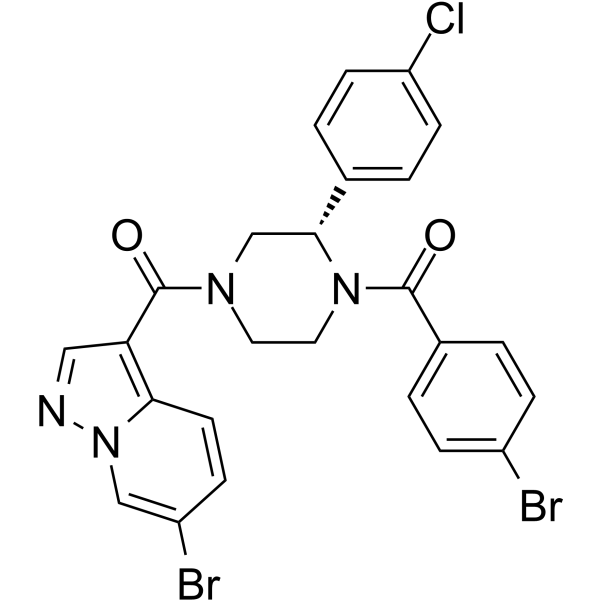
Physicochemical Properties
| Molecular Formula | C25H19BR2CLN4O2 |
| Molecular Weight | 602.704962968826 |
| Exact Mass | 601.954 |
| CAS # | 2095677-20-4 |
| Related CAS # | (R)-eIF4A3-IN-2;2095484-82-3 |
| PubChem CID | 131953885 |
| Appearance | White to light yellow solid powder |
| LogP | 5 |
| Hydrogen Bond Donor Count | 0 |
| Hydrogen Bond Acceptor Count | 3 |
| Rotatable Bond Count | 3 |
| Heavy Atom Count | 34 |
| Complexity | 744 |
| Defined Atom Stereocenter Count | 1 |
| SMILES | BrC1C=CC2=C(C=NN2C=1)C(N1CCN(C(C2C=CC(=CC=2)Br)=O)[C@@H](C2C=CC(=CC=2)Cl)C1)=O |
| InChi Key | WKKAVTNXNVPCCN-HSZRJFAPSA-N |
| InChi Code | InChI=1S/C25H19Br2ClN4O2/c26-18-5-1-17(2-6-18)24(33)31-12-11-30(15-23(31)16-3-8-20(28)9-4-16)25(34)21-13-29-32-14-19(27)7-10-22(21)32/h1-10,13-14,23H,11-12,15H2/t23-/m1/s1 |
| Chemical Name | (4-bromophenyl)-[(2S)-4-(6-bromopyrazolo[1,5-a]pyridine-3-carbonyl)-2-(4-chlorophenyl)piperazin-1-yl]methanone |
| HS Tariff Code | 2934.99.9001 |
| Storage |
Powder-20°C 3 years 4°C 2 years In solvent -80°C 6 months -20°C 1 month |
| Shipping Condition | Room temperature (This product is stable at ambient temperature for a few days during ordinary shipping and time spent in Customs) |
Biological Activity
| ln Vitro | eIF4A3-IN-2 (Compound 2) binds to the allosteric region of eIF4A3 and, in vitro, inhibits the activities of ATPase, helicase, and cellular nonsense-mediated RNA decay (NMD) [1]. |
| Cell Assay |
Apoptosis analysis [1] Cell Types: HEK293T cells (transfected with NMD reporter gene) Luciferase assay Tested Concentrations: 0.3, 1, 3 or 10 μM Incubation Duration: 3 or 6 hrs (hours) Experimental Results: eIF4A3-IN-2 induces apoptosis The luciferase activity increased approximately 3.2 times, indicating that NMD was inhibited by compound 2[1]. |
| References |
[1]. Discovery and Characterization of a Eukaryotic Initiation Factor 4A-3-Selective Inhibitor That Suppresses Nonsense-Mediated mRNA Decay. ACS Chem Biol. 2017 Jul 21;12(7):1760-1768. |
Solubility Data
| Solubility (In Vitro) | DMSO : ~100 mg/mL (~165.92 mM) |
| Solubility (In Vivo) |
Solubility in Formulation 1: 2.5 mg/mL (4.15 mM) in 5% DMSO + 40% PEG300 + 5% Tween80 + 50% Saline (add these co-solvents sequentially from left to right, and one by one), suspension solution; with sonication. Preparation of saline: Dissolve 0.9 g of sodium chloride in 100 mL ddH₂ O to obtain a clear solution. Solubility in Formulation 2: ≥ 1.67 mg/mL (2.77 mM) (saturation unknown) in 10% DMSO + 40% PEG300 + 5% Tween80 + 45% Saline (add these co-solvents sequentially from left to right, and one by one), clear solution. For example, if 1 mL of working solution is to be prepared, you can add 100 μL of 16.7 mg/mL clear DMSO stock solution to 400 μL PEG300 and mix evenly; then add 50 μL Tween-80 to the above solution and mix evenly; then add 450 μL normal saline to adjust the volume to 1 mL. Preparation of saline: Dissolve 0.9 g of sodium chloride in 100 mL ddH₂ O to obtain a clear solution. Solubility in Formulation 3: ≥ 1.67 mg/mL (2.77 mM) (saturation unknown) in 10% DMSO + 90% Corn Oil (add these co-solvents sequentially from left to right, and one by one), clear solution. For example, if 1 mL of working solution is to be prepared, you can add 100 μL of 16.7 mg/mL clear DMSO stock solution to 900 μL of corn oil and mix evenly. (Please use freshly prepared in vivo formulations for optimal results.) |
| Preparing Stock Solutions | 1 mg | 5 mg | 10 mg | |
| 1 mM | 1.6592 mL | 8.2959 mL | 16.5917 mL | |
| 5 mM | 0.3318 mL | 1.6592 mL | 3.3183 mL | |
| 10 mM | 0.1659 mL | 0.8296 mL | 1.6592 mL |