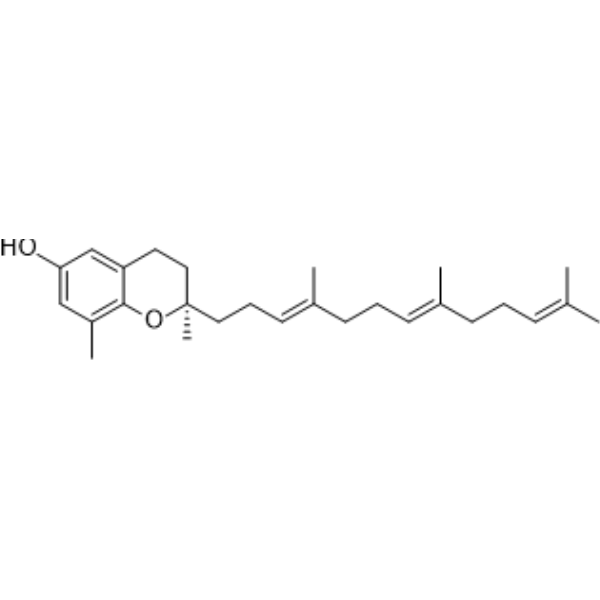
Physicochemical Properties
| Molecular Formula | C27H40O2 |
| Molecular Weight | 396.61 |
| Exact Mass | 396.302 |
| CAS # | 25612-59-3 |
| PubChem CID | 5282350 |
| Appearance | Colorless to light yellow liquid |
| Density | 1.0±0.1 g/cm3 |
| Boiling Point | 517.3±39.0 °C at 760 mmHg |
| Flash Point | 212.8±21.3 °C |
| Vapour Pressure | 0.0±1.4 mmHg at 25°C |
| Index of Refraction | 1.524 |
| LogP | 9.84 |
| Hydrogen Bond Donor Count | 1 |
| Hydrogen Bond Acceptor Count | 2 |
| Rotatable Bond Count | 9 |
| Heavy Atom Count | 29 |
| Complexity | 596 |
| Defined Atom Stereocenter Count | 1 |
| SMILES | O1C2C(C([H])([H])[H])=C([H])C(=C([H])C=2C([H])([H])C([H])([H])[C@@]1(C([H])([H])[H])C([H])([H])C([H])([H])/C(/[H])=C(\C([H])([H])[H])/C([H])([H])C([H])([H])/C(/[H])=C(\C([H])([H])[H])/C([H])([H])C([H])([H])/C(/[H])=C(\C([H])([H])[H])/C([H])([H])[H])O[H] |
| InChi Key | ODADKLYLWWCHNB-LDYBVBFYSA-N |
| InChi Code | InChI=1S/C27H40O2/c1-20(2)10-7-11-21(3)12-8-13-22(4)14-9-16-27(6)17-15-24-19-25(28)18-23(5)26(24)29-27/h10,12,14,18-19,28H,7-9,11,13,15-17H2,1-6H3/b21-12+,22-14+/t27-/m1/s1 |
| Chemical Name | (2R)-2,8-dimethyl-2-[(3E,7E)-4,8,12-trimethyltrideca-3,7,11-trienyl]-3,4-dihydrochromen-6-ol |
| HS Tariff Code | 2934.99.9001 |
| Storage |
Powder-20°C 3 years 4°C 2 years In solvent -80°C 6 months -20°C 1 month Note: This product requires protection from light (avoid light exposure) during transportation and storage. |
| Shipping Condition | Room temperature (This product is stable at ambient temperature for a few days during ordinary shipping and time spent in Customs) |
Biological Activity
| Additional Infomation |
Delta-tocotrienol is a tocotrienol that is chroman-6-ol substituted by methyl groups at positions 2 and 8 and a farnesyl chain at position 2. It has a role as a plant metabolite, a NF-kappaB inhibitor, an antineoplastic agent, an apoptosis inducer, a Saccharomyces cerevisiae metabolite, a radiation protective agent, an anti-inflammatory agent and a bone density conservation agent. It is a tocotrienol and a vitamin E. delta-Tocotrienol has been reported in Garcinia multiflora, Bixa orellana, and other organisms with data available. Delta-Tocotrienol is the delta form of the vitamin E family member tocotrienol, with potential antineoplastic activity. Upon administration, delta-tocotrienol accumulates in cancer cells and may exert their anti-cancer activity in part through 3-hydroxy-3-methylglutaryl coenzyme A (HMG-CoA) reductase downregulation and/or degradation, cell cycle arrest, and induction of caspase-mediated apoptosis. In addition, this agent may inhibit angiogenesis partially through the blockage of vascular endothelial growth factor receptor (VEGFR) and the inhibition of tumor cell-induced vessel formation. Altogether, this may result in the inhibition of tumor cell growth. Tocotrienols contain 3 double bonds, absent in tocopherols, on its farnesyl isoprenoid side chain that likely contribute to its anti-cancer activities. |
Solubility Data
| Solubility (In Vitro) | DMSO: 100 mg/mL (252.14 mM) |
| Solubility (In Vivo) |
Solubility in Formulation 1: 2.5 mg/mL (6.30 mM) in 10% DMSO + 40% PEG300 + 5% Tween80 + 45% Saline (add these co-solvents sequentially from left to right, and one by one), suspension solution; with sonication. For example, if 1 mL of working solution is to be prepared, you can add 100 μL of 25.0 mg/mL clear DMSO stock solution to 400 μL PEG300 and mix evenly; then add 50 μL Tween-80 to the above solution and mix evenly; then add 450 μL normal saline to adjust the volume to 1 mL. Preparation of saline: Dissolve 0.9 g of sodium chloride in 100 mL ddH₂ O to obtain a clear solution. Solubility in Formulation 2: 2.5 mg/mL (6.30 mM) in 10% DMSO + 90% (20% SBE-β-CD in Saline) (add these co-solvents sequentially from left to right, and one by one), suspension solution; with ultrasonication. For example, if 1 mL of working solution is to be prepared, you can add 100 μL of 25.0 mg/mL clear DMSO stock solution to 900 μL of 20% SBE-β-CD physiological saline solution and mix evenly. Preparation of 20% SBE-β-CD in Saline (4°C,1 week): Dissolve 2 g SBE-β-CD in 10 mL saline to obtain a clear solution. Solubility in Formulation 3: ≥ 2.5 mg/mL (6.30 mM) (saturation unknown) in 10% DMSO + 90% Corn Oil (add these co-solvents sequentially from left to right, and one by one), clear solution. For example, if 1 mL of working solution is to be prepared, you can add 100 μL of 25.0 mg/mL clear DMSO stock solution to 900 μL of corn oil and mix evenly. (Please use freshly prepared in vivo formulations for optimal results.) |
| Preparing Stock Solutions | 1 mg | 5 mg | 10 mg | |
| 1 mM | 2.5214 mL | 12.6068 mL | 25.2137 mL | |
| 5 mM | 0.5043 mL | 2.5214 mL | 5.0427 mL | |
| 10 mM | 0.2521 mL | 1.2607 mL | 2.5214 mL |