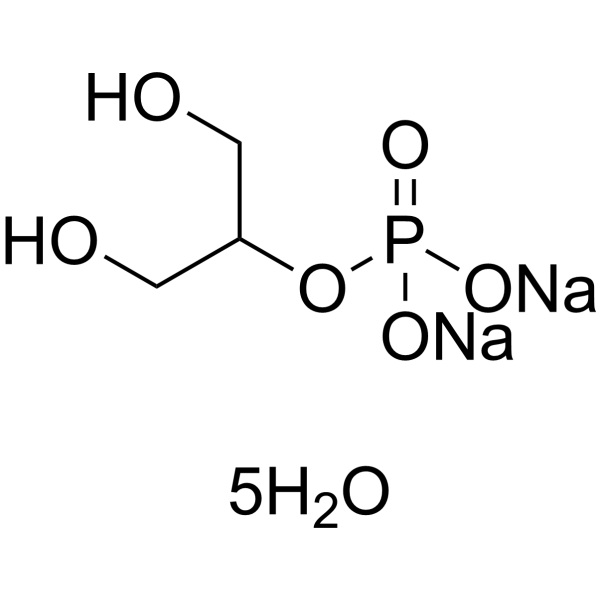
Physicochemical Properties
| Molecular Formula | C3H7NA2O6P |
| Molecular Weight | 216.0374 |
| Exact Mass | 233.988 |
| CAS # | 13408-09-8 |
| Related CAS # | β-Glycerophosphate disodium salt hydrate;154804-51-0 |
| PubChem CID | 22251426 |
| Appearance | White to yellow solid powder |
| Boiling Point | 488.2ºC at 760mmHg |
| Melting Point | >300ºC |
| Flash Point | 249.1ºC |
| LogP | 0.284 |
| Hydrogen Bond Donor Count | 3 |
| Hydrogen Bond Acceptor Count | 7 |
| Rotatable Bond Count | 3 |
| Heavy Atom Count | 13 |
| Complexity | 117 |
| Defined Atom Stereocenter Count | 0 |
| InChi Key | OFNNKPAERNWEDD-UHFFFAOYSA-L |
| InChi Code | InChI=1S/C3H9O6P.2Na.H2O/c4-1-3(5)2-9-10(6,7)8;;;/h3-5H,1-2H2,(H2,6,7,8);;;1H2/q;2*+1;/p-2 |
| Chemical Name | disodium;2,3-dihydroxypropyl phosphate;hydrate |
| HS Tariff Code | 2934.99.9001 |
| Storage |
Powder-20°C 3 years 4°C 2 years In solvent -80°C 6 months -20°C 1 month Note: Please store this product in a sealed and protected environment (e.g. under nitrogen), avoid exposure to moisture and light. |
| Shipping Condition | Room temperature (This product is stable at ambient temperature for a few days during ordinary shipping and time spent in Customs) |
Biological Activity
| Targets |
Extracellular signal-regulated kinase 1/2 (ERK1/2) signaling pathway – activation via phosphorylation . Bone morphogenetic protein 2 (BMP2) gene expression – upregulation . Osteopontin gene expression – regulation ). Note: The primary role of β-Glycerol phosphate disodium salt pentahydrate is to serve as a source of inorganic phosphate (Pi) for hydroxyapatite formation and as an intracellular signaling molecule. [2] |
| ln Vitro |
When added to osteogenic differentiation media, the inorganic phosphate (Pi) released from β-Glycerol phosphate disodium salt pentahydrate acts as an intracellular signaling molecule. It regulates the expression of several osteogenic genes, including osteopontin (in murine cementoblasts) and BMP2. [2] Treatment of cells incapable of true osteogenic differentiation with high concentrations (≥2 mM) of β-Glycerol phosphate disodium salt pentahydrate can lead to dystrophic (non-osteogenic) mineralization, which can be falsely detected by common stains like Alizarin Red S or Von Kossa, potentially leading to false-positive conclusions about osteogenic potential. [2] Pi from β-Glycerol phosphate disodium salt pentahydrate increases BMP2 mRNA expression through two independent pathways: activation of the ERK signaling pathway and activation of the cyclic-AMP/protein-kinase-A (cAMP/PKA) pathway. Inhibition of ERK completely blocked the Pi-mediated increase in BMP2 expression. [2] Pi activation of the ERK signaling pathway is biphasic, mediated by two independent phosphorylation events separated by several hours. Only the second phosphorylation event leads to ERK exerting its effect on osteogenic gene expression. [2] |
| Cell Assay | To distinguish between bone-specific hydroxyapatite mineralization and non-specific dystrophic mineralization (a potential pitfall when using β-Glycerol phosphate disodium salt pentahydrate), a complex set of analytical methods is recommended beyond simple histochemical stains. These methods include quantitative wavelength-dispersive X-ray spectroscopy to determine the calcium-to-phosphate (Ca/P) ratio (bone-specific hydroxyapatite has a ratio of 1.67), transmission electron microscopy to characterize the oriented, needle-shaped crystal growth specific to hydroxyapatite versus unorganized deposits, selected area electron diffraction analysis to compare crystal diffraction patterns, and Raman spectroscopy to analyze phosphate-oxygen bond characteristics. [2] |
| Animal Protocol |
β-Glycerol phosphate disodium salt pentahydrate was used as a critical component in formulating the thermosensitive chitosan/β-glycerophosphate (C/GP) hydrogel for intratumoral drug delivery. [4] The final injectable formulation contained 9% (w/w) β-Glycerol phosphate disodium salt pentahydrate, 1.8% (w/w) chitosan, and DTX (1 or 4 mg/mL). The β-GP was dissolved in deionized water to make a solution, chilled, and then added dropwise to an acidic chitosan solution (containing dissolved DTX) under stirring to form the pre-gel solution. [4] For the in vivo antitumor efficacy study, H22 tumor-bearing ICR mice were given a single intratumoral injection of the DTX-C/GP hydrogel at a DTX dose of 20 mg/kg. Tumor growth and body weight were monitored over 21 days. [4] For the pharmacokinetic and biodistribution study, H22 tumor-bearing mice received a single intratumoral injection of the DTX-C/GP hydrogel at a DTX dose of 20 mg/kg. Blood and tissue samples (tumor, heart, liver, spleen, lung, kidney) were collected at time points up to 21 days post-injection for analysis. [4] |
| ADME/Pharmacokinetics |
Absorption, Distribution and Excretion Peak serum phosphate concentration is reached in 4h. Inorganic phosphate produced is eliminated in the urine. There may be a very small amount of glycerophosphate excreted in the urine unchanged. Metabolism / Metabolites Glycerophosphate is hydrolyzed to form inorganic phosphate. The extent of this reaction is dependent on serum alkaline phosphatase activity. Biological Half-Life Inorganic phosphate has a half-life of elimination of 2.06h. |
| Toxicity/Toxicokinetics |
No systemic toxicity or local adverse reactions (e.g., necrosis) at the injection site were observed in mice treated with the blank C/GP hydrogel or the DTX-loaded C/GP hydrogel (DTX-C/GP) over the 21-day study period. Body weight in the DTX-C/GP group increased steadily and remained within normal range. This suggests that the hydrogel formulation containing β-Glycerol phosphate disodium salt pentahydrate was well-tolerated locally. [4] The study attributed reduced systemic toxicity of DTX (compared to intravenous DTX solution) to the localized delivery and sustained release from the C/GP hydrogel, which minimized distribution to normal tissues. [4] |
| References |
[1]. Inhibition of the nucleotidase effect of alkaline phosphatase by beta-glycerophosphate. Nature. 1968 Jul 6;219(5149):73-5. [2]. Effects of dexamethasone, ascorbic acid and β-glycerophosphate on the osteogenic differentiation of stem cells in vitro. Stem Cell Res Ther. 2013;4(5):117. [3]. Mechanism of action of beta-glycerophosphate on bone cell mineralization. Calcif Tissue Int. 1992;51(4):305-311. [4]. Efficacy, pharmacokinetics, and biodistribution of thermosensitive chitosan/β-glycerophosphate hydrogel loaded with docetaxel. AAPS PharmSciTech. 2014 Apr;15(2):417-24. |
| Additional Infomation |
Sodium glycerophosphate is one of several glycerophosphate salts. It is used clinically to treat or prevent low phosphate levels. Glycerophosphate is hydrolyzed to inorganic phosphate and glycerol in the body. The extent of this reaction is dependent on the activity of serum alkaline phosphatases. Sodium Glycerophosphate is the sodium salt form of an organic phosphate compound that provides phosphate for nutritional purposes. In addition, sodium glycerophosphate can be used as a phosphate diluting agent upon internal contamination with the beta-emiting radioisotope phosphate P 32 (P-32) that competes with P-32 for absorption. As sodium glycerophosphate is administered in high amounts, the absorption of P-32 is prevented or minimalized. See also: sodium glycerophosphate anhydrous (annotation moved to). Drug Indication Sodium glycerophosphate is indicated for use as a source of phosphate in total parenteral nutrition. It is used in combination with amino acids, dextrose, lipid emulsions, and other electrolytes. FDA Label Mechanism of Action Sodium glycerophosphate acts as a donor of inorganic phosphate. See [DB09413] for a description of phosphate's role in the body. Pharmacodynamics Glycerophosphate acts as a source of inorganic phosphate through hydrolysis. β-Glycerol phosphate disodium salt pentahydrate is a standard component of the osteogenic differentiation cocktail (often combined with dexamethasone and ascorbic acid, referred to as DAG) used for multipotent stem cells, particularly bone marrow stromal cells (BMSCs). [2] Its primary function is dual: 1) It serves as a source of inorganic phosphate (Pi), which is incorporated into the mineral phase of bone as hydroxyapatite (Ca₁₀(PO₄)₆(OH)₂). 2) The released Pi acts as an intracellular signaling molecule that influences osteogenic gene expression. [2] A key caution highlighted in the literature is that β-Glycerol phosphate disodium salt pentahydrate can induce mineralization in cells that are not truly undergoing osteogenic differentiation (dystrophic mineralization), especially at high concentrations (≥2 mM). This underscores the importance of using specific analytical methods beyond standard mineralization stains (Alizarin Red S, Von Kossa) to confirm bone-specific mineralization when assessing osteogenic potential. [2] The proposed mechanism for its signaling role involves Pi entering the cell and activating the ERK1/2 MAPK signaling pathway through phosphorylation. This activated P-ERK1/2 translocates to the nucleus where it contributes to the regulation of osteogenic gene expression. [2] β-Glycerol phosphate disodium salt pentahydrate is a key component in forming an injectable, thermosensitive hydrogel when mixed with chitosan in an acidic solution. Upon warming to body temperature (37°C), the mixture undergoes a sol-gel transition, forming a biodegradable gel in situ. [4] In this study, its primary functions were: 1) To neutralize the acidic chitosan solution, raising the pH to around 6.9 (within the tumor pH range) and enabling temperature-sensitive gelation. 2) To act as a gelling agent, with its concentration (along with chitosan concentration) directly influencing the gelation time (higher concentrations led to shorter gelation times). [4] The C/GP hydrogel system containing β-Glycerol phosphate disodium salt pentahydrate served as a sustained-release carrier for the hydrophobic anticancer drug Docetaxel (DTX), eliminating the need for toxic solvents like polysorbate 80. [4] The formulation demonstrated controlled drug release, enhanced local drug retention in tumors, reduced systemic distribution, and consequently improved antitumor efficacy with lower toxicity in a mouse model of hepatocellular carcinoma (H22). [4] |
Solubility Data
| Solubility (In Vitro) |
H2O : ~83.33 mg/mL (~272.22 mM) DMSO :< 1 mg/mL |
| Solubility (In Vivo) |
Solubility in Formulation 1: 100 mg/mL (326.68 mM) in PBS (add these co-solvents sequentially from left to right, and one by one), clear solution; with sonication. (Please use freshly prepared in vivo formulations for optimal results.) |
| Preparing Stock Solutions | 1 mg | 5 mg | 10 mg | |
| 1 mM | 4.6288 mL | 23.1439 mL | 46.2877 mL | |
| 5 mM | 0.9258 mL | 4.6288 mL | 9.2575 mL | |
| 10 mM | 0.4629 mL | 2.3144 mL | 4.6288 mL |