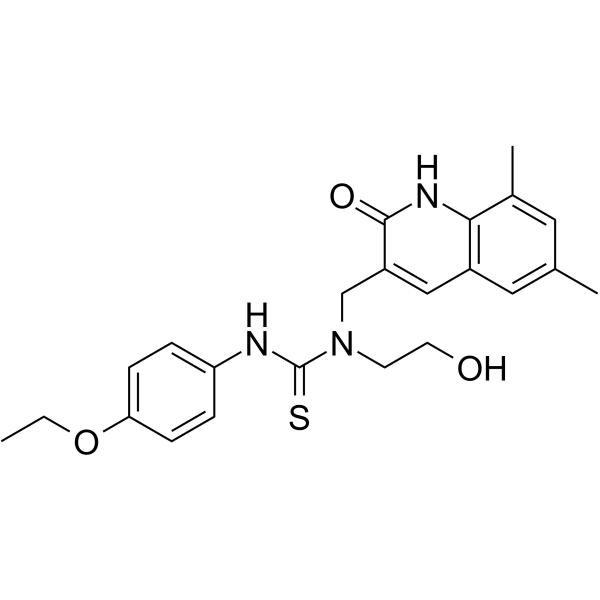
Physicochemical Properties
| Molecular Formula | C23H27N3O3S |
| Molecular Weight | 425.544 |
| Exact Mass | 425.177 |
| CAS # | 484006-66-8 |
| PubChem CID | 1134402 |
| Appearance | Light yellow to green yellow solid powder |
| LogP | 3 |
| Hydrogen Bond Donor Count | 3 |
| Hydrogen Bond Acceptor Count | 4 |
| Rotatable Bond Count | 7 |
| Heavy Atom Count | 30 |
| Complexity | 633 |
| Defined Atom Stereocenter Count | 0 |
| SMILES | CC1C=C(C)C=C2C=C(CN(CCO)C(=S)NC3C=CC(OCC)=CC=3)C(=O)NC=12 |
| InChi Key | PSKUPWXOVUAUJD-UHFFFAOYSA-N |
| InChi Code | InChI=1S/C23H27N3O3S/c1-4-29-20-7-5-19(6-8-20)24-23(30)26(9-10-27)14-18-13-17-12-15(2)11-16(3)21(17)25-22(18)28/h5-8,11-13,27H,4,9-10,14H2,1-3H3,(H,24,30)(H,25,28) |
| Chemical Name | 1-[(6,8-dimethyl-2-oxo-1H-quinolin-3-yl)methyl]-3-(4-ethoxyphenyl)-1-(2-hydroxyethyl)thiourea |
| HS Tariff Code | 2934.99.9001 |
| Storage |
Powder-20°C 3 years 4°C 2 years In solvent -80°C 6 months -20°C 1 month |
| Shipping Condition | Room temperature (This product is stable at ambient temperature for a few days during ordinary shipping and time spent in Customs) |
Biological Activity
| ln Vitro | β-Glucuronidase-IN-1 (Inhibitor 1) (0.01-100 μM) suppresses the β-glucuronidase activity of E. coli in a dose-dependent manner with IC50 and Ki values of 283 nM and 164 nM, respectively [1]. β-Glucuronidase-IN-1 (100 μM; 24-72 hours) does not affect the development of bacterial cells in either aerobic or anaerobic settings while maintaining a strong efficacy in living bacterial cells (EC50=17.7 nM). won't destroy the epithelial cells in mammals[1]. |
| ln Vivo | β-Glucuronidase-IN-1 (oral gavage; 10 μg; twice daily; 11 days) preserves the glandular structure of tract tissue in CPT-11-treated intestines and shields the mouse gastrointestinal epithelium from damage[1]. |
| Cell Assay |
Cell Viability Assay[1] Cell Types: CMT93, CaCO-2, HCT116 Cell Tested Concentrations: 100 μM Incubation Duration: 24 hrs (hours), 48 hrs (hours) and 72 hrs (hours) Experimental Results: Mammalian cell survival is not affected, any decrease in cell viability is attributed to presence of DMSO. |
| Animal Protocol |
Animal/Disease Models: Healthy 6- to 8weeks old Balb/cJ mice [1] Doses: 10 μg Route of Administration: po (oral gavage); twice a day; 11 days Experimental Results: Reduces the toxicity of mice caused by CPT-11. |
| References |
[1]. Alleviating cancer drug toxicity by inhibiting a bacterial enzyme.Science. 2010 Nov 5;330(6005):831-5. |
Solubility Data
| Solubility (In Vitro) | DMSO : ~100 mg/mL (~235.00 mM) |
| Solubility (In Vivo) |
Solubility in Formulation 1: ≥ 2.5 mg/mL (5.87 mM) (saturation unknown) in 10% DMSO + 40% PEG300 + 5% Tween80 + 45% Saline (add these co-solvents sequentially from left to right, and one by one), clear solution. For example, if 1 mL of working solution is to be prepared, you can add 100 μL of 25.0 mg/mL clear DMSO stock solution to 400 μL PEG300 and mix evenly; then add 50 μL Tween-80 to the above solution and mix evenly; then add 450 μL normal saline to adjust the volume to 1 mL. Preparation of saline: Dissolve 0.9 g of sodium chloride in 100 mL ddH₂ O to obtain a clear solution. Solubility in Formulation 2: 2.5 mg/mL (5.87 mM) in 10% DMSO + 90% Corn Oil (add these co-solvents sequentially from left to right, and one by one), clear solution; with ultrasonication. For example, if 1 mL of working solution is to be prepared, you can add 100 μL of 25.0 mg/mL clear DMSO stock solution to 900 μL of corn oil and mix evenly. (Please use freshly prepared in vivo formulations for optimal results.) |
| Preparing Stock Solutions | 1 mg | 5 mg | 10 mg | |
| 1 mM | 2.3500 mL | 11.7498 mL | 23.4996 mL | |
| 5 mM | 0.4700 mL | 2.3500 mL | 4.6999 mL | |
| 10 mM | 0.2350 mL | 1.1750 mL | 2.3500 mL |