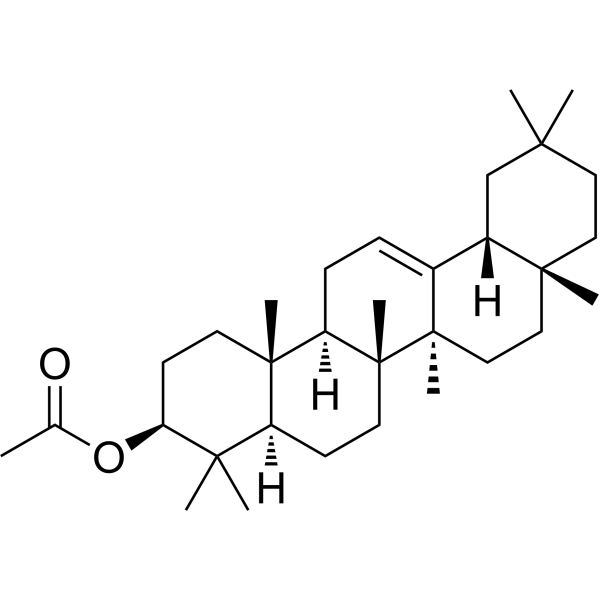
Physicochemical Properties
| Molecular Formula | C32H52O2 |
| Molecular Weight | 468.75408 |
| Exact Mass | 468.396 |
| CAS # | 1616-93-9 |
| PubChem CID | 92156 |
| Appearance | White to off-white solid powder |
| Density | 1.0±0.1 g/cm3 |
| Boiling Point | 505.1±49.0 °C at 760 mmHg |
| Flash Point | 256.2±17.4 °C |
| Vapour Pressure | 0.0±1.3 mmHg at 25°C |
| Index of Refraction | 1.529 |
| LogP | 11.95 |
| Hydrogen Bond Donor Count | 0 |
| Hydrogen Bond Acceptor Count | 2 |
| Rotatable Bond Count | 2 |
| Heavy Atom Count | 34 |
| Complexity | 897 |
| Defined Atom Stereocenter Count | 8 |
| SMILES | CC(=O)O[C@H]1CC[C@]2([C@H](C1(C)C)CC[C@@]3([C@@H]2CC=C4[C@]3(CC[C@@]5([C@H]4CC(CC5)(C)C)C)C)C)C |
| InChi Key | UMRPOGLIBDXFNK-ZYGITSNFSA-N |
| InChi Code | InChI=1S/C32H52O2/c1-21(33)34-26-13-14-30(7)24(28(26,4)5)12-15-32(9)25(30)11-10-22-23-20-27(2,3)16-17-29(23,6)18-19-31(22,32)8/h10,23-26H,11-20H2,1-9H3/t23-,24-,25+,26-,29+,30-,31+,32+/m0/s1 |
| Chemical Name | [(3S,4aR,6aR,6bS,8aR,12aR,14aR,14bR)-4,4,6a,6b,8a,11,11,14b-octamethyl-1,2,3,4a,5,6,7,8,9,10,12,12a,14,14a-tetradecahydropicen-3-yl] acetate |
| HS Tariff Code | 2934.99.9001 |
| Storage |
Powder-20°C 3 years 4°C 2 years In solvent -80°C 6 months -20°C 1 month Note: This product requires protection from light (avoid light exposure) during transportation and storage. |
| Shipping Condition | Room temperature (This product is stable at ambient temperature for a few days during ordinary shipping and time spent in Customs) |
Biological Activity
| ln Vitro | β-Amyrinacetate (50 μg/mL) prevents human red blood cell hemolysis brought on by heat and hypotonic stress [1]. HMG-CoA reductase is present in β-aromatic resin acetate (5–100 μM), and it inhibits the active HMG CoA reductase [2]. All Candida fungus studied were suppressed by β-Aramacetate (7.8-1000 μg/mL, 48 hours), with MIC values ranging from 30 to 250 μg/mL [4]. |
| ln Vivo | Mice's xylene-induced ear edema was considerably reduced by β-Amylin acetate (100 μg/ear, single dosage) applied to the front surface of the right ear [1]. In adult albino rats, β-Aramid acetate (4 mg/100 g, intraperitoneal injection, daily for 6 days) shown considerable anti-inflammatory action (43.6%) [3]. In liver homogenates of both normal and arthritic rats, subcutaneous injection of beta-amyrin acetate (4 mg/100 g, once day for 10 days) boosts the activity of ATP-phosphohydrolase [3]. |
| Animal Protocol |
Animal/Disease Models: xylene-induced local edema model of mouse ear [1] Doses: 50 and 100 μg/ear (5 μL) Route of Administration: applied to the front surface of the right ear Experimental Results: Inhibition of xylene-induced mouse ear edema Edema Animal/Disease Models: adult albino rat [3] Doses: 4 mg/100g, daily, for 6 days Route of Administration: intraperitoneal (ip) injection Experimental Results: demonstrated significant anti-inflammatory activity, the average weight of granulation tissue after 6 days was 9.2 mg. |
| References |
[1]. beta-Amyrin and alpha-amyrin acetate isolated from the stem bark of Alstonia boonei display profound anti-inflammatory activity. Pharm Biol. 2014 Nov;52(11):1478-86. [2]. β-Amyrin acetate and β-amyrin palmitate as antidyslipidemic agents from Wrightia tomentosa leaves. Phytomedicine. 2012 Jun 15;19(8-9):682-5. [3]. Biochemical study of the anti-inflammatory activity of α and β-amyrin acetate. Biochemical Pharmacology. 1971 Feb; 2(20): 401-405. [4]. Antifungal activity of the amyrin derivatives and in vitro inhibition of Candida albicans adhesion to human epithelial cells. Lett Appl Microbiol. 2007 Aug;45(2):148-53. |
| Additional Infomation |
Beta-amyrin acetate is a triterpenoid. beta-Amyrin acetate has been reported in Erythrophleum fordii, Euphorbia polycaulis, and other organisms with data available. |
Solubility Data
| Solubility (In Vitro) | May dissolve in DMSO (in most cases), if not, try other solvents such as H2O, Ethanol, or DMF with a minute amount of products to avoid loss of samples |
| Solubility (In Vivo) |
Note: Listed below are some common formulations that may be used to formulate products with low water solubility (e.g. < 1 mg/mL), you may test these formulations using a minute amount of products to avoid loss of samples. Injection Formulations (e.g. IP/IV/IM/SC) Injection Formulation 1: DMSO : Tween 80: Saline = 10 : 5 : 85 (i.e. 100 μL DMSO stock solution → 50 μL Tween 80 → 850 μL Saline) *Preparation of saline: Dissolve 0.9 g of sodium chloride in 100 mL ddH ₂ O to obtain a clear solution. Injection Formulation 2: DMSO : PEG300 :Tween 80 : Saline = 10 : 40 : 5 : 45 (i.e. 100 μL DMSO → 400 μLPEG300 → 50 μL Tween 80 → 450 μL Saline) Injection Formulation 3: DMSO : Corn oil = 10 : 90 (i.e. 100 μL DMSO → 900 μL Corn oil) Example: Take the Injection Formulation 3 (DMSO : Corn oil = 10 : 90) as an example, if 1 mL of 2.5 mg/mL working solution is to be prepared, you can take 100 μL 25 mg/mL DMSO stock solution and add to 900 μL corn oil, mix well to obtain a clear or suspension solution (2.5 mg/mL, ready for use in animals). Injection Formulation 4: DMSO : 20% SBE-β-CD in saline = 10 : 90 [i.e. 100 μL DMSO → 900 μL (20% SBE-β-CD in saline)] *Preparation of 20% SBE-β-CD in Saline (4°C,1 week): Dissolve 2 g SBE-β-CD in 10 mL saline to obtain a clear solution. Injection Formulation 5: 2-Hydroxypropyl-β-cyclodextrin : Saline = 50 : 50 (i.e. 500 μL 2-Hydroxypropyl-β-cyclodextrin → 500 μL Saline) Injection Formulation 6: DMSO : PEG300 : castor oil : Saline = 5 : 10 : 20 : 65 (i.e. 50 μL DMSO → 100 μLPEG300 → 200 μL castor oil → 650 μL Saline) Injection Formulation 7: Ethanol : Cremophor : Saline = 10: 10 : 80 (i.e. 100 μL Ethanol → 100 μL Cremophor → 800 μL Saline) Injection Formulation 8: Dissolve in Cremophor/Ethanol (50 : 50), then diluted by Saline Injection Formulation 9: EtOH : Corn oil = 10 : 90 (i.e. 100 μL EtOH → 900 μL Corn oil) Injection Formulation 10: EtOH : PEG300:Tween 80 : Saline = 10 : 40 : 5 : 45 (i.e. 100 μL EtOH → 400 μLPEG300 → 50 μL Tween 80 → 450 μL Saline) Oral Formulations Oral Formulation 1: Suspend in 0.5% CMC Na (carboxymethylcellulose sodium) Oral Formulation 2: Suspend in 0.5% Carboxymethyl cellulose Example: Take the Oral Formulation 1 (Suspend in 0.5% CMC Na) as an example, if 100 mL of 2.5 mg/mL working solution is to be prepared, you can first prepare 0.5% CMC Na solution by measuring 0.5 g CMC Na and dissolve it in 100 mL ddH2O to obtain a clear solution; then add 250 mg of the product to 100 mL 0.5% CMC Na solution, to make the suspension solution (2.5 mg/mL, ready for use in animals). Oral Formulation 3: Dissolved in PEG400 Oral Formulation 4: Suspend in 0.2% Carboxymethyl cellulose Oral Formulation 5: Dissolve in 0.25% Tween 80 and 0.5% Carboxymethyl cellulose Oral Formulation 6: Mixing with food powders Note: Please be aware that the above formulations are for reference only. InvivoChem strongly recommends customers to read literature methods/protocols carefully before determining which formulation you should use for in vivo studies, as different compounds have different solubility properties and have to be formulated differently. (Please use freshly prepared in vivo formulations for optimal results.) |
| Preparing Stock Solutions | 1 mg | 5 mg | 10 mg | |
| 1 mM | 2.1333 mL | 10.6667 mL | 21.3333 mL | |
| 5 mM | 0.4267 mL | 2.1333 mL | 4.2667 mL | |
| 10 mM | 0.2133 mL | 1.0667 mL | 2.1333 mL |