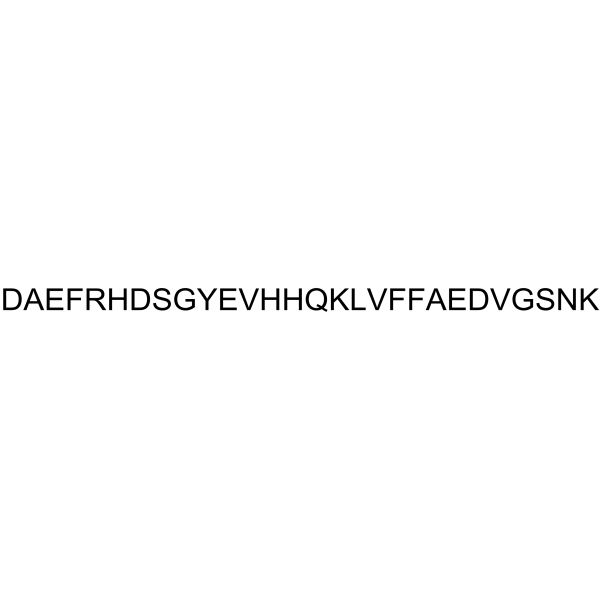
Physicochemical Properties
| Molecular Formula | C145H209N41O46 |
| Molecular Weight | 1953.16082 |
| Exact Mass | 3261.53 |
| CAS # | 109770-29-8 |
| PubChem CID | 91977102 |
| Appearance | Typically exists as solid at room temperature |
| LogP | -15.9 |
| Hydrogen Bond Donor Count | 48 |
| Hydrogen Bond Acceptor Count | 53 |
| Rotatable Bond Count | 109 |
| Heavy Atom Count | 232 |
| Complexity | 7650 |
| Defined Atom Stereocenter Count | 0 |
| InChi Key | CMKVKXQGLWBAFY-UHFFFAOYSA-N |
| InChi Code | InChI=1S/C145H209N41O46/c1-71(2)49-93(138(225)186-118(74(7)8)142(229)181-97(52-79-29-18-13-19-30-79)132(219)175-95(50-77-25-14-11-15-26-77)129(216)163-76(10)120(207)167-90(40-44-111(196)197)127(214)179-103(60-115(204)205)139(226)184-116(72(3)4)141(228)158-65-109(193)165-105(67-188)140(227)178-101(58-107(150)191)136(223)172-92(144(231)232)32-21-23-47-147)173-123(210)86(31-20-22-46-146)168-125(212)88(38-42-106(149)190)170-133(220)98(54-81-61-153-68-159-81)177-135(222)100(56-83-63-155-70-161-83)182-143(230)117(73(5)6)185-128(215)91(41-45-112(198)199)171-130(217)94(53-80-34-36-84(189)37-35-80)164-108(192)64-157-122(209)104(66-187)183-137(224)102(59-114(202)203)180-134(221)99(55-82-62-154-69-160-82)176-124(211)87(33-24-48-156-145(151)152)169-131(218)96(51-78-27-16-12-17-28-78)174-126(213)89(39-43-110(194)195)166-119(206)75(9)162-121(208)85(148)57-113(200)201/h11-19,25-30,34-37,61-63,68-76,85-105,116-118,187-189H,20-24,31-33,38-60,64-67,146-148H2,1-10H3,(H2,149,190)(H2,150,191)(H,153,159)(H,154,160)(H,155,161)(H,157,209)(H,158,228)(H,162,208)(H,163,216)(H,164,192)(H,165,193)(H,166,206)(H,167,207)(H,168,212)(H,169,218)(H,170,220)(H,171,217)(H,172,223)(H,173,210)(H,174,213)(H,175,219)(H,176,211)(H,177,222)(H,178,227)(H,179,214)(H,180,221)(H,181,229)(H,182,230)(H,183,224)(H,184,226)(H,185,215)(H,186,225)(H,194,195)(H,196,197)(H,198,199)(H,200,201)(H,202,203)(H,204,205)(H,231,232)(H4,151,152,156) |
| Chemical Name | 6-amino-2-[[4-amino-2-[[2-[[2-[[2-[[2-[[2-[2-[[2-[[2-[[2-[[2-[[6-amino-2-[[5-amino-2-[[2-[[2-[[2-[[2-[[2-[[2-[[2-[[2-[[2-[[2-[[2-[[2-[2-[(2-amino-3-carboxypropanoyl)amino]propanoylamino]-4-carboxybutanoyl]amino]-3-phenylpropanoyl]amino]-5-carbamimidamidopentanoyl]amino]-3-(1H-imidazol-4-yl)propanoyl]amino]-3-carboxypropanoyl]amino]-3-hydroxypropanoyl]amino]acetyl]amino]-3-(4-hydroxyphenyl)propanoyl]amino]-4-carboxybutanoyl]amino]-3-methylbutanoyl]amino]-3-(1H-imidazol-4-yl)propanoyl]amino]-3-(1H-imidazol-4-yl)propanoyl]amino]-5-oxopentanoyl]amino]hexanoyl]amino]-4-methylpentanoyl]amino]-3-methylbutanoyl]amino]-3-phenylpropanoyl]amino]-3-phenylpropanoyl]amino]propanoylamino]-4-carboxybutanoyl]amino]-3-carboxypropanoyl]amino]-3-methylbutanoyl]amino]acetyl]amino]-3-hydroxypropanoyl]amino]-4-oxobutanoyl]amino]hexanoic acid |
| HS Tariff Code | 2934.99.9001 |
| Storage |
Powder-20°C 3 years 4°C 2 years In solvent -80°C 6 months -20°C 1 month |
| Shipping Condition | Room temperature (This product is stable at ambient temperature for a few days during ordinary shipping and time spent in Customs) |
Biological Activity
| ln Vitro | Recommendations for Beta-Amyloid Aggregation (This is our suggested approach; it should be adjusted to suit your particular need as it simply offers guidelines). 1. Solid Aβ peptide should be dissolved in cold hexafluoro-2-propanol (HFIP). To achieve monomerization and randomization of the structure, incubate the peptides for a minimum of one hour at room temperature. 2. To get rid of HFIP, evaporate, and then store the resultant peptide in a film at -20 or -80°C. 3. The resultant membrane should be dissolved in 5 mM of anhydrous DMSO, vortexed, and diluted with buffer (serum- and phenol-red-free media) to the proper concentration. 4. After that, let the solution age for 48 hours at 4–8°C. After centrifuging the samples for 10 minutes at 4–8°C at 14,000 g, the supernatant contained soluble oligomers. For the studies, the supernatant was diluted 10-200 times. |
| ln Vivo | For analyzing the contribution of important histidine residues (His, His in mouse and His, His, His in human fragments) to the Ab-Cu2+ interaction model, the β-amyloid(1-28) fragment is thought to be useful[1]. At pH 7.4, copper exhibits a Ka10 7 M-1 affinity for β-amyloid (1-28). |
| References |
[1]. Kowalik-Jankowska T, et al. Coordination abilities of the 1-16 and 1-28 fragments of beta-amyloid peptide towards copper(II) ions: a combined potentiometric and spectroscopic study. J Inorg Biochem. 2003 Jul 1;95(4):270-82. [2]. Syme CD, et al. Copper binding to the amyloid-beta (Abeta) peptide associated with Alzheimer's disease: folding, coordination geometry, pH dependence, stoichiometry, and affinity of Abeta-(1-28): insights from a range of complementary spectroscopic techni [3]. Jing-Ming Shi, et al. Dissecting the behaviour of β-amyloid peptide variants during oligomerization and fibrillation. J Pept Sci. 2017 Nov;23(11):810-817. |
Solubility Data
| Solubility (In Vitro) | May dissolve in DMSO (in most cases), if not, try other solvents such as H2O, Ethanol, or DMF with a minute amount of products to avoid loss of samples |
| Solubility (In Vivo) |
Note: Listed below are some common formulations that may be used to formulate products with low water solubility (e.g. < 1 mg/mL), you may test these formulations using a minute amount of products to avoid loss of samples. Injection Formulations (e.g. IP/IV/IM/SC) Injection Formulation 1: DMSO : Tween 80: Saline = 10 : 5 : 85 (i.e. 100 μL DMSO stock solution → 50 μL Tween 80 → 850 μL Saline) *Preparation of saline: Dissolve 0.9 g of sodium chloride in 100 mL ddH ₂ O to obtain a clear solution. Injection Formulation 2: DMSO : PEG300 :Tween 80 : Saline = 10 : 40 : 5 : 45 (i.e. 100 μL DMSO → 400 μLPEG300 → 50 μL Tween 80 → 450 μL Saline) Injection Formulation 3: DMSO : Corn oil = 10 : 90 (i.e. 100 μL DMSO → 900 μL Corn oil) Example: Take the Injection Formulation 3 (DMSO : Corn oil = 10 : 90) as an example, if 1 mL of 2.5 mg/mL working solution is to be prepared, you can take 100 μL 25 mg/mL DMSO stock solution and add to 900 μL corn oil, mix well to obtain a clear or suspension solution (2.5 mg/mL, ready for use in animals). Injection Formulation 4: DMSO : 20% SBE-β-CD in saline = 10 : 90 [i.e. 100 μL DMSO → 900 μL (20% SBE-β-CD in saline)] *Preparation of 20% SBE-β-CD in Saline (4°C,1 week): Dissolve 2 g SBE-β-CD in 10 mL saline to obtain a clear solution. Injection Formulation 5: 2-Hydroxypropyl-β-cyclodextrin : Saline = 50 : 50 (i.e. 500 μL 2-Hydroxypropyl-β-cyclodextrin → 500 μL Saline) Injection Formulation 6: DMSO : PEG300 : castor oil : Saline = 5 : 10 : 20 : 65 (i.e. 50 μL DMSO → 100 μLPEG300 → 200 μL castor oil → 650 μL Saline) Injection Formulation 7: Ethanol : Cremophor : Saline = 10: 10 : 80 (i.e. 100 μL Ethanol → 100 μL Cremophor → 800 μL Saline) Injection Formulation 8: Dissolve in Cremophor/Ethanol (50 : 50), then diluted by Saline Injection Formulation 9: EtOH : Corn oil = 10 : 90 (i.e. 100 μL EtOH → 900 μL Corn oil) Injection Formulation 10: EtOH : PEG300:Tween 80 : Saline = 10 : 40 : 5 : 45 (i.e. 100 μL EtOH → 400 μLPEG300 → 50 μL Tween 80 → 450 μL Saline) Oral Formulations Oral Formulation 1: Suspend in 0.5% CMC Na (carboxymethylcellulose sodium) Oral Formulation 2: Suspend in 0.5% Carboxymethyl cellulose Example: Take the Oral Formulation 1 (Suspend in 0.5% CMC Na) as an example, if 100 mL of 2.5 mg/mL working solution is to be prepared, you can first prepare 0.5% CMC Na solution by measuring 0.5 g CMC Na and dissolve it in 100 mL ddH2O to obtain a clear solution; then add 250 mg of the product to 100 mL 0.5% CMC Na solution, to make the suspension solution (2.5 mg/mL, ready for use in animals). Oral Formulation 3: Dissolved in PEG400 Oral Formulation 4: Suspend in 0.2% Carboxymethyl cellulose Oral Formulation 5: Dissolve in 0.25% Tween 80 and 0.5% Carboxymethyl cellulose Oral Formulation 6: Mixing with food powders Note: Please be aware that the above formulations are for reference only. InvivoChem strongly recommends customers to read literature methods/protocols carefully before determining which formulation you should use for in vivo studies, as different compounds have different solubility properties and have to be formulated differently. (Please use freshly prepared in vivo formulations for optimal results.) |
| Preparing Stock Solutions | 1 mg | 5 mg | 10 mg | |
| 1 mM | 0.5120 mL | 2.5600 mL | 5.1199 mL | |
| 5 mM | 0.1024 mL | 0.5120 mL | 1.0240 mL | |
| 10 mM | 0.0512 mL | 0.2560 mL | 0.5120 mL |