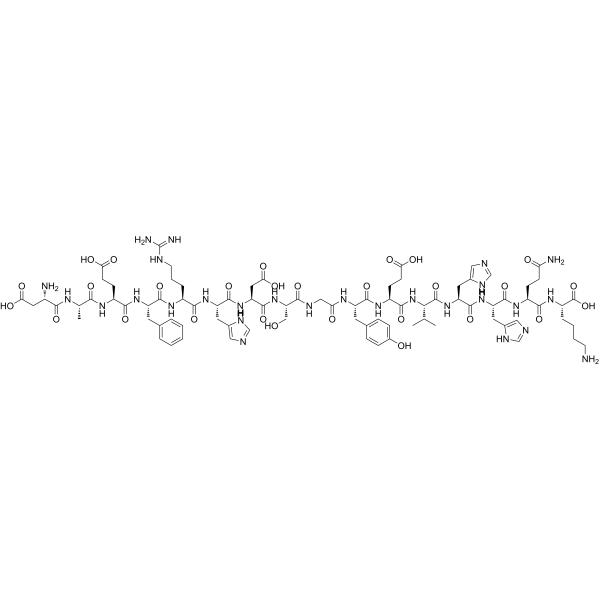
Physicochemical Properties
| Molecular Formula | C84H119N27O28 |
| Molecular Weight | 1955.01 |
| Exact Mass | 1953.871 |
| CAS # | 131580-10-4 |
| PubChem CID | 146156923 |
| Appearance | White to off-white solid powder |
| Density | 1.6±0.1 g/cm3 |
| Index of Refraction | 1.696 |
| LogP | -6.41 |
| Hydrogen Bond Donor Count | 31 |
| Hydrogen Bond Acceptor Count | 34 |
| Rotatable Bond Count | 65 |
| Heavy Atom Count | 139 |
| Complexity | 4200 |
| Defined Atom Stereocenter Count | 0 |
| InChi Key | PKSRFXGDLPWBBS-UHFFFAOYSA-N |
| InChi Code | InChI=1S/C84H119N27O28/c1-41(2)68(82(137)109-59(30-47-35-92-40-97-47)80(135)107-57(28-45-33-90-38-95-45)78(133)102-51(18-21-62(87)114)73(128)104-54(83(138)139)12-7-8-24-85)111-75(130)53(20-23-65(118)119)103-76(131)55(27-44-14-16-48(113)17-15-44)99-63(115)36-94-71(126)61(37-112)110-81(136)60(32-67(122)123)108-79(134)58(29-46-34-91-39-96-46)106-72(127)50(13-9-25-93-84(88)89)101-77(132)56(26-43-10-5-4-6-11-43)105-74(129)52(19-22-64(116)117)100-69(124)42(3)98-70(125)49(86)31-66(120)121/h4-6,10-11,14-17,33-35,38-42,49-61,68,112-113H,7-9,12-13,18-32,36-37,85-86H2,1-3H3,(H2,87,114)(H,90,95)(H,91,96)(H,92,97)(H,94,126)(H,98,125)(H,99,115)(H,100,124)(H,101,132)(H,102,133)(H,103,131)(H,104,128)(H,105,129)(H,106,127)(H,107,135)(H,108,134)(H,109,137)(H,110,136)(H,111,130)(H,116,117)(H,118,119)(H,120,121)(H,122,123)(H,138,139)(H4,88,89,93) |
| Chemical Name | 6-amino-2-[[5-amino-2-[[2-[[2-[[2-[[2-[[2-[[2-[[2-[[2-[[2-[[2-[[2-[[2-[2-[(2-amino-3-carboxypropanoyl)amino]propanoylamino]-4-carboxybutanoyl]amino]-3-phenylpropanoyl]amino]-5-carbamimidamidopentanoyl]amino]-3-(1H-imidazol-4-yl)propanoyl]amino]-3-carboxypropanoyl]amino]-3-hydroxypropanoyl]amino]acetyl]amino]-3-(4-hydroxyphenyl)propanoyl]amino]-4-carboxybutanoyl]amino]-3-methylbutanoyl]amino]-3-(1H-imidazol-4-yl)propanoyl]amino]-3-(1H-imidazol-4-yl)propanoyl]amino]-5-oxopentanoyl]amino]hexanoic acid |
| HS Tariff Code | 2934.99.9001 |
| Storage |
Powder-20°C 3 years 4°C 2 years In solvent -80°C 6 months -20°C 1 month Note: (1). This product is not stable in solution, please use freshly prepared working solution for optimal results.(2). Please store this product in a sealed and protected environment, avoid exposure to moisture. |
| Shipping Condition | Room temperature (This product is stable at ambient temperature for a few days during ordinary shipping and time spent in Customs) |
Biological Activity
| ln Vivo | Examining the contribution of important histidine residues (His, His in mouse and His, His, His in human segments) to the Ab-Cu2+ interaction Model is thought to be possible with the β-amyloid(1-16) fragment. β-amyloid (1-16) targets histidine residues that bind to metal ions for oxidation. In Alzheimer's disease senile plaques, copper attaches to Aβ, and β-amyloid (1-16) takes part in the coordination of Cu2+ ions. Cu2+ and Zn2+ have been linked to damage from free radicals and amyloid neurotoxicity [1]. The smallest sequence of amino acids exhibiting a Cu coordination pattern including three histidines (His6, His13, and His14) is β-Amyloid(1-16). It is believed that β-Amyloid (1-16) has a role in metal binding [2]. Zinc ions interact with human beta-amyloid via its metal-binding domains 1–16. The two polypeptide chains of the rat Aβ(1-16) dimer have opposing C-tail orientations, which prevents the rat Aβ dimer from assembling into oligomer aggregates. Consequently, drug resistance could be caused by variations in the structure of the zinc-binding site between human and rat β-amyloid (1-16), their capacity to form regular cross-monomer connections, and the orientation of their hydrophobic C-tails. Rats are at risk for Alzheimer's disease [3]. |
| References |
[1]. Coordination abilities of the 1-16 and 1-28 fragments of beta-amyloid peptide towards copper(II) ions: a combined potentiometric and spectroscopic study. J Inorg Biochem. 2003 Jul 1;95(4):270-82. [2]. Identifying the minimal copper- and zinc-binding site sequence in amyloid-beta peptides. J Biol Chem. 2008 Apr 18;283(16):10784-92. [3]. NMR solution structure of rat aβ(1-16): toward understanding the mechanism of rats' resistance to Alzheimer's disease. Biophys J. 2012 Jan 4;102(1):136-43. |
Solubility Data
| Solubility (In Vitro) | May dissolve in DMSO (in most cases), if not, try other solvents such as H2O, Ethanol, or DMF with a minute amount of products to avoid loss of samples |
| Solubility (In Vivo) |
Note: Listed below are some common formulations that may be used to formulate products with low water solubility (e.g. < 1 mg/mL), you may test these formulations using a minute amount of products to avoid loss of samples. Injection Formulations (e.g. IP/IV/IM/SC) Injection Formulation 1: DMSO : Tween 80: Saline = 10 : 5 : 85 (i.e. 100 μL DMSO stock solution → 50 μL Tween 80 → 850 μL Saline) *Preparation of saline: Dissolve 0.9 g of sodium chloride in 100 mL ddH ₂ O to obtain a clear solution. Injection Formulation 2: DMSO : PEG300 :Tween 80 : Saline = 10 : 40 : 5 : 45 (i.e. 100 μL DMSO → 400 μLPEG300 → 50 μL Tween 80 → 450 μL Saline) Injection Formulation 3: DMSO : Corn oil = 10 : 90 (i.e. 100 μL DMSO → 900 μL Corn oil) Example: Take the Injection Formulation 3 (DMSO : Corn oil = 10 : 90) as an example, if 1 mL of 2.5 mg/mL working solution is to be prepared, you can take 100 μL 25 mg/mL DMSO stock solution and add to 900 μL corn oil, mix well to obtain a clear or suspension solution (2.5 mg/mL, ready for use in animals). Injection Formulation 4: DMSO : 20% SBE-β-CD in saline = 10 : 90 [i.e. 100 μL DMSO → 900 μL (20% SBE-β-CD in saline)] *Preparation of 20% SBE-β-CD in Saline (4°C,1 week): Dissolve 2 g SBE-β-CD in 10 mL saline to obtain a clear solution. Injection Formulation 5: 2-Hydroxypropyl-β-cyclodextrin : Saline = 50 : 50 (i.e. 500 μL 2-Hydroxypropyl-β-cyclodextrin → 500 μL Saline) Injection Formulation 6: DMSO : PEG300 : castor oil : Saline = 5 : 10 : 20 : 65 (i.e. 50 μL DMSO → 100 μLPEG300 → 200 μL castor oil → 650 μL Saline) Injection Formulation 7: Ethanol : Cremophor : Saline = 10: 10 : 80 (i.e. 100 μL Ethanol → 100 μL Cremophor → 800 μL Saline) Injection Formulation 8: Dissolve in Cremophor/Ethanol (50 : 50), then diluted by Saline Injection Formulation 9: EtOH : Corn oil = 10 : 90 (i.e. 100 μL EtOH → 900 μL Corn oil) Injection Formulation 10: EtOH : PEG300:Tween 80 : Saline = 10 : 40 : 5 : 45 (i.e. 100 μL EtOH → 400 μLPEG300 → 50 μL Tween 80 → 450 μL Saline) Oral Formulations Oral Formulation 1: Suspend in 0.5% CMC Na (carboxymethylcellulose sodium) Oral Formulation 2: Suspend in 0.5% Carboxymethyl cellulose Example: Take the Oral Formulation 1 (Suspend in 0.5% CMC Na) as an example, if 100 mL of 2.5 mg/mL working solution is to be prepared, you can first prepare 0.5% CMC Na solution by measuring 0.5 g CMC Na and dissolve it in 100 mL ddH2O to obtain a clear solution; then add 250 mg of the product to 100 mL 0.5% CMC Na solution, to make the suspension solution (2.5 mg/mL, ready for use in animals). Oral Formulation 3: Dissolved in PEG400 Oral Formulation 4: Suspend in 0.2% Carboxymethyl cellulose Oral Formulation 5: Dissolve in 0.25% Tween 80 and 0.5% Carboxymethyl cellulose Oral Formulation 6: Mixing with food powders Note: Please be aware that the above formulations are for reference only. InvivoChem strongly recommends customers to read literature methods/protocols carefully before determining which formulation you should use for in vivo studies, as different compounds have different solubility properties and have to be formulated differently. (Please use freshly prepared in vivo formulations for optimal results.) |
| Preparing Stock Solutions | 1 mg | 5 mg | 10 mg | |
| 1 mM | 0.5115 mL | 2.5575 mL | 5.1151 mL | |
| 5 mM | 0.1023 mL | 0.5115 mL | 1.0230 mL | |
| 10 mM | 0.0512 mL | 0.2558 mL | 0.5115 mL |