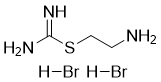
beta-Aminoethylisothiuronium Bromide is a novel and potent radiation-protective agent
Physicochemical Properties
| Molecular Formula | C3H11BR2N3S |
| Molecular Weight | 281.0125 |
| Exact Mass | 278.904 |
| CAS # | 56-10-0 |
| Related CAS # | 151-16-6 (parent cpd);18144-22-4 (sulfate (1:1));2141-04-0 (mono-hydrobromide);63680-10-4 (diacetate);63680-11-5 (diperchlorate);63680-12-6 (di-hydriodide);63680-13-7 (phosphate (1:1));871-25-0 (di-hydrochloride) |
| PubChem CID | 5940 |
| Appearance | White to yellow solid powder |
| Boiling Point | 231.1ºC at 760mmHg |
| Melting Point | 190-196 °C(lit.) |
| Flash Point | 93.6ºC |
| LogP | 2.988 |
| Hydrogen Bond Donor Count | 5 |
| Hydrogen Bond Acceptor Count | 3 |
| Rotatable Bond Count | 3 |
| Heavy Atom Count | 9 |
| Complexity | 63.2 |
| Defined Atom Stereocenter Count | 0 |
| InChi Key | XDVMCVGTDUKDHL-UHFFFAOYSA-N |
| InChi Code | InChI=1S/C3H9N3S.2BrH/c4-1-2-7-3(5)6;;/h1-2,4H2,(H3,5,6);2*1H |
| Chemical Name | 2-aminoethyl carbamimidothioate;dihydrobromide |
| HS Tariff Code | 2934.99.9001 |
| Storage |
Powder-20°C 3 years 4°C 2 years In solvent -80°C 6 months -20°C 1 month |
| Shipping Condition | Room temperature (This product is stable at ambient temperature for a few days during ordinary shipping and time spent in Customs) |
Biological Activity
| Targets |
Aminomethyl-isothiourea (AE-ITU) is a relatively selective inhibitor of inducible nitric oxide synthase (iNOS) activity. |
| ln Vivo |
In endotoxemic rats (induced by E. coli LPS), treatment with AE-ITU (1 mg/kg i.v. bolus + 1 mg/kg/h infusion starting 2h after LPS) significantly attenuated the delayed vascular hyperacactivity to noradrenaline. AE-ITU significantly attenuated liver dysfunction induced by endotoxemia, as evidenced by reduction in serum levels of aspartate aminotransferase (GOT), alanine aminotransferase (GPT), γ-glutamyl transferase (gGT), and bilirubin. AE-ITU did not attenuate renal dysfunction induced by endotoxemia, as serum urea and creatinine levels remained elevated. AE-ITU significantly reduced the rise in serum nitrite levels induced by endotoxemia (from 9.13 ± 0.77 µM to 6.32 ± 0.48 µM). AE-ITU significantly reduced iNOS activity in lung and liver homogenates from endotoxemic rats. In rats not treated with LPS, AE-ITU had no significant effect on mean arterial pressure, pressor response to noradrenaline, or serum markers of liver and kidney function. |
| Enzyme Assay |
Calcium-independent iNOS activity was measured in lung and liver homogenates. Tissues were homogenized in a buffer containing Tris-HCl, EDTA, EGTA, 2-mercaptoethanol, and phenylethylsulphonyl fluoride. Homogenates were incubated with ³H-L-arginine, NADPH, calmodulin, tetrahydrobiopterin, and calcium in HEPES buffer for 25 min at 25°C. Reactions were stopped with ice-cold HEPES buffer containing EGTA and EDTA. ³H-L-citrulline was separated by Dowex 50W (Na⁺ form) column chromatography and quantified by scintillation counting. |
| Animal Protocol |
Male Wistar rats (240–320 g) were anesthetized with thiopentone sodium. Cannulation of carotid artery, femoral vein, and jugular vein was performed for hemodynamic monitoring and drug administration. Endotoxemia was induced by intravenous injection of E. coli lipopolysaccharide (LPS, 10 mg/kg). AE-ITU was administered as an intravenous bolus dose of 1 mg/kg, followed by a continuous infusion of 1 mg/kg/h, starting 2 hours after LPS injection. The drug was dissolved in saline. Control animals received saline vehicle. Hemodynamic parameters (mean arterial pressure, heart rate, pressor response to noradrenaline) were monitored. Blood samples were collected at 2 and 6 hours for serum biochemistry and nitrite measurement. Lungs and livers were collected at 6 hours for iNOS activity assay. |
| References |
[1]. The multiple organ dysfunction syndrome caused by endotoxin in the rat: attenuation of liver dysfunction by inhibitors of nitric oxide synthase. Br J Pharmacol. 1995 Dec;116(7):2845-51. |
| Additional Infomation |
A radiation-protective agent that can inhibit DNA damage by binding to the DNA. It also increases the susceptibility of blood cells to complement-mediated lysis. See also: beta-Aminoethyl Isothiourea (annotation moved to). Aminomethyl-isothiourea (AE-ITU) is described as a relatively selective inhibitor of iNOS activity. It attenuates circulatory failure and liver dysfunction in endotoxic shock without significantly affecting endothelial NOS (eNOS) activity, as it does not increase blood pressure in non-endotoxemic rats. The study suggests that selective inhibition of iNOS may be beneficial in treating liver dysfunction associated with endotoxemia, while non-selective NOS inhibitors may have adverse effects due to concurrent eNOS inhibition. |
Solubility Data
| Solubility (In Vitro) | May dissolve in DMSO (in most cases), if not, try other solvents such as H2O, Ethanol, or DMF with a minute amount of products to avoid loss of samples |
| Solubility (In Vivo) |
Note: Listed below are some common formulations that may be used to formulate products with low water solubility (e.g. < 1 mg/mL), you may test these formulations using a minute amount of products to avoid loss of samples. Injection Formulations (e.g. IP/IV/IM/SC) Injection Formulation 1: DMSO : Tween 80: Saline = 10 : 5 : 85 (i.e. 100 μL DMSO stock solution → 50 μL Tween 80 → 850 μL Saline) *Preparation of saline: Dissolve 0.9 g of sodium chloride in 100 mL ddH ₂ O to obtain a clear solution. Injection Formulation 2: DMSO : PEG300 :Tween 80 : Saline = 10 : 40 : 5 : 45 (i.e. 100 μL DMSO → 400 μLPEG300 → 50 μL Tween 80 → 450 μL Saline) Injection Formulation 3: DMSO : Corn oil = 10 : 90 (i.e. 100 μL DMSO → 900 μL Corn oil) Example: Take the Injection Formulation 3 (DMSO : Corn oil = 10 : 90) as an example, if 1 mL of 2.5 mg/mL working solution is to be prepared, you can take 100 μL 25 mg/mL DMSO stock solution and add to 900 μL corn oil, mix well to obtain a clear or suspension solution (2.5 mg/mL, ready for use in animals). Injection Formulation 4: DMSO : 20% SBE-β-CD in saline = 10 : 90 [i.e. 100 μL DMSO → 900 μL (20% SBE-β-CD in saline)] *Preparation of 20% SBE-β-CD in Saline (4°C,1 week): Dissolve 2 g SBE-β-CD in 10 mL saline to obtain a clear solution. Injection Formulation 5: 2-Hydroxypropyl-β-cyclodextrin : Saline = 50 : 50 (i.e. 500 μL 2-Hydroxypropyl-β-cyclodextrin → 500 μL Saline) Injection Formulation 6: DMSO : PEG300 : castor oil : Saline = 5 : 10 : 20 : 65 (i.e. 50 μL DMSO → 100 μLPEG300 → 200 μL castor oil → 650 μL Saline) Injection Formulation 7: Ethanol : Cremophor : Saline = 10: 10 : 80 (i.e. 100 μL Ethanol → 100 μL Cremophor → 800 μL Saline) Injection Formulation 8: Dissolve in Cremophor/Ethanol (50 : 50), then diluted by Saline Injection Formulation 9: EtOH : Corn oil = 10 : 90 (i.e. 100 μL EtOH → 900 μL Corn oil) Injection Formulation 10: EtOH : PEG300:Tween 80 : Saline = 10 : 40 : 5 : 45 (i.e. 100 μL EtOH → 400 μLPEG300 → 50 μL Tween 80 → 450 μL Saline) Oral Formulations Oral Formulation 1: Suspend in 0.5% CMC Na (carboxymethylcellulose sodium) Oral Formulation 2: Suspend in 0.5% Carboxymethyl cellulose Example: Take the Oral Formulation 1 (Suspend in 0.5% CMC Na) as an example, if 100 mL of 2.5 mg/mL working solution is to be prepared, you can first prepare 0.5% CMC Na solution by measuring 0.5 g CMC Na and dissolve it in 100 mL ddH2O to obtain a clear solution; then add 250 mg of the product to 100 mL 0.5% CMC Na solution, to make the suspension solution (2.5 mg/mL, ready for use in animals). Oral Formulation 3: Dissolved in PEG400 Oral Formulation 4: Suspend in 0.2% Carboxymethyl cellulose Oral Formulation 5: Dissolve in 0.25% Tween 80 and 0.5% Carboxymethyl cellulose Oral Formulation 6: Mixing with food powders Note: Please be aware that the above formulations are for reference only. InvivoChem strongly recommends customers to read literature methods/protocols carefully before determining which formulation you should use for in vivo studies, as different compounds have different solubility properties and have to be formulated differently. (Please use freshly prepared in vivo formulations for optimal results.) |
| Preparing Stock Solutions | 1 mg | 5 mg | 10 mg | |
| 1 mM | 3.5586 mL | 17.7930 mL | 35.5859 mL | |
| 5 mM | 0.7117 mL | 3.5586 mL | 7.1172 mL | |
| 10 mM | 0.3559 mL | 1.7793 mL | 3.5586 mL |