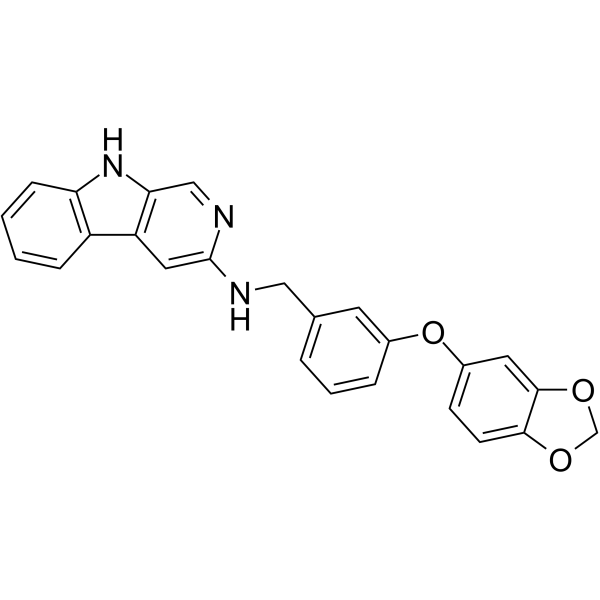
Physicochemical Properties
| Molecular Formula | C25H19N3O3 |
| Molecular Weight | 409.44 |
| CAS # | 2478584-74-4 |
| Appearance | Typically exists as solid at room temperature |
| HS Tariff Code | 2934.99.9001 |
| Storage |
Powder-20°C 3 years 4°C 2 years In solvent -80°C 6 months -20°C 1 month |
| Shipping Condition | Room temperature (This product is stable at ambient temperature for a few days during ordinary shipping and time spent in Customs) |
Biological Activity
| ln Vitro | αβ-tubulin-IN-1 (compound 12 b) (0, 0.5, 1, 5, 10, 50 µM; 16 hours) concentration-dependently increases αβ-tubulin in Hela and K562 (0-10 µM). cells that degrade tubulin[1]. Strong cytotoxic action is shown by αβ-Tubulin-IN-1 against both drug-resistant and susceptible cells [1]. In A2780S and A2780T cells, αβ-Tubulin-IN-1 (0-300 nM; 48 hours) can cause G2/M phase arrest and efficient apoptosis [1]. Human umbilical vein endothelial cells' tumor cell migration and metastasis are inhibited by αβ-Tubulin-IN-1 (0, 1.25, 2.5, 5, 10 nM; 24, 48 h); the inhibition rates are 76.21% and 85.07% at 24 and 48 h, respectively. HUVEC cells [1]. |
| ln Vivo | It has been demonstrated that αβ-Tubulin-IN-1 (5 mg/kg; intravenously, orally) can be given both ways in vivo [1]. In a dose-dependent manner, αβ-Tubulin-IN-1 (10, 20, 40 mg/kg; intravenously administered three times a week for 2-4 weeks) exhibits noteworthy anti-tumor efficacy [1]. Characteristics of αβ-Tubulin-IN-1 pharmacokinetics in rats [1]. Route IVPO dosage (mg/kg) 5 5 T1/2 (h) 3.57±1.10 4.42±1.90 CL (L/h/kg) 1.52±0.39 5.06±1.70 Vss (L/kg) 8.08±4.19 35.26±25.76 AUC0- ∞ (μg/mL·h) 3448.81±782.66 1058.74±285.62 Cmax (μg/L) 2601.47±444.20 189.29±119.02 F (%) 30.70 Rat, 5 mg/kg intravenously, 5 mg/kg orally [1]. |
| Cell Assay |
Cell proliferation assay[1] Cell Types: Hela, A2780S, MCF-7, Raji, H460 Cell Tested Concentrations: 0-500 nM Incubation Duration: 24 hrs (hours) Experimental Results: demonstrated anti-proliferative activity with IC50 of 5, 8, 9,13, Hela, A2780S, MCF-7, Raji, and H460 cells are 14 nM respectively. Western Blot Analysis [1] Cell Types: HeLa cells Tested Concentrations: 10 µM Incubation Duration: 16 h Experimental Results: By binding to the colchicine site, tubulin degradation is Dramatically promoted, and the degradation process depends on the ubiquitin-proteasome pathway . Cell viability assay [1] Cell Types: A2780S, A2780T, A549, A549T, MCF7, MCF7/ADR Cell Tested Concentrations: Incubation Duration: 24 hrs (hours) Experimental Results: demonstrated effective cytotoxic activity, IC50 was 16.4, 13.1, 60.1, 63.8, 11.3, 13.5 nM for A2780S, A2780T, A549, A549T, MCF7, and MCF7/ADR cells respectively. Cell cycle analysis [1] Cell Types: A2780S (PTX sensitive), A2780T (PTX resistant) Cell Tested Concentrations: 0, 3, 10, 30, 100, 300 nM Incubation Duration: 48 hrs (hours) Experimental Results: Induced cell cycle arre |
| Animal Protocol |
Animal/Disease Models: Rat[1] Doses: 5 mg/kg Route of Administration: intravenous (iv) (iv)injection or oral administration Experimental Results: demonstrated oral bioavailability (F=30.70%), T1/2 value of intravenous (iv) (iv)and oral administration methods were 3.57 respectively hrs (hrs (hours)) and 4.42 hrs (hrs (hours)). Animal/Disease Models: 5-6 weeks old female Balb/C and athymic nude mice (A2780S and A2780T xenograft) model [1] Doses: 10, 20, 40 mg/kg intravenously (iv) (iv)(iv), 40 mg/kg orally. Three times a week for 2-4 weeks. Experimental Results: demonstrated significant anti-tumor efficacy. The tumor growth inhibition (TGI) of 10, 20 and 40 mg/kg in the A2780S xenograft nude mouse model was 66.06% and 71.47% respectively. and 92.41%, and 26.94% in the intravenous (iv) (iv)PTX-resistant A2780T xenograft model, TGI doses of 10, 20, and 40 mg/kg, and 37.2%, 75.73% at the oral TGI dose of 40 mg/kg. It was 34.93%, which did not show acceptable anti-tumor efficacy. |
| References |
[1]. Structure-Based Design and Synthesis of N-Substituted 3-Amino-β-Carboline Derivatives as Potent αβ-Tubulin Degradation Agents. J Med Chem. 2022 Feb 10;65(3):2675-2693. |
Solubility Data
| Solubility (In Vitro) | May dissolve in DMSO (in most cases), if not, try other solvents such as H2O, Ethanol, or DMF with a minute amount of products to avoid loss of samples |
| Solubility (In Vivo) |
Note: Listed below are some common formulations that may be used to formulate products with low water solubility (e.g. < 1 mg/mL), you may test these formulations using a minute amount of products to avoid loss of samples. Injection Formulations (e.g. IP/IV/IM/SC) Injection Formulation 1: DMSO : Tween 80: Saline = 10 : 5 : 85 (i.e. 100 μL DMSO stock solution → 50 μL Tween 80 → 850 μL Saline) *Preparation of saline: Dissolve 0.9 g of sodium chloride in 100 mL ddH ₂ O to obtain a clear solution. Injection Formulation 2: DMSO : PEG300 :Tween 80 : Saline = 10 : 40 : 5 : 45 (i.e. 100 μL DMSO → 400 μLPEG300 → 50 μL Tween 80 → 450 μL Saline) Injection Formulation 3: DMSO : Corn oil = 10 : 90 (i.e. 100 μL DMSO → 900 μL Corn oil) Example: Take the Injection Formulation 3 (DMSO : Corn oil = 10 : 90) as an example, if 1 mL of 2.5 mg/mL working solution is to be prepared, you can take 100 μL 25 mg/mL DMSO stock solution and add to 900 μL corn oil, mix well to obtain a clear or suspension solution (2.5 mg/mL, ready for use in animals). Injection Formulation 4: DMSO : 20% SBE-β-CD in saline = 10 : 90 [i.e. 100 μL DMSO → 900 μL (20% SBE-β-CD in saline)] *Preparation of 20% SBE-β-CD in Saline (4°C,1 week): Dissolve 2 g SBE-β-CD in 10 mL saline to obtain a clear solution. Injection Formulation 5: 2-Hydroxypropyl-β-cyclodextrin : Saline = 50 : 50 (i.e. 500 μL 2-Hydroxypropyl-β-cyclodextrin → 500 μL Saline) Injection Formulation 6: DMSO : PEG300 : castor oil : Saline = 5 : 10 : 20 : 65 (i.e. 50 μL DMSO → 100 μLPEG300 → 200 μL castor oil → 650 μL Saline) Injection Formulation 7: Ethanol : Cremophor : Saline = 10: 10 : 80 (i.e. 100 μL Ethanol → 100 μL Cremophor → 800 μL Saline) Injection Formulation 8: Dissolve in Cremophor/Ethanol (50 : 50), then diluted by Saline Injection Formulation 9: EtOH : Corn oil = 10 : 90 (i.e. 100 μL EtOH → 900 μL Corn oil) Injection Formulation 10: EtOH : PEG300:Tween 80 : Saline = 10 : 40 : 5 : 45 (i.e. 100 μL EtOH → 400 μLPEG300 → 50 μL Tween 80 → 450 μL Saline) Oral Formulations Oral Formulation 1: Suspend in 0.5% CMC Na (carboxymethylcellulose sodium) Oral Formulation 2: Suspend in 0.5% Carboxymethyl cellulose Example: Take the Oral Formulation 1 (Suspend in 0.5% CMC Na) as an example, if 100 mL of 2.5 mg/mL working solution is to be prepared, you can first prepare 0.5% CMC Na solution by measuring 0.5 g CMC Na and dissolve it in 100 mL ddH2O to obtain a clear solution; then add 250 mg of the product to 100 mL 0.5% CMC Na solution, to make the suspension solution (2.5 mg/mL, ready for use in animals). Oral Formulation 3: Dissolved in PEG400 Oral Formulation 4: Suspend in 0.2% Carboxymethyl cellulose Oral Formulation 5: Dissolve in 0.25% Tween 80 and 0.5% Carboxymethyl cellulose Oral Formulation 6: Mixing with food powders Note: Please be aware that the above formulations are for reference only. InvivoChem strongly recommends customers to read literature methods/protocols carefully before determining which formulation you should use for in vivo studies, as different compounds have different solubility properties and have to be formulated differently. (Please use freshly prepared in vivo formulations for optimal results.) |
| Preparing Stock Solutions | 1 mg | 5 mg | 10 mg | |
| 1 mM | 2.4424 mL | 12.2118 mL | 24.4236 mL | |
| 5 mM | 0.4885 mL | 2.4424 mL | 4.8847 mL | |
| 10 mM | 0.2442 mL | 1.2212 mL | 2.4424 mL |