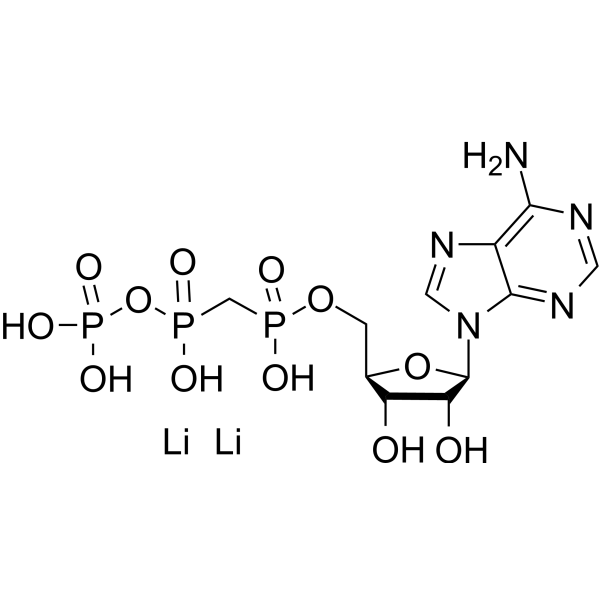
Physicochemical Properties
| Molecular Formula | C11H18LI2N5O12P3 |
| Molecular Weight | 511.14138 |
| Exact Mass | 511.025 |
| CAS # | 104809-20-3 |
| PubChem CID | 23702957 |
| Appearance | Typically exists as solid at room temperature |
| Hydrogen Bond Donor Count | 6 |
| Hydrogen Bond Acceptor Count | 16 |
| Rotatable Bond Count | 8 |
| Heavy Atom Count | 32 |
| Complexity | 813 |
| Defined Atom Stereocenter Count | 4 |
| SMILES | [Li+].NC1=NC=NC2N([C@@H]3O[C@H](COP(CP(OP([O-])(O)=O)(O)=O)(O)=O)[C@@H](O)[C@H]3O)C=NC1=2 |
| InChi Key | NVHVREPTGDOYIC-YCSZXMBFSA-M |
| InChi Code | InChI=1S/C11H18N5O12P3.Li/c12-9-6-10(14-2-13-9)16(3-15-6)11-8(18)7(17)5(27-11)1-26-29(19,20)4-30(21,22)28-31(23,24)25;/h2-3,5,7-8,11,17-18H,1,4H2,(H,19,20)(H,21,22)(H2,12,13,14)(H2,23,24,25);/q;+1/p-1/t5-,7-,8-,11-;/m1./s1 |
| Chemical Name | lithium;[[[(2R,3S,4R,5R)-5-(6-aminopurin-9-yl)-3,4-dihydroxyoxolan-2-yl]methoxy-hydroxyphosphoryl]methyl-hydroxyphosphoryl] hydrogen phosphate |
| Synonyms | 104809-20-3; alpha,beta-Methyleneadenosine 5'-triphosphate lithium salt; AMP-cpp lithium salt; AMP-CPP; DTXSID10635741; lithium;[[[(2R,3S,4R,5R)-5-(6-aminopurin-9-yl)-3,4-dihydroxyoxolan-2-yl]methoxy-hydroxyphosphoryl]methyl-hydroxyphosphoryl] hydrogen phosphate; |
| HS Tariff Code | 2934.99.9001 |
| Storage |
Powder-20°C 3 years 4°C 2 years In solvent -80°C 6 months -20°C 1 month |
| Shipping Condition | Room temperature (This product is stable at ambient temperature for a few days during ordinary shipping and time spent in Customs) |
Biological Activity
| Targets | p2x1 Receptor P2X3 Receptor P2X7 Receptor |
| References |
[1]. Overexpression of P2X3 and P2X7 Receptors and TRPV1 Channels in Adrenomedullary Chromaffin Cells in a Rat Model of Neuropathic Pain. Int J Mol Sci. 2019 Jan 3;20(1). [2]. Activation and regulation of purinergic P2X receptor channels. Pharmacol Rev. 2011 Sep;63(3):641-83. |
| Additional Infomation |
Adenosine 5'-[alpha,beta-methylene]triphosphate is a nucleoside triphosphate analogue. We have tested the hypothesis that neuropathic pain acting as a stressor drives functional plasticity in the sympathoadrenal system. The relation between neuropathic pain and adrenal medulla function was studied with behavioral, immunohistochemical and electrophysiological techniques in rats subjected to chronic constriction injury of the sciatic nerve. In slices of the adrenal gland from neuropathic animals, we have evidenced increased cholinergic innervation and spontaneous synaptic activity at the splanchnic nerve⁻chromaffin cell junction. Likewise, adrenomedullary chromaffin cells displayed enlarged acetylcholine-evoked currents with greater sensitivity to α-conotoxin RgIA, a selective blocker of α9 subunit-containing nicotinic acetylcholine receptors, as well as increased exocytosis triggered by voltage-activated Ca2+ entry. Altogether, these adaptations are expected to facilitate catecholamine output into the bloodstream. Last, but most intriguing, functional and immunohistochemical data indicate that P2X3 and P2X7 purinergic receptors and transient receptor potential vanilloid-1 (TRPV1) channels are overexpressed in chromaffin cells from neuropathic animals. These latter observations are reminiscent of molecular changes characteristic of peripheral sensitization of nociceptors following the lesion of a peripheral nerve, and suggest that similar phenomena can occur in other tissues, potentially contributing to behavioral manifestations of neuropathic pain. [1] Mammalian ATP-gated nonselective cation channels (P2XRs) can be composed of seven possible subunits, denoted P2X1 to P2X7. Each subunit contains a large ectodomain, two transmembrane domains, and intracellular N and C termini. Functional P2XRs are organized as homomeric and heteromeric trimers. This review focuses on the binding sites involved in the activation (orthosteric) and regulation (allosteric) of P2XRs. The ectodomains contain three ATP binding sites, presumably located between neighboring subunits and formed by highly conserved residues. The detection and coordination of three ATP phosphate residues by positively charged amino acids are likely to play a dominant role in determining agonist potency, whereas an AsnPheArg motif may contribute to binding by coordinating the adenine ring. Nonconserved ectodomain histidines provide the binding sites for trace metals, divalent cations, and protons. The transmembrane domains account not only for the formation of the channel pore but also for the binding of ivermectin (a specific P2X4R allosteric regulator) and alcohols. The N- and C- domains provide the structures that determine the kinetics of receptor desensitization and/or pore dilation and are critical for the regulation of receptor functions by intracellular messengers, kinases, reactive oxygen species and mercury. The recent publication of the crystal structure of the zebrafish P2X4.1R in a closed state provides a major advance in the understanding of this family of receptor channels. We will discuss data obtained from numerous site-directed mutagenesis experiments accumulated during the last 15 years with reference to the crystal structure, allowing a structural interpretation of the molecular basis of orthosteric and allosteric ligand actions. [2] |
Solubility Data
| Solubility (In Vitro) | May dissolve in DMSO (in most cases), if not, try other solvents such as H2O, Ethanol, or DMF with a minute amount of products to avoid loss of samples |
| Solubility (In Vivo) |
Note: Listed below are some common formulations that may be used to formulate products with low water solubility (e.g. < 1 mg/mL), you may test these formulations using a minute amount of products to avoid loss of samples. Injection Formulations (e.g. IP/IV/IM/SC) Injection Formulation 1: DMSO : Tween 80: Saline = 10 : 5 : 85 (i.e. 100 μL DMSO stock solution → 50 μL Tween 80 → 850 μL Saline) *Preparation of saline: Dissolve 0.9 g of sodium chloride in 100 mL ddH ₂ O to obtain a clear solution. Injection Formulation 2: DMSO : PEG300 :Tween 80 : Saline = 10 : 40 : 5 : 45 (i.e. 100 μL DMSO → 400 μLPEG300 → 50 μL Tween 80 → 450 μL Saline) Injection Formulation 3: DMSO : Corn oil = 10 : 90 (i.e. 100 μL DMSO → 900 μL Corn oil) Example: Take the Injection Formulation 3 (DMSO : Corn oil = 10 : 90) as an example, if 1 mL of 2.5 mg/mL working solution is to be prepared, you can take 100 μL 25 mg/mL DMSO stock solution and add to 900 μL corn oil, mix well to obtain a clear or suspension solution (2.5 mg/mL, ready for use in animals). Injection Formulation 4: DMSO : 20% SBE-β-CD in saline = 10 : 90 [i.e. 100 μL DMSO → 900 μL (20% SBE-β-CD in saline)] *Preparation of 20% SBE-β-CD in Saline (4°C,1 week): Dissolve 2 g SBE-β-CD in 10 mL saline to obtain a clear solution. Injection Formulation 5: 2-Hydroxypropyl-β-cyclodextrin : Saline = 50 : 50 (i.e. 500 μL 2-Hydroxypropyl-β-cyclodextrin → 500 μL Saline) Injection Formulation 6: DMSO : PEG300 : castor oil : Saline = 5 : 10 : 20 : 65 (i.e. 50 μL DMSO → 100 μLPEG300 → 200 μL castor oil → 650 μL Saline) Injection Formulation 7: Ethanol : Cremophor : Saline = 10: 10 : 80 (i.e. 100 μL Ethanol → 100 μL Cremophor → 800 μL Saline) Injection Formulation 8: Dissolve in Cremophor/Ethanol (50 : 50), then diluted by Saline Injection Formulation 9: EtOH : Corn oil = 10 : 90 (i.e. 100 μL EtOH → 900 μL Corn oil) Injection Formulation 10: EtOH : PEG300:Tween 80 : Saline = 10 : 40 : 5 : 45 (i.e. 100 μL EtOH → 400 μLPEG300 → 50 μL Tween 80 → 450 μL Saline) Oral Formulations Oral Formulation 1: Suspend in 0.5% CMC Na (carboxymethylcellulose sodium) Oral Formulation 2: Suspend in 0.5% Carboxymethyl cellulose Example: Take the Oral Formulation 1 (Suspend in 0.5% CMC Na) as an example, if 100 mL of 2.5 mg/mL working solution is to be prepared, you can first prepare 0.5% CMC Na solution by measuring 0.5 g CMC Na and dissolve it in 100 mL ddH2O to obtain a clear solution; then add 250 mg of the product to 100 mL 0.5% CMC Na solution, to make the suspension solution (2.5 mg/mL, ready for use in animals). Oral Formulation 3: Dissolved in PEG400 Oral Formulation 4: Suspend in 0.2% Carboxymethyl cellulose Oral Formulation 5: Dissolve in 0.25% Tween 80 and 0.5% Carboxymethyl cellulose Oral Formulation 6: Mixing with food powders Note: Please be aware that the above formulations are for reference only. InvivoChem strongly recommends customers to read literature methods/protocols carefully before determining which formulation you should use for in vivo studies, as different compounds have different solubility properties and have to be formulated differently. (Please use freshly prepared in vivo formulations for optimal results.) |
| Preparing Stock Solutions | 1 mg | 5 mg | 10 mg | |
| 1 mM | 1.9564 mL | 9.7821 mL | 19.5641 mL | |
| 5 mM | 0.3913 mL | 1.9564 mL | 3.9128 mL | |
| 10 mM | 0.1956 mL | 0.9782 mL | 1.9564 mL |