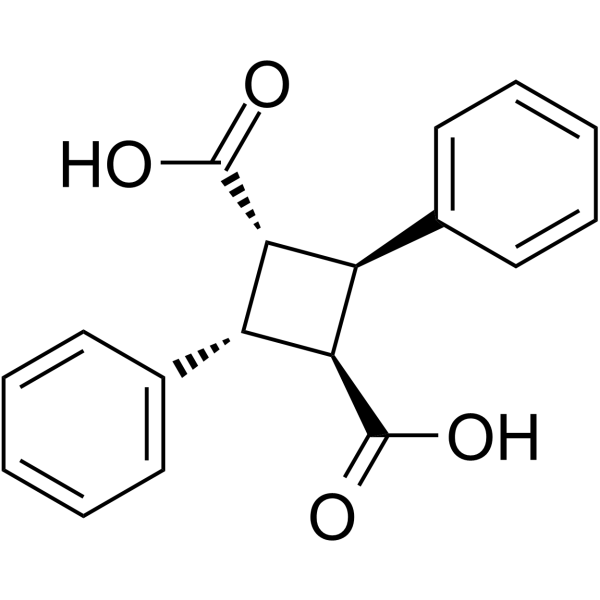
Physicochemical Properties
| Molecular Formula | C18H16O4 |
| Molecular Weight | 296.32 |
| Exact Mass | 296.104 |
| CAS # | 490-20-0 |
| PubChem CID | 78213 |
| Appearance | White to off-white solid powder |
| Density | 1.3±0.1 g/cm3 |
| Boiling Point | 470.5±45.0 °C at 760 mmHg |
| Flash Point | 252.4±25.2 °C |
| Vapour Pressure | 0.0±1.2 mmHg at 25°C |
| Index of Refraction | 1.629 |
| LogP | 3.57 |
| Hydrogen Bond Donor Count | 2 |
| Hydrogen Bond Acceptor Count | 4 |
| Rotatable Bond Count | 4 |
| Heavy Atom Count | 22 |
| Complexity | 369 |
| Defined Atom Stereocenter Count | 0 |
| SMILES | C1=CC=C(C=C1)[C@H]2[C@@H]([C@H](C3=CC=CC=C3)[C@H]2C(=O)O)C(=O)O |
| InChi Key | QWFRRFLKWRIKSZ-UHFFFAOYSA-N |
| InChi Code | InChI=1S/C18H16O4/c19-17(20)15-13(11-7-3-1-4-8-11)16(18(21)22)14(15)12-9-5-2-6-10-12/h1-10,13-16H,(H,19,20)(H,21,22) |
| Chemical Name | 2,4-diphenylcyclobutane-1,3-dicarboxylic acid |
| Synonyms | Truxillic acid; 4462-95-7; 2,4-Diphenyl-1,3-cyclobutanedicarboxylic acid; DTXSID20196252; DTXCID30118743; 490-20-0; alpha-Truxillic Acid; 2,4-Diphenylcyclobutane-1,3-dicarboxylic acid; |
| HS Tariff Code | 2934.99.9001 |
| Storage |
Powder-20°C 3 years 4°C 2 years In solvent -80°C 6 months -20°C 1 month |
| Shipping Condition | Room temperature (This product is stable at ambient temperature for a few days during ordinary shipping and time spent in Customs) |
Biological Activity
| Targets | Its analgesic effects are hypothesized to involve modulation of inflammatory pathways, but direct molecular targets remain unspecified [1] |
| ln Vivo |
- α-Truxillic Acid and its derivatives exhibited significant antinociceptive activity in the mouse formalin test, particularly inhibiting the inflammatory phase (phase II) of pain. Specifically, derivative 4,4'-dihydroxy-α-truxillic acid (compound 2) and 1,3-dibenzoyl-2,4-di(4-chlorophenyl)cyclobutane (compound 6) showed stronger efficacy than indomethacin, a non-steroidal anti-inflammatory drug (NSAID). The inhibitory effect on paw licking time was dose-dependent [1] - Oral or intraperitoneal administration of α-Truxillic Acid derivatives reduced acetic acid-induced writhing in mice, further confirming anti-inflammatory analgesic properties. The magnitude of effect increased with higher doses, though exact ED50 values were not provided [1] |
| Animal Protocol |
- Formalin test: Male mice were administered α-Truxillic Acid or its derivatives via oral gavage or intraperitoneal injection. The compound was dissolved in a mixture of DMSO and PBS (1:12 v/v) to ensure solubility. Thirty minutes after administration, 20 μL of 5% formalin was injected into the hind paw, and the total time spent licking the paw was recorded for 30 minutes (phase I: 0-5 min; phase II: 15-30 min). Indomethacin was used as a positive control [1] - Acetic acid-induced writhing test: Mice received α-Truxillic Acid derivatives (dissolved in DMSO/PBS) intraperitoneally. Ten minutes later, 0.6% acetic acid was injected intraperitoneally, and the number of writhes was counted over 15 minutes [1] |
| References | [1]. Antinociceptive activities of alpha-truxillic acid and beta-truxinic acid derivatives. Biol Pharm Bull. 2006 Mar;29(3):580-4. |
| Additional Infomation |
- α-Truxillic Acid is a dimeric derivative of trans-cinnamic acid, with a cyclobutane core structure. Its antinociceptive activity is structurally dependent: α-configured derivatives showed stronger efficacy than β-isomers, and substitutions (e.g., hydroxyl, chloro groups) on the benzene ring enhanced activity [1] - The mechanism of action is proposed to involve inhibition of inflammatory mediators (e.g., prostaglandins, leukotrienes), though direct evidence (e.g., COX/LOX inhibition) was not provided. The analgesic effect was partially reversed by naloxone, suggesting potential involvement of opioid pathways [1] |
Solubility Data
| Solubility (In Vitro) | DMSO: 125 mg/mL (421.84 mM) |
| Solubility (In Vivo) |
Solubility in Formulation 1: ≥ 2.08 mg/mL (7.02 mM) (saturation unknown) in 10% DMSO + 40% PEG300 + 5% Tween80 + 45% Saline (add these co-solvents sequentially from left to right, and one by one), clear solution. For example, if 1 mL of working solution is to be prepared, you can add 100 μL of 20.8 mg/mL clear DMSO stock solution to 400 μL PEG300 and mix evenly; then add 50 μL Tween-80 to the above solution and mix evenly; then add 450 μL normal saline to adjust the volume to 1 mL. Preparation of saline: Dissolve 0.9 g of sodium chloride in 100 mL ddH₂ O to obtain a clear solution. Solubility in Formulation 2: ≥ 2.08 mg/mL (7.02 mM) (saturation unknown) in 10% DMSO + 90% (20% SBE-β-CD in Saline) (add these co-solvents sequentially from left to right, and one by one), clear solution. For example, if 1 mL of working solution is to be prepared, you can add 100 μL of 20.8 mg/mL clear DMSO stock solution to 900 μL of 20% SBE-β-CD physiological saline solution and mix evenly. Preparation of 20% SBE-β-CD in Saline (4°C,1 week): Dissolve 2 g SBE-β-CD in 10 mL saline to obtain a clear solution. Solubility in Formulation 3: ≥ 2.08 mg/mL (7.02 mM) (saturation unknown) in 10% DMSO + 90% Corn Oil (add these co-solvents sequentially from left to right, and one by one), clear solution. For example, if 1 mL of working solution is to be prepared, you can add 100 μL of 20.8 mg/mL clear DMSO stock solution to 900 μL of corn oil and mix evenly. (Please use freshly prepared in vivo formulations for optimal results.) |
| Preparing Stock Solutions | 1 mg | 5 mg | 10 mg | |
| 1 mM | 3.3747 mL | 16.8737 mL | 33.7473 mL | |
| 5 mM | 0.6749 mL | 3.3747 mL | 6.7495 mL | |
| 10 mM | 0.3375 mL | 1.6874 mL | 3.3747 mL |