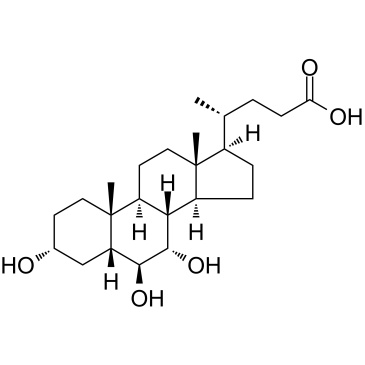
Physicochemical Properties
| Molecular Formula | C24H40O5 |
| Molecular Weight | 408.5714 |
| Exact Mass | 408.288 |
| CAS # | 2393-58-0 |
| PubChem CID | 5283852 |
| Appearance | White to off-white solid powder |
| Density | 1.184g/cm3 |
| Boiling Point | 565.7ºC at 760mmHg |
| Melting Point | 199 - 200 °C |
| Flash Point | 310ºC |
| Vapour Pressure | 3.75E-15mmHg at 25°C |
| Index of Refraction | 1.558 |
| LogP | 3.448 |
| Hydrogen Bond Donor Count | 4 |
| Hydrogen Bond Acceptor Count | 5 |
| Rotatable Bond Count | 4 |
| Heavy Atom Count | 29 |
| Complexity | 637 |
| Defined Atom Stereocenter Count | 11 |
| SMILES | C[C@H](CCC(=O)O)[C@H]1CC[C@@H]2[C@@]1(CC[C@H]3[C@H]2[C@@H]([C@H]([C@H]4[C@@]3(CC[C@H](C4)O)C)O)O)C |
| InChi Key | DKPMWHFRUGMUKF-GDYCBZMLSA-N |
| InChi Code | InChI=1S/C24H40O5/c1-13(4-7-19(26)27)15-5-6-16-20-17(9-11-23(15,16)2)24(3)10-8-14(25)12-18(24)21(28)22(20)29/h13-18,20-22,25,28-29H,4-12H2,1-3H3,(H,26,27)/t13-,14-,15-,16+,17+,18+,20+,21+,22+,23-,24-/m1/s1 |
| Chemical Name | (4R)-4-[(3R,5R,6S,7S,8S,9S,10R,13R,14S,17R)-3,6,7-trihydroxy-10,13-dimethyl-2,3,4,5,6,7,8,9,11,12,14,15,16,17-tetradecahydro-1H-cyclopenta[a]phenanthren-17-yl]pentanoic acid |
| Synonyms | 5β-Cholanic acid-3α,6β,7α-triol; α-Muricholic acid; alpha-Muricholic acid; 2393-58-0; (3a,5b,6b,7a)-3,6,7-trihydroxy-Cholan-24-oic acid; a-Muricholic acid; 5beta-Cholanic acid-3alpha,6beta,7alpha-triol; 3alpha,6beta,7alpha-Trihydroxy-5beta-cholan-24-oic Acid; (4R)-4-[(3R,5R,6S,7S,8S,9S,10R,13R,14S,17R)-3,6,7-trihydroxy-10,13-dimethyl-2,3,4,5,6,7,8,9,11,12,14,15,16,17-tetradecahydro-1H-cyclopenta[a]phenanthren-17-yl]pentanoic acid; 3a,6b,7a-trihydroxy-5b-Cholanic acid; α Muricholic acid |
| HS Tariff Code | 2934.99.9001 |
| Storage |
Powder-20°C 3 years 4°C 2 years In solvent -80°C 6 months -20°C 1 month |
| Shipping Condition | Room temperature (This product is stable at ambient temperature for a few days during ordinary shipping and time spent in Customs) |
Biological Activity
| Targets | Secondary metabolite; microbial metabolite; secondary bile acid; endogenous metabolite |
| ln Vivo | The levels of sulfated and non-sulfated bile acids are measured in the intestines and excrement of male, conventional, 7-month-old germ-free mice. The three main bile acids found in germ-free mice's bile are muricholic acid (β-), α-, and cholic acid [1]. as it comes to primary bile acid, high-fat diet (HFD)-soybean protein isolate (SPI) animals exhibit a significant decrease in α-Muricholic acid as compared to HFD controls [2]. |
| Animal Protocol | Sulfated and non-sulfated bile acids were determined in the intestines and in the feces of 7-month-old germ-free and conventional male mice. 1. The bile acid pools in the gall bladder and small intestine were 21.13 mg/100g body weight in germ-free and 11.50 mg in conventional mice. The bile acid pools in the cecum and large intestine of germ-free mice were 3.03 mg/100 g body weight as compared to 1.24 mg in conventional mice. Fecal bile acid excretion was 2.93 mg and 4.12 mg/100 g body weight in 24 h in germ-free and conventional mice respectively. 2. The major bile acids from germ-free mice were cholic acid, alpha-muricholic acid and beta-muricholic acid. Small amounts of chenodeoxycholic and allocholic acid were also present. In addition to these primary bile acids the following secondary bile acids were identified in conventional mice: lithocholic, deoxycholic and omega-muricholic acid. 3. In both germ-free and conventional animals significant amounts of chenodeoxycholic and cholic acid were present as the 7-monosulfate esters. The sulfate esters of these bile acids did not exceed 2% of the total bile acids in the small intestine, but accounted for approximately 50% of the bile acids in the cecum and the large intestine. In contrast, the muricholic acids were nearly exclusively found in the non-sulfate fraction. 4. Alkaline hydrolysis without prior solvolysis of the sulfate esters resulted in loss of bile acids and production of artifacts. Hence, the bile acids of the mouse cannot be analysed by methods involving alkaline deconjugation unless a solvolysis step is included in the procedure. [2] |
| References |
[1]. Sulfate bile acids in germ-free and conventional mice. Eur J Biochem. 1976 Jul 15;66(3):507-14. [2]. Dietary soybean protein ameliorates high-fat diet-induced obesity by modifying the gut microbiota-dependent biotransformation of bile acids. PLoS One. 2018 Aug 13;13(8):e0202083. |
| Additional Infomation |
Alpha-muricholic acid is a member of the class of muricholic acids in which the hydroxy groups at positions 6 and 7 have beta- and alpha- configuration respectively. It is a member of muricholic acids, a 6beta-hydroxy steroid and a 7alpha-hydroxy steroid. It is a conjugate acid of an alpha-muricholate. See also: alpha-Muricholate (annotation moved to). |
Solubility Data
| Solubility (In Vitro) | May dissolve in DMSO (in most cases), if not, try other solvents such as H2O, Ethanol, or DMF with a minute amount of products to avoid loss of samples |
| Solubility (In Vivo) |
Note: Listed below are some common formulations that may be used to formulate products with low water solubility (e.g. < 1 mg/mL), you may test these formulations using a minute amount of products to avoid loss of samples. Injection Formulations (e.g. IP/IV/IM/SC) Injection Formulation 1: DMSO : Tween 80: Saline = 10 : 5 : 85 (i.e. 100 μL DMSO stock solution → 50 μL Tween 80 → 850 μL Saline) *Preparation of saline: Dissolve 0.9 g of sodium chloride in 100 mL ddH ₂ O to obtain a clear solution. Injection Formulation 2: DMSO : PEG300 :Tween 80 : Saline = 10 : 40 : 5 : 45 (i.e. 100 μL DMSO → 400 μLPEG300 → 50 μL Tween 80 → 450 μL Saline) Injection Formulation 3: DMSO : Corn oil = 10 : 90 (i.e. 100 μL DMSO → 900 μL Corn oil) Example: Take the Injection Formulation 3 (DMSO : Corn oil = 10 : 90) as an example, if 1 mL of 2.5 mg/mL working solution is to be prepared, you can take 100 μL 25 mg/mL DMSO stock solution and add to 900 μL corn oil, mix well to obtain a clear or suspension solution (2.5 mg/mL, ready for use in animals). Injection Formulation 4: DMSO : 20% SBE-β-CD in saline = 10 : 90 [i.e. 100 μL DMSO → 900 μL (20% SBE-β-CD in saline)] *Preparation of 20% SBE-β-CD in Saline (4°C,1 week): Dissolve 2 g SBE-β-CD in 10 mL saline to obtain a clear solution. Injection Formulation 5: 2-Hydroxypropyl-β-cyclodextrin : Saline = 50 : 50 (i.e. 500 μL 2-Hydroxypropyl-β-cyclodextrin → 500 μL Saline) Injection Formulation 6: DMSO : PEG300 : castor oil : Saline = 5 : 10 : 20 : 65 (i.e. 50 μL DMSO → 100 μLPEG300 → 200 μL castor oil → 650 μL Saline) Injection Formulation 7: Ethanol : Cremophor : Saline = 10: 10 : 80 (i.e. 100 μL Ethanol → 100 μL Cremophor → 800 μL Saline) Injection Formulation 8: Dissolve in Cremophor/Ethanol (50 : 50), then diluted by Saline Injection Formulation 9: EtOH : Corn oil = 10 : 90 (i.e. 100 μL EtOH → 900 μL Corn oil) Injection Formulation 10: EtOH : PEG300:Tween 80 : Saline = 10 : 40 : 5 : 45 (i.e. 100 μL EtOH → 400 μLPEG300 → 50 μL Tween 80 → 450 μL Saline) Oral Formulations Oral Formulation 1: Suspend in 0.5% CMC Na (carboxymethylcellulose sodium) Oral Formulation 2: Suspend in 0.5% Carboxymethyl cellulose Example: Take the Oral Formulation 1 (Suspend in 0.5% CMC Na) as an example, if 100 mL of 2.5 mg/mL working solution is to be prepared, you can first prepare 0.5% CMC Na solution by measuring 0.5 g CMC Na and dissolve it in 100 mL ddH2O to obtain a clear solution; then add 250 mg of the product to 100 mL 0.5% CMC Na solution, to make the suspension solution (2.5 mg/mL, ready for use in animals). Oral Formulation 3: Dissolved in PEG400 Oral Formulation 4: Suspend in 0.2% Carboxymethyl cellulose Oral Formulation 5: Dissolve in 0.25% Tween 80 and 0.5% Carboxymethyl cellulose Oral Formulation 6: Mixing with food powders Note: Please be aware that the above formulations are for reference only. InvivoChem strongly recommends customers to read literature methods/protocols carefully before determining which formulation you should use for in vivo studies, as different compounds have different solubility properties and have to be formulated differently. (Please use freshly prepared in vivo formulations for optimal results.) |
| Preparing Stock Solutions | 1 mg | 5 mg | 10 mg | |
| 1 mM | 2.4476 mL | 12.2378 mL | 24.4756 mL | |
| 5 mM | 0.4895 mL | 2.4476 mL | 4.8951 mL | |
| 10 mM | 0.2448 mL | 1.2238 mL | 2.4476 mL |