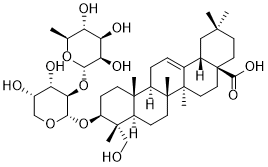
Physicochemical Properties
| Molecular Formula | C41H66O12 |
| Molecular Weight | 750.9556 |
| Exact Mass | 750.455 |
| CAS # | 27013-91-8 |
| PubChem CID | 73296 |
| Appearance | White to off-white solid powder |
| Density | 1.3±0.1 g/cm3 |
| Boiling Point | 849.6±65.0 °C at 760 mmHg |
| Melting Point | 215ºC (dec.) |
| Flash Point | 250.7±27.8 °C |
| Vapour Pressure | 0.0±0.6 mmHg at 25°C |
| Index of Refraction | 1.601 |
| LogP | 8.37 |
| Hydrogen Bond Donor Count | 7 |
| Hydrogen Bond Acceptor Count | 12 |
| Rotatable Bond Count | 6 |
| Heavy Atom Count | 53 |
| Complexity | 1440 |
| Defined Atom Stereocenter Count | 18 |
| SMILES | O(C1([H])C([H])(C([H])(C([H])(C([H])([H])O1)O[H])O[H])OC1([H])C([H])(C([H])(C([H])(C([H])(C([H])([H])[H])O1)O[H])O[H])O[H])C1([H])C([H])([H])C([H])([H])C2(C([H])([H])[H])C([H])(C([H])([H])C([H])([H])C3(C([H])([H])[H])C4(C([H])([H])[H])C([H])([H])C([H])([H])C5(C(=O)O[H])C([H])([H])C([H])([H])C(C([H])([H])[H])(C([H])([H])[H])C([H])([H])C5([H])C4=C([H])C([H])([H])C32[H])C1(C([H])([H])[H])C([H])([H])O[H] |
| InChi Key | KEOITPILCOILGM-LLJOFIFVSA-N |
| InChi Code | InChI=1S/C41H66O12/c1-21-28(44)30(46)31(47)33(51-21)53-32-29(45)24(43)19-50-34(32)52-27-11-12-37(4)25(38(27,5)20-42)10-13-40(7)26(37)9-8-22-23-18-36(2,3)14-16-41(23,35(48)49)17-15-39(22,40)6/h8,21,23-34,42-47H,9-20H2,1-7H3,(H,48,49)/t21-,23-,24-,25+,26+,27-,28-,29-,30+,31+,32+,33-,34-,37-,38-,39+,40+,41-/m0/s1 |
| Chemical Name | (4aS,6aR,6aS,6bR,8aR,9R,10S,12aR,14bS)-10-[(2S,3R,4S,5S)-4,5-dihydroxy-3-[(2S,3R,4R,5R,6S)-3,4,5-trihydroxy-6-methyloxan-2-yl]oxyoxan-2-yl]oxy-9-(hydroxymethyl)-2,2,6a,6b,9,12a-hexamethyl-1,3,4,5,6,6a,7,8,8a,10,11,12,13,14b-tetradecahydropicene-4a-carboxylic acid |
| HS Tariff Code | 2934.99.9001 |
| Storage |
Powder-20°C 3 years 4°C 2 years In solvent -80°C 6 months -20°C 1 month |
| Shipping Condition | Room temperature (This product is stable at ambient temperature for a few days during ordinary shipping and time spent in Customs) |
Biological Activity
| ln Vitro | α-Hederin is cytotoxic and, at comparatively low concentrations, prevents both cell lines from proliferating. Treated cells exhibit less mitotic activity when exposed to α-Hederin [2]. |
| ln Vivo | Similar to thymoquinone, α-hederin also acts as a preventative measure in sensitized rats. It might suppress the inflammatory response by interfering with the expression of miRNA-126, which would disrupt the IL-13 secretion pathway [3]. |
| References |
[1]. Wang J, et al. α-Hederin induces the apoptosis of gastric cancer cells accompanied by glutathione decrement and reactive oxygen species generation via activating mitochondrial dependent pathway. Phytother Res. 2020;34(3):601-611. [2]. Danloy S et al. Effects of alpha-hederin, a saponin extracted from Hedera helix, on cells cultured in vitro. Planta Med, 1994 Feb, 60(1):45-9. [3]. Maryam Fallahi et al. Effect of Alpha-Hederin, the active constituent of Nigella sativa, on miRNA-126, IL-13 mRNA levels and inflammation of lungs in ovalbumin-sensitized male rats. Planta Med, 1994 Feb, 60(1):45-9. |
| Additional Infomation |
Kalopanaxsaponin A is a triterpenoid saponin that is hederagenin attached to a 2-O-(6-deoxy-alpha-L-mannopyranosyl)-alpha-L-arabinopyranosyl residue at position 3 via a glycosidic linkage. It has been isolated from the stem bark of Kalopanax pictus. It has a role as an anti-inflammatory agent and a plant metabolite. It is a pentacyclic triterpenoid, a triterpenoid saponin, a disaccharide derivative and a hydroxy monocarboxylic acid. It is functionally related to a hederagenin. alpha-Hederin has been reported in Lonicera macrantha, Anemone taipaiensis, and other organisms with data available. |
Solubility Data
| Solubility (In Vitro) |
DMSO : ≥ 100 mg/mL (~133.16 mM) H2O : < 0.1 mg/mL |
| Solubility (In Vivo) |
Solubility in Formulation 1: ≥ 2.5 mg/mL (3.33 mM) (saturation unknown) in 10% DMSO + 40% PEG300 + 5% Tween80 + 45% Saline (add these co-solvents sequentially from left to right, and one by one), clear solution. For example, if 1 mL of working solution is to be prepared, you can add 100 μL of 25.0 mg/mL clear DMSO stock solution to 400 μL PEG300 and mix evenly; then add 50 μL Tween-80 to the above solution and mix evenly; then add 450 μL normal saline to adjust the volume to 1 mL. Preparation of saline: Dissolve 0.9 g of sodium chloride in 100 mL ddH₂ O to obtain a clear solution. Solubility in Formulation 2: ≥ 2.5 mg/mL (3.33 mM) (saturation unknown) in 10% DMSO + 90% (20% SBE-β-CD in Saline) (add these co-solvents sequentially from left to right, and one by one), clear solution. For example, if 1 mL of working solution is to be prepared, you can add 100 μL of 25.0 mg/mL clear DMSO stock solution to 900 μL of 20% SBE-β-CD physiological saline solution and mix evenly. Preparation of 20% SBE-β-CD in Saline (4°C,1 week): Dissolve 2 g SBE-β-CD in 10 mL saline to obtain a clear solution. Solubility in Formulation 3: ≥ 2.5 mg/mL (3.33 mM) (saturation unknown) in 10% DMSO + 90% Corn Oil (add these co-solvents sequentially from left to right, and one by one), clear solution. For example, if 1 mL of working solution is to be prepared, you can add 100 μL of 25.0 mg/mL clear DMSO stock solution to 900 μL of corn oil and mix evenly. (Please use freshly prepared in vivo formulations for optimal results.) |
| Preparing Stock Solutions | 1 mg | 5 mg | 10 mg | |
| 1 mM | 1.3316 mL | 6.6581 mL | 13.3163 mL | |
| 5 mM | 0.2663 mL | 1.3316 mL | 2.6633 mL | |
| 10 mM | 0.1332 mL | 0.6658 mL | 1.3316 mL |