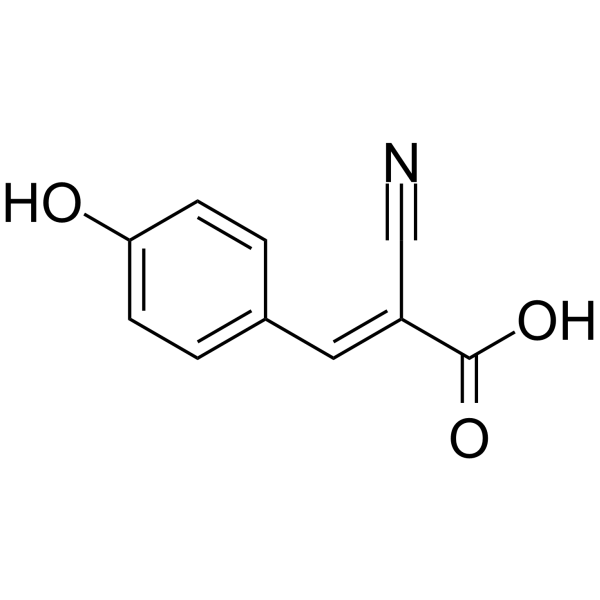
Physicochemical Properties
| Molecular Formula | C₁₀H₇NO₃ |
| Molecular Weight | 189.17 |
| Exact Mass | 189.042 |
| CAS # | 28166-41-8 |
| PubChem CID | 5328791 |
| Appearance | Light yellow to yellow solid powder |
| Density | 1.4±0.1 g/cm3 |
| Boiling Point | 398.1±32.0 °C at 760 mmHg |
| Melting Point | 245-250 °C(lit.) |
| Flash Point | 194.5±25.1 °C |
| Vapour Pressure | 0.0±1.0 mmHg at 25°C |
| Index of Refraction | 1.674 |
| LogP | 1.53 |
| Hydrogen Bond Donor Count | 2 |
| Hydrogen Bond Acceptor Count | 4 |
| Rotatable Bond Count | 2 |
| Heavy Atom Count | 14 |
| Complexity | 292 |
| Defined Atom Stereocenter Count | 0 |
| SMILES | C1=CC(=CC=C1/C=C(\C#N)/C(=O)O)O |
| InChi Key | AFVLVVWMAFSXCK-VMPITWQZSA-N |
| InChi Code | InChI=1S/C10H7NO3/c11-6-8(10(13)14)5-7-1-3-9(12)4-2-7/h1-5,12H,(H,13,14)/b8-5+ |
| Chemical Name | (E)-2-cyano-3-(4-hydroxyphenyl)prop-2-enoic acid |
| Synonyms | αCyano4hydroxycinnamic acid α Cyano 4 hydroxycinnamic acid |
| HS Tariff Code | 2934.99.9001 |
| Storage |
Powder-20°C 3 years 4°C 2 years In solvent -80°C 6 months -20°C 1 month |
| Shipping Condition | Room temperature (This product is stable at ambient temperature for a few days during ordinary shipping and time spent in Customs) |
Biological Activity
| ln Vitro | α-Cyano-4-Hydroxycinnamic Acid (α-Cyano-4-Hydroxycinnamic Acid) prevents monocarboxylates like pyruvate and lactate from being transported [2]. Lung explants' epithelial circumference was lowered and branching morphogenesis was significantly inhibited by α-cyano-4-hydroxycinnamic acid (CHC; 0.5 and 1 mM) at 1 mM in a dose-dependent manner. region[2]. At a dosage of 100 μM, α-Cyano-4-hydroxycinnamic acid inhibits oxidized pyruvate's ability to absorb O2 in rat heart mitochondria quickly and nearly entirely. As low as 1 μM of inhibitor can cause inhibition, however it takes time for inhibition to manifest at this dosage [1]. |
| References |
[1]. The mitochondrial pyruvate carrier. Kinetics and specificity for substrates and inhibitors. Biochem J. 1975 Apr; 148(1): 85-96. [2]. The Monocarboxylate Transporter Inhibitor α-cyano-4-hydroxycinnamic Acid Disrupts Rat Lung Branching. Cell Physiol Biochem. 2013;32(6):1845-56. [3]. Improvement of Mass Spectrometry Analysis of Glycoproteins by MALDI-MS Using 3-aminoquinoline/α-cyano-4-hydroxycinnamic Acid. Anal Bioanal Chem. 2013 May;405(12):4289-93. |
| Additional Infomation |
Alpha-cyano-4-hydroxycinnamic acid is a monohydroxycinnamic acid that is 4-hydroxycinnamic acid in which the hydrogen alpha- to the carboxy group is replaced by a cyano group. It is used as a matrix in matrix-assisted laser desorption/ionization (MALDI) mass spectrometry for the analysis of peptides and oligonucleotides. It has a role as a MALDI matrix material. It is a nitrile, a member of phenols and a monohydroxycinnamic acid. See also: alpha-Cyano-4-hydroxycinnamate (annotation moved to). |
Solubility Data
| Solubility (In Vitro) |
DMSO : ~250 mg/mL (~1321.56 mM) H2O : < 0.1 mg/mL |
| Solubility (In Vivo) |
Solubility in Formulation 1: ≥ 2.08 mg/mL (11.00 mM) (saturation unknown) in 10% DMSO + 40% PEG300 + 5% Tween80 + 45% Saline (add these co-solvents sequentially from left to right, and one by one), clear solution. For example, if 1 mL of working solution is to be prepared, you can add 100 μL of 20.8 mg/mL clear DMSO stock solution to 400 μL PEG300 and mix evenly; then add 50 μL Tween-80 to the above solution and mix evenly; then add 450 μL normal saline to adjust the volume to 1 mL. Preparation of saline: Dissolve 0.9 g of sodium chloride in 100 mL ddH₂ O to obtain a clear solution. Solubility in Formulation 2: ≥ 2.08 mg/mL (11.00 mM) (saturation unknown) in 10% DMSO + 90% (20% SBE-β-CD in Saline) (add these co-solvents sequentially from left to right, and one by one), clear solution. For example, if 1 mL of working solution is to be prepared, you can add 100 μL of 20.8 mg/mL clear DMSO stock solution to 900 μL of 20% SBE-β-CD physiological saline solution and mix evenly. Preparation of 20% SBE-β-CD in Saline (4°C,1 week): Dissolve 2 g SBE-β-CD in 10 mL saline to obtain a clear solution. Solubility in Formulation 3: ≥ 2.08 mg/mL (11.00 mM) (saturation unknown) in 10% DMSO + 90% Corn Oil (add these co-solvents sequentially from left to right, and one by one), clear solution. For example, if 1 mL of working solution is to be prepared, you can add 100 μL of 20.8 mg/mL clear DMSO stock solution to 900 μL of corn oil and mix evenly. (Please use freshly prepared in vivo formulations for optimal results.) |
| Preparing Stock Solutions | 1 mg | 5 mg | 10 mg | |
| 1 mM | 5.2863 mL | 26.4313 mL | 52.8625 mL | |
| 5 mM | 1.0573 mL | 5.2863 mL | 10.5725 mL | |
| 10 mM | 0.5286 mL | 2.6431 mL | 5.2863 mL |