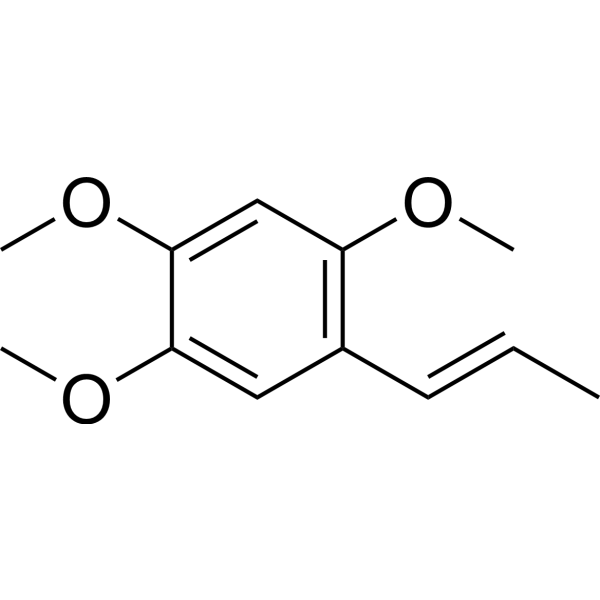
Physicochemical Properties
| Molecular Formula | C12H16O3 |
| Molecular Weight | 208.2536 |
| Exact Mass | 208.109 |
| CAS # | 2883-98-9 |
| PubChem CID | 636822 |
| Appearance | White to off-white solid powder |
| Density | 1.0±0.1 g/cm3 |
| Boiling Point | 296.0±0.0 °C at 760 mmHg |
| Melting Point | 57-61 °C(lit.) |
| Flash Point | 107.7±23.8 °C |
| Vapour Pressure | 0.0±0.6 mmHg at 25°C |
| Index of Refraction | 1.526 |
| LogP | 2.98 |
| Hydrogen Bond Donor Count | 0 |
| Hydrogen Bond Acceptor Count | 3 |
| Rotatable Bond Count | 4 |
| Heavy Atom Count | 15 |
| Complexity | 203 |
| Defined Atom Stereocenter Count | 0 |
| SMILES | C/C=C/C1=CC(=C(C=C1OC)OC)OC |
| InChi Key | RKFAZBXYICVSKP-AATRIKPKSA-N |
| InChi Code | InChI=1S/C12H16O3/c1-5-6-9-7-11(14-3)12(15-4)8-10(9)13-2/h5-8H,1-4H3/b6-5+ |
| Chemical Name | 1,2,4-trimethoxy-5-[(E)-prop-1-enyl]benzene |
| HS Tariff Code | 2934.99.9001 |
| Storage |
Powder-20°C 3 years 4°C 2 years In solvent -80°C 6 months -20°C 1 month |
| Shipping Condition | Room temperature (This product is stable at ambient temperature for a few days during ordinary shipping and time spent in Customs) |
Biological Activity
| Targets |
- Noradrenergic system (α2-adrenoceptors) [1] - Serotonergic system (5-HT1A receptors) [1] - Nuclear factor-κB (NF-κB) signaling pathway [2] - Matrix metalloproteinases (MMP-2, MMP-9) [3] - Microglia-mediated neuroinflammation-related targets [2] - Vascular endothelial cell proliferation and angiogenesis-related targets (IC50 = 42.5 ± 3.2 μM for HUVEC proliferation) [3] |
| ln Vitro |
The results demonstrated that α-asarone effectively decreased the rise in neuroinflammatory response caused by LPS and inhibited the production of pro-inflammatory cytokines in BV-2 cells. Mechanistic investigations have demonstrated that α-Asarone reduces the activation of LPS stimulation by preventing the breakdown of the inhibitor kappa B-α signal in BV-2 microglia and regulating nuclear factor kappa-B [2]. - alpha-Asarone inhibited LPS-induced neuroinflammation in BV2 microglial cells. At 10, 20, 40 μM, it dose-dependently reduced TNF-α (32±4%, 58±5%, 73±6%), IL-1β (28±3%, 52±4%, 69±5%), and NO (25±3%, 48±4%, 65±5%) production compared to the model group [2] - It suppressed NF-κB activation in BV2 cells: 40 μM alpha-Asarone reduced IκBα phosphorylation by 62±5% and NF-κB p65 nuclear translocation by 58±4% [2] - The compound inhibited angiogenesis in human umbilical vein endothelial cells (HUVECs): it suppressed cell proliferation with an IC50 of 42.5 ± 3.2 μM, reduced migration by 56±4% (40 μM), and inhibited tube formation by 63±5% (40 μM) [3] - It downregulated MMP-2 and MMP-9 expression and activity in HUVECs: 40 μM reduced MMP-2 activity by 59±4% and MMP-9 activity by 64±5% (gelatin zymography assay) [3] - No significant cytotoxicity was observed in BV2 cells (up to 80 μM) and HUVECs (up to 100 μM) [2][3] |
| ln Vivo |
The current findings show that an acute alpha-asarone therapy causes an immobile biphasic response. This means that at lower doses of alpha-asarone (15 and 20 mg/kg, i.p.), the duration of immobility is reduced, while at larger dosages, it increases. TST doses (i.p., 50 and 100 mg/kg). Furthermore, greater intraperitoneal injection doses of α-Asarone (50 and 100 mg/kg) markedly decreased spontaneous locomotor activity [1]. - Antidepressant-like activity in mice: Oral administration of alpha-Asarone (10, 20 mg/kg) significantly shortened immobility time in the tail suspension test (TST) by 28±3% and 42±4%, respectively, compared to the control group. The effect was blocked by α2-adrenoceptor antagonist (yohimbine) and 5-HT1A receptor antagonist (WAY-100635) [1] - Attenuated Parkinson's disease (PD) in MPTP-induced mice: Intraperitoneal injection of alpha-Asarone (20, 40 mg/kg daily for 14 days) improved motor deficits (rotarod test: 35±4% and 52±5% increase in latency) and reduced dopaminergic neuron loss in the substantia nigra (38±4% and 55±5% protection) [2] - Inhibited neuroinflammation in PD mice: 40 mg/kg alpha-Asarone reduced microglial activation (Iba-1 staining) by 62±5% and decreased TNF-α, IL-1β levels in the striatum by 58±4% and 61±5%, respectively [2] - Inhibited angiogenesis in vivo: alpha-Asarone (50, 100 mg/kg oral) reduced blood vessel density in the chick chorioallantoic membrane (CAM) model by 45±4% and 68±5%, and suppressed tumor angiogenesis in a mouse xenograft model (4T1 breast cancer) by 52±5% (100 mg/kg) [3] |
| Enzyme Assay |
- NF-κB activity assay: BV2 cells were treated with alpha-Asarone (20, 40 μM) for 1 h, then stimulated with LPS for 6 h. Nuclear extracts were prepared, and NF-κB DNA-binding activity was measured using an electrophoretic mobility shift assay (EMSA) [2] - MMP activity assay: HUVECs were treated with alpha-Asarone (20, 40 μM) for 24 h. Culture supernatants were collected, and MMP-2/MMP-9 activity was detected by gelatin zymography (electrophoresis on gelatin-containing gels, followed by staining and destaining to visualize lytic bands) [3] |
| Cell Assay |
- Microglial inflammation assay: BV2 cells were seeded in 96-well plates (1×10⁴ cells/well) and 6-well plates (2×10⁵ cells/well). After overnight incubation, cells were pretreated with alpha-Asarone (10, 20, 40 μM) for 1 h, then stimulated with LPS for 24 h. Cytokine (TNF-α, IL-1β) levels were measured by ELISA; NO production by Griess reagent; NF-κB pathway proteins by Western blot [2] - HUVEC angiogenesis assay: HUVECs were seeded in 96-well plates (5×10³ cells/well) for proliferation assay (CCK-8 method), 6-well plates for migration assay (scratch test), and Matrigel-coated plates for tube formation assay. Cells were treated with alpha-Asarone (10, 20, 40, 80 μM) for 24–48 h, and relevant indicators were quantified [3] |
| Animal Protocol |
- Tail suspension test (TST) in mice: Male ICR mice (20–25 g) were randomly divided into control (vehicle oral) and alpha-Asarone groups (10, 20, 40 mg/kg oral). The compound was dissolved in 0.5% carboxymethylcellulose sodium and administered once daily for 7 days. On day 7, immobility time in TST was recorded for 6 minutes. For antagonist experiments, yohimbine (1 mg/kg i.p.) or WAY-100635 (0.5 mg/kg i.p.) was injected 30 minutes before alpha-Asarone administration [1] - MPTP-induced PD mouse model: Male C57BL/6 mice (22–25 g) were injected with MPTP (20 mg/kg i.p.) daily for 5 days to induce PD. alpha-Asarone (20, 40 mg/kg i.p.) was administered daily for 14 days starting from the first day of MPTP injection. Motor function was evaluated by rotarod test; dopaminergic neurons were detected by immunohistochemistry (TH staining); neuroinflammation markers by ELISA and Western blot [2] - Angiogenesis models: Chick embryos (day 3) were treated with alpha-Asarone (50, 100 μg/egg) on the CAM for 48 h, then blood vessel density was counted. For xenograft model, BALB/c nude mice (18–22 g) were implanted with 4T1 cells, and alpha-Asarone (50, 100 mg/kg oral) was administered every other day for 21 days. Tumor volume and angiogenesis (CD31 staining) were measured [3] |
| Toxicity/Toxicokinetics |
Interactions The action of asarone and beta-asarone, alone or in combination with either reserpine or chloropromazine, on conditioned avoidance behavior in rats, fighting behavior in mice, and electroshock convulsions in rats was determined. ... Asarone potentiated the action of reserpine and chlorpromazine on conditioned avoidance behavior and fighting behavior; beta-asarone did not. ... Asarone potentiated the lethal effect of chlorpromazine during electroshock convulsions; beta-asarone did not. Pretreatment with Acorus oil, asarone, or beta-asarone did not increase the concentration of 5-hydroxytryptamine in rat brain. /Asarones/ Non-Human Toxicity Values LD50 Rat oral 1010 mg/kg bw /beta-Asarone/ LD50 Mouse oral 184.2 mg/kg bw /beta-asarone/ LD50 Mouse oral 418 mg/kg LD50 Mouse ip 310 mg/kg - alpha-Asarone showed no significant cytotoxicity to BV2 cells (up to 80 μM) and HUVECs (up to 100 μM) [2][3] - No obvious toxic side effects (abnormal behavior, organ damage) were observed in in vivo experiments at therapeutic doses (10–100 mg/kg) [1][2][3] |
| References |
[1]. Biphasic Effects of α-Asarone on Immobility in the Tail Suspension Test: Evidence for the Involvement of the Noradrenergic and Serotonergic Systems in Its Antidepressant-Like Activity. Front Pharmacol. 2016; 7: 72. [2]. α-Asarone attenuates microglia-mediated neuroinflammation by inhibiting NF kappa B activation and mitigates MPTP-induced behavioral deficits in a mouse model of Parkinson's disease. Neuropharmacology, Volume 97, October 2015, Pages 46–57. [3]. Effect of α-asarone on angiogenesis and matrix metalloproteinase. Environmental Toxicology and Pharmacology, Volume 39, Issue 3, May 2015, Pages 1107–1114. |
| Additional Infomation |
Alpha-asarone is the trans-isomer of asarone. It has a role as an anticonvulsant and a GABA modulator. alpha-Asarone has been reported in Perilla frutescens, Asarum hypogynum, and other organisms with data available. See also: beta-Asarone (annotation moved to). Mechanism of Action Docking experiments using a number of published crystal structures of HMG-CoA reductase with the potent hypocholesterolemic agent alpha-asarone are described. The results indicate that alpha-asarone binds in the enzyme's active site. The methoxy groups play a key role in the binding and probably also in its biological activity, as shown by extensive SAR studies reported for analogues of alpha-asarone. The docking results will be valuable for the structure-based design of novel hypolipidemic agents. Therapeutic Uses /EXPTL THER/ The results of the present report show that alpha-asarone was an inhibitor of hepatic HMG-CoA reductase and that the administration of alpha-asarone at 80 mg/kg bw for 8 days decreased serum cholesterol by 38% (p < 0.001) in hypercholesterolemic rats. This alpha-asarone treatment affected mainly the serum LDL-cholesterol levels, leaving serum HDL-cholesterol lipoproteins unaffected, with a consequent decrease of 74% in the LDL/HDL ratio. In addition, alpha-asarone especially stimulated bile flow in hypercholesterolemic rats (60%), increasing the secretion of bile salts, phospholipids and bile cholesterol. The drug also reduced the cholesterol levels of gallbladder bile, whereas the concentration of phospholipids and bile salts increased only slightly, leading to a decrease in the cholesterol saturation index (CSI) of bile in the hypercholesterolemic rats. This CSI decrease and the increase in bile flow induced by alpha-asarone may account for the cholelitholytic effect of alpha-asarone. It seems that alpha-asarone induced clearance of cholesterol from the bloodstream and that the excess of hepatic cholesterol provided by LDL-cholesterol is diverted to bile sterol secretion via a bile choleresis process. The inhibition of HMG-CoA reductase and the increase in bile flow induced by alpha-asarone, as well as the decrease in the CSI, could then explain the hypocholesterolemic and cholelitholytic effects of alpha-asarone. /EXPTL THER/ After daily dosing po of 80 mg/kg of alpha-asarone ... for seven days to hypercholesterolemic male rats, cholesterol decreased 57.3% ... and triglycerides diminished 42.5% ..., respectively. ... alpha-asarone decreased 80.6% the weight of gallstones in hamsters. ... Alpha-asarone did not produce any toxic effect after oral administration to rats of 10 or 50 mg/kg for 28 days, or genotoxicity by the dominant lethal test. ... No teratogenicity was observed in pregnant rats during organogenesis but in mice slight fetal toxicity was manifested by hydrocephaly, skeletal defects and fetal weight retardation ... /EXPTL THER/ There was no significant difference between the antifungal activity of beta and alpha-asarone in crude drugs. - alpha-Asarone is a natural phenylpropanoid compound isolated from plants of the Araceae family (e.g., Acorus tatarinowii) [1][2][3] - Its antidepressant-like mechanism involves activation of α2-adrenoceptors and 5-HT1A receptors in the brain [1] - The anti-PD effect is mediated by inhibiting microglial activation and neuroinflammation via blocking the NF-κB signaling pathway [2] - It exerts anti-angiogenic activity by downregulating MMP-2/MMP-9 expression and inhibiting HUVEC proliferation, migration, and tube formation [3] - alpha-Asarone has potential therapeutic applications in depression, Parkinson's disease, and angiogenesis-related diseases (e.g., cancer) [1][2][3] |
Solubility Data
| Solubility (In Vitro) |
DMSO : ~100 mg/mL (~480.19 mM) H2O : ~0.67 mg/mL (~3.22 mM) |
| Solubility (In Vivo) |
Solubility in Formulation 1: ≥ 2.5 mg/mL (12.00 mM) (saturation unknown) in 10% DMSO + 40% PEG300 + 5% Tween80 + 45% Saline (add these co-solvents sequentially from left to right, and one by one), clear solution. For example, if 1 mL of working solution is to be prepared, you can add 100 μL of 25.0 mg/mL clear DMSO stock solution to 400 μL PEG300 and mix evenly; then add 50 μL Tween-80 to the above solution and mix evenly; then add 450 μL normal saline to adjust the volume to 1 mL. Preparation of saline: Dissolve 0.9 g of sodium chloride in 100 mL ddH₂ O to obtain a clear solution. Solubility in Formulation 2: ≥ 2.5 mg/mL (12.00 mM) (saturation unknown) in 10% DMSO + 90% (20% SBE-β-CD in Saline) (add these co-solvents sequentially from left to right, and one by one), clear solution. For example, if 1 mL of working solution is to be prepared, you can add 100 μL of 25.0 mg/mL clear DMSO stock solution to 900 μL of 20% SBE-β-CD physiological saline solution and mix evenly. Preparation of 20% SBE-β-CD in Saline (4°C,1 week): Dissolve 2 g SBE-β-CD in 10 mL saline to obtain a clear solution. Solubility in Formulation 3: ≥ 2.5 mg/mL (12.00 mM) (saturation unknown) in 10% DMSO + 90% Corn Oil (add these co-solvents sequentially from left to right, and one by one), clear solution. For example, if 1 mL of working solution is to be prepared, you can add 100 μL of 25.0 mg/mL clear DMSO stock solution to 900 μL of corn oil and mix evenly. (Please use freshly prepared in vivo formulations for optimal results.) |
| Preparing Stock Solutions | 1 mg | 5 mg | 10 mg | |
| 1 mM | 4.8019 mL | 24.0096 mL | 48.0192 mL | |
| 5 mM | 0.9604 mL | 4.8019 mL | 9.6038 mL | |
| 10 mM | 0.4802 mL | 2.4010 mL | 4.8019 mL |