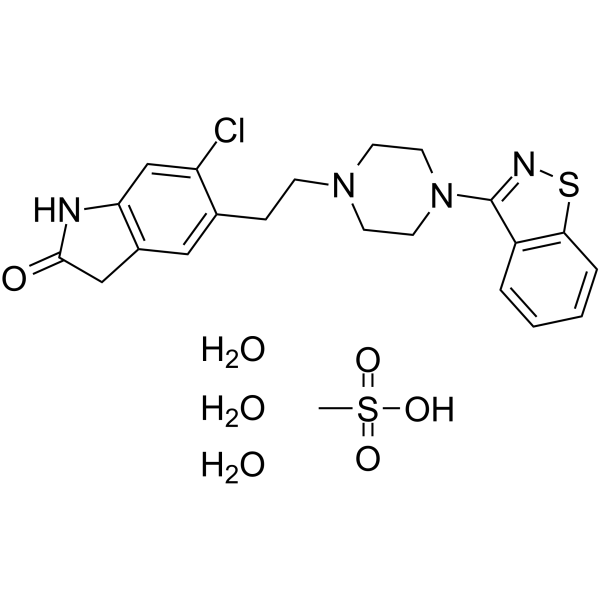
Ziprasidone mesylate trihydrate (CP 88059; CP-88,059; CP-88,059-01; Geodon; Zeldox; Zipwell) HCl, the mesylate salt and tri-hydrated form of Ziprasidone, is a novel and potent dopamine and serotonin (5-HT) receptor antagonist with antipsychotic effects. It has been approved for treating schizophrenia and bipolar disorder, schizophrenia, acute mania and mixed states associated with bipolar disorder. Its intramuscular injection form is approved for acute agitation in schizophrenic patients for whom treatment with just ziprasidone is appropriate. The mechanism of action of ziprasidone has been proposed that this drug's efficacy in schizophrenia is mediated through a combination of dopamine type 2 (D2) and serotonin type 2 (5HT2) antagonism. As with other drugs having efficacy in bipolar disorder, the mechanism of action of ziprasidone in bipolar disorder is unknown.
Physicochemical Properties
| Molecular Formula | C21H21N4OSCL.CH4O3S.3[H2O] |
| Molecular Weight | 563.08714 |
| Exact Mass | 562.132 |
| CAS # | 199191-69-0 |
| Related CAS # | Ziprasidone;146939-27-7;Ziprasidone-d8;1126745-58-1;Ziprasidone hydrochloride monohydrate;138982-67-9;Ziprasidone hydrochloride;122883-93-6;Ziprasidone mesylate;185021-64-1 |
| PubChem CID | 656685 |
| Appearance | Typically exists as solid at room temperature |
| Boiling Point | 554.8ºC at 760 mmHg |
| Vapour Pressure | 1.13E-29mmHg at 25°C |
| LogP | 4.341 |
| Hydrogen Bond Donor Count | 5 |
| Hydrogen Bond Acceptor Count | 11 |
| Rotatable Bond Count | 4 |
| Heavy Atom Count | 36 |
| Complexity | 665 |
| Defined Atom Stereocenter Count | 0 |
| InChi Key | WLQZEFFFIUHSJB-UHFFFAOYSA-N |
| InChi Code | InChI=1S/C21H21ClN4OS.CH4O3S.3H2O/c22-17-13-18-15(12-20(27)23-18)11-14(17)5-6-25-7-9-26(10-8-25)21-16-3-1-2-4-19(16)28-24-21;1-5(2,3)4;;;/h1-4,11,13H,5-10,12H2,(H,23,27);1H3,(H,2,3,4);3*1H2 |
| Chemical Name | 5-[2-[4-(1,2-benzothiazol-3-yl)piperazin-1-yl]ethyl]-6-chloro-1,3-dihydroindol-2-one;methanesulfonic acid;trihydrate |
| HS Tariff Code | 2934.99.9001 |
| Storage |
Powder-20°C 3 years 4°C 2 years In solvent -80°C 6 months -20°C 1 month |
| Shipping Condition | Room temperature (This product is stable at ambient temperature for a few days during ordinary shipping and time spent in Customs) |
Biological Activity
| ln Vitro | Wild-type hERG currents are blocked by ziprasidone mesylate trihydrate (0-500 nM, 150 seconds) [2]. |
| ln Vivo | Oral gavage of ziprasidone mesylate trihydrate (20 mg/kg; once daily; 7 weeks) has been linked to decreased levels of physical activity, weight loss, increased resting energy expenditure, and improved thermogenesis in cold weather [3]. |
| Cell Assay |
Cell Viability Assay Cell Types: HEK-293 cells [2] Tested Concentrations: 0-500 nM Incubation Duration: 150 seconds Experimental Results: Blocks wild-type hERG current (IC50 = 120 nm) in a voltage- and concentration-dependent manner. |
| Animal Protocol |
Animal/Disease Models: 8weeks old female SD (SD (Sprague-Dawley)) rats, weighing 200 to 250 g[3] Doses: 20 mg/kg Route of Administration: po (oral gavage); 20 mg/kg; one time/day; 7-week Experimental Results: significant weight loss (P = 0.031), had lower levels of physical activity (P = 0.016), had higher resting energy expenditure (P < 0.001), and demonstrated greater thermogenic capacity when cold (P < 0.001). |
| References |
[1]. H Rollema, et al. 5-HT(1A) receptor activation contributes to ziprasidone-induced dopamine release in the rat prefrontal cortex. Biol Psychiatry. 2000 Aug 1;48(3):229-37. [2]. Zhi Su, et al. Block of hERG channel by ziprasidone: biophysical properties and molecular determinants. Biochem Pharmacol. 2006 Jan 12;71(3):278-86. [3]. Subin Park, et al. The effect of ziprasidone on body weight and energy expenditure in female rats. Metabolism. 2012 Jun;61(6):787-93. |
| Additional Infomation |
Ziprasidone mesylate trihydrate is the methanesulfonate trihydrate salt of ziprasidone. It is a hydrate and a methanesulfonate salt. It contains a ziprasidone. Ziprasidone Mesylate is the mesylate salt form of ziprasidone, a benzothiazolylpiperazine derivative and an atypical antipsychotic agent with an antischizophrenic property. Ziprasidone mesylate functions as an antagonist at the dopamine D2 and serotonin 5-HT2A and 5-HT1D receptors, and as an agonist at the 5-HT1A receptor. Ziprasidone mesylate also inhibits the synaptic reuptake of serotonin and norepinephrine. The mechanism of action by which ziprasidone mesylate exerts its antischizophrenic effect is unknown but is potentially mediated through a combination of dopamine D2 and serotonin 5-HT2 antagonism. This agent also has antagonistic activity against histamine H1 and alpha-1-adrenergic receptors. See also: Ziprasidone (has active moiety). |
Solubility Data
| Solubility (In Vitro) | May dissolve in DMSO (in most cases), if not, try other solvents such as H2O, Ethanol, or DMF with a minute amount of products to avoid loss of samples |
| Solubility (In Vivo) |
Note: Listed below are some common formulations that may be used to formulate products with low water solubility (e.g. < 1 mg/mL), you may test these formulations using a minute amount of products to avoid loss of samples. Injection Formulations (e.g. IP/IV/IM/SC) Injection Formulation 1: DMSO : Tween 80: Saline = 10 : 5 : 85 (i.e. 100 μL DMSO stock solution → 50 μL Tween 80 → 850 μL Saline) *Preparation of saline: Dissolve 0.9 g of sodium chloride in 100 mL ddH ₂ O to obtain a clear solution. Injection Formulation 2: DMSO : PEG300 :Tween 80 : Saline = 10 : 40 : 5 : 45 (i.e. 100 μL DMSO → 400 μLPEG300 → 50 μL Tween 80 → 450 μL Saline) Injection Formulation 3: DMSO : Corn oil = 10 : 90 (i.e. 100 μL DMSO → 900 μL Corn oil) Example: Take the Injection Formulation 3 (DMSO : Corn oil = 10 : 90) as an example, if 1 mL of 2.5 mg/mL working solution is to be prepared, you can take 100 μL 25 mg/mL DMSO stock solution and add to 900 μL corn oil, mix well to obtain a clear or suspension solution (2.5 mg/mL, ready for use in animals). Injection Formulation 4: DMSO : 20% SBE-β-CD in saline = 10 : 90 [i.e. 100 μL DMSO → 900 μL (20% SBE-β-CD in saline)] *Preparation of 20% SBE-β-CD in Saline (4°C,1 week): Dissolve 2 g SBE-β-CD in 10 mL saline to obtain a clear solution. Injection Formulation 5: 2-Hydroxypropyl-β-cyclodextrin : Saline = 50 : 50 (i.e. 500 μL 2-Hydroxypropyl-β-cyclodextrin → 500 μL Saline) Injection Formulation 6: DMSO : PEG300 : castor oil : Saline = 5 : 10 : 20 : 65 (i.e. 50 μL DMSO → 100 μLPEG300 → 200 μL castor oil → 650 μL Saline) Injection Formulation 7: Ethanol : Cremophor : Saline = 10: 10 : 80 (i.e. 100 μL Ethanol → 100 μL Cremophor → 800 μL Saline) Injection Formulation 8: Dissolve in Cremophor/Ethanol (50 : 50), then diluted by Saline Injection Formulation 9: EtOH : Corn oil = 10 : 90 (i.e. 100 μL EtOH → 900 μL Corn oil) Injection Formulation 10: EtOH : PEG300:Tween 80 : Saline = 10 : 40 : 5 : 45 (i.e. 100 μL EtOH → 400 μLPEG300 → 50 μL Tween 80 → 450 μL Saline) Oral Formulations Oral Formulation 1: Suspend in 0.5% CMC Na (carboxymethylcellulose sodium) Oral Formulation 2: Suspend in 0.5% Carboxymethyl cellulose Example: Take the Oral Formulation 1 (Suspend in 0.5% CMC Na) as an example, if 100 mL of 2.5 mg/mL working solution is to be prepared, you can first prepare 0.5% CMC Na solution by measuring 0.5 g CMC Na and dissolve it in 100 mL ddH2O to obtain a clear solution; then add 250 mg of the product to 100 mL 0.5% CMC Na solution, to make the suspension solution (2.5 mg/mL, ready for use in animals). Oral Formulation 3: Dissolved in PEG400 Oral Formulation 4: Suspend in 0.2% Carboxymethyl cellulose Oral Formulation 5: Dissolve in 0.25% Tween 80 and 0.5% Carboxymethyl cellulose Oral Formulation 6: Mixing with food powders Note: Please be aware that the above formulations are for reference only. InvivoChem strongly recommends customers to read literature methods/protocols carefully before determining which formulation you should use for in vivo studies, as different compounds have different solubility properties and have to be formulated differently. (Please use freshly prepared in vivo formulations for optimal results.) |
| Preparing Stock Solutions | 1 mg | 5 mg | 10 mg | |
| 1 mM | 1.7759 mL | 8.8796 mL | 17.7592 mL | |
| 5 mM | 0.3552 mL | 1.7759 mL | 3.5518 mL | |
| 10 mM | 0.1776 mL | 0.8880 mL | 1.7759 mL |