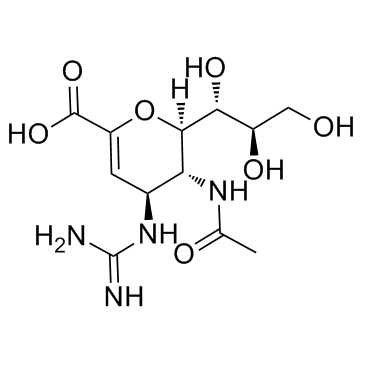
Zanamivir (GR-121167X; GG-167; Relenza) is a novel and potent neuraminidase inhibitor with antiviral activity against influenza. It inhibits influenza with IC50 values of 0.95 nM and 2.7 nM for influenza A and B, respectively. It can be used in the treatment and prophylaxis of influenza caused by influenza A and B viruses. Zanamivir acts by binding to the active site of the neuraminidase protein, rendering the influenza virus unable to escape its host cell and infect others. It is also an inhibitor of influenza virus replication in vitro and in vivo.
Physicochemical Properties
| Molecular Formula | C12H20N4O7 |
| Molecular Weight | 332.313 |
| Exact Mass | 332.133 |
| Elemental Analysis | C, 43.37; H, 6.07; N, 16.86; O, 33.70 |
| CAS # | 139110-80-8 |
| Related CAS # | Zanamivir (hydrate)(5:1);171094-50-1 |
| PubChem CID | 60855 |
| Appearance | White to off-white solid powder |
| Density | 1.8±0.1 g/cm3 |
| Melting Point | 256ºC (dec.) |
| Index of Refraction | 1.679 |
| LogP | -4.13 |
| Hydrogen Bond Donor Count | 7 |
| Hydrogen Bond Acceptor Count | 8 |
| Rotatable Bond Count | 6 |
| Heavy Atom Count | 23 |
| Complexity | 518 |
| Defined Atom Stereocenter Count | 5 |
| SMILES | O1C(C(=O)O[H])=C([H])[C@@]([H])([C@]([H])([C@]1([H])[C@@]([H])([C@@]([H])(C([H])([H])O[H])O[H])O[H])N([H])C(C([H])([H])[H])=O)/N=C(\N([H])[H])/N([H])[H] |
| InChi Key | ARAIBEBZBOPLMB-UFGQHTETSA-N |
| InChi Code | InChI=1S/C12H20N4O7/c1-4(18)15-8-5(16-12(13)14)2-7(11(21)22)23-10(8)9(20)6(19)3-17/h2,5-6,8-10,17,19-20H,3H2,1H3,(H,15,18)(H,21,22)(H4,13,14,16)/t5-,6+,8+,9+,10+/m0/s1 |
| Chemical Name | (2R,3R,4S)-3-acetamido-4-(diaminomethylideneamino)-2-[(1R,2R)-1,2,3-trihydroxypropyl]-3,4-dihydro-2H-pyran-6-carboxylic acid |
| Synonyms | Zanamivir; GR-121167X; GG167; GR121167X; GG-167; GR 121167X; GG 167; trade name Relenza. |
| HS Tariff Code | 2934.99.9001 |
| Storage |
Powder-20°C 3 years 4°C 2 years In solvent -80°C 6 months -20°C 1 month |
| Shipping Condition | Room temperature (This product is stable at ambient temperature for a few days during ordinary shipping and time spent in Customs) |
Biological Activity
| Targets | Influenza A(IC50= 0.95 nM);Influenza B(IC50= 2.7 nM) |
| ln Vitro | Zanamivir (GR-121167X; GG-167; Relenza) interacts with a group of amino acids in the active site of neuraminidase, which are conserved in all influenza A and B strains.By inhibiting neuraminidase's ability to cleave sialic acid on cell receptors, zanamivir stops the release and dissemination of newly formed virions[2]. |
| ln Vivo | Zanamivir has a poor bioavailability in oral administration, with only 4–17% of the agent. Because of its strong hydrophilic nature, which restricts its transport across the intestinal epithelium, oral delivery of zanamivir has proven to be problematic. When combined with zanamivir, permeability enhancers like sodium cholate and hydroxypropyl β-cyclodextrin can improve intestinal permeability[3]. |
| Animal Protocol |
Rats Combinations Rats kept conscious are given IV-R (reference Zanamivir saline solution for intravenous injection) at a dose of 1 mg/kg.PO-SC (Zanamivir with SC for p.o.) and PO-C (Zanamivir control solution for p.o.) are given oral Zanamivir doses of 10 mg/kg. Before, at 0.5, 1, 2, 3, 4, 6, 8, and 24 hours after administration, blood samples are taken. Three rats from each group are sacrificed at each sampling point to remove the lungs following blood collection.After the rats' lungs are removed through a chest incision, the lungs are cleaned with saline. After that, the lungs are placed in an E-tube and kept in a freezer at -80°C until they are examined. After being centrifuged at 1,500 × g for 10 minutes, plasma samples are collected and kept at -20°C until analysis. Zanamivir is analyzed using the previously stated LC-MS/MS method in both plasma and lungs[3]. |
| ADME/Pharmacokinetics |
Absorption, Distribution and Excretion Absolute bioavailability is very low following oral administration (2%). Following oral inhalation, bioavailability is 4% to 17%. It is excreted unchanged in the urine with excretion of a single dose completed within 24 hours. Unabsorbed drug is excreted in the feces.Zanamivir is renally excreted as unchanged drug. 2.5 - 10.9 L/h [Following oral inhalation 10 mg] 5.3 L/h [Normal renal function receiving IV single dose of 4 mg or 2 mg] 2.7 L/h [Patients with mild and moderate renal impairement receiving IV single dose of 4 mg or 2 mg] 0.8 L/h [Patients with severe renal impairement receiving IV single dose of 4 mg or 2 mg] Protein binding: Very low (<10%). Orally inhaled zanamivir is systemically absorbed, approximately 4% to 17%. Elimination: Renal: Excreted unchanged in the urine with excretion of a single dose completed within 24 hours. Total clearance ranges from 2.5 to 10.9 L/hr. Fecal: Unabsorbed drug is secreted in the feces. Time to peak effect: 72 hours. For more Absorption, Distribution and Excretion (Complete) data for ZANAMIVIR (7 total), please visit the HSDB record page. Metabolism / Metabolites Not metabolized Not metabolized. Biological Half-Life 2.5-5.1 hours The serum half-life of zanamivir following administration by oral inhalation ranges from 2.5 to 5.1 hours. |
| Toxicity/Toxicokinetics |
Hepatotoxicity In randomized controlled trials, 2% to 3% of zanamivir recipients developed ALT or AST elevations above twice the upper limit of the normal range, but a similar rate was found in placebo-treated patients. Despite widespread use, there is little evidence that zanamivir when used by inhalation causes liver injury, either in the form of asymptomatic serum enzyme elevations or clinically apparent liver disease. In pilot studies of intravenous zanamivir for severe influenza, serum enzyme elevations have been reported in ~10% of patients, occasionally with jaundice, but the role of zanamivir versus the underlying severe viral infection has not been defined. Likelihood score: E (unlikely cause of clinically apparent liver injury). Effects During Pregnancy and Lactation ◉ Summary of Use during Lactation No information is available on the use of zanamivir during breastfeeding. One group of authors estimated that an exclusively breastfed 5 kg infant would receive about 0.075 mg daily in breastmilk after an inhaled maternal dose of 10 mg, which is less than 1% of the dose in older children. In addition, because zanamivir is poorly absorbed orally, it is not likely to reach the bloodstream of the infant in clinically important amounts. ◉ Effects in Breastfed Infants Relevant published information was not found as of the revision date. ◉ Effects on Lactation and Breastmilk Relevant published information was not found as of the revision date. Protein Binding Zanamivir has limited plasma protein binding (<10%). Interactions Zanamivir is not a substrate nor does it affect cytochrome P450 (CYP) isoenzymes (CYP1A1/2, 2A6, 2C9, 2C18, 2D6, 2E1, and 3A4) in human liver microsomes. |
| References |
[1]. Comparison of the activities of zanamivir, oseltamivir, and RWJ-270201 against clinical isolates ofinfluenza virus and neuraminidase inhibitor-resistant variants. Antimicrob Agents Chemother. 2001 Dec;45(12):3403-8. [2]. Management of influenza virus infections with neuraminidase inhibitors: detection, incidence, and implications of drug resistance. Treat Respir Med. 2005;4(2):107-16. [3]. Zanamivir oral delivery: enhanced plasma and lung bioavailability in rats. Biomol Ther (Seoul). 2013 Mar;21(2):161-9. |
| Additional Infomation |
Zanamivir is a member of guanidines. It has a role as an EC 3.2.1.18 (exo-alpha-sialidase) inhibitor and an antiviral agent. A guanido-neuraminic acid that is used to inhibit neuraminidase. Zanamivir is a Neuraminidase Inhibitor. The mechanism of action of zanamivir is as a Neuraminidase Inhibitor. Zanamivir is an inhibitor of the influenza neuraminidase enzyme and is given by inhalation as therapy and prophylaxis against influenza A and B. Zanamivir has not been associated with clinically apparent liver injury, at least when given by inhalation. Zanamivir is a sialic acid-analogue neuraminidase inhibitor with antiviral activity. Administered into the respiratory tract by aerosol inhalation, zanamivir selectively binds to and inhibits influenza A and B virus neuraminidase-mediated cleavage of sialic acid residues in host cell membrane-bound glycoprotein receptors for influenza viruses, preventing the release of progeny viruses from host cell surfaces and, so, further viral replication. A guanido-neuraminic acid that is used to inhibit NEURAMINIDASE. Drug Indication For the prevention and treatment of influenza A and B. FDA Label Dectova is indicated for the treatment of complicated and potentially life-threatening influenza A or B virus infection in adult and paediatric patients (aged â¥6 months) when: The patient's influenza virus is known or suspected to be resistant to anti-influenza medicinal products other than zanamivir, and/orOther anti-viral medicinal products for treatment of influenza, including inhaled zanamivir, are not suitable for the individual patient. Dectova should be used in accordance with official guidance. Prevention of influenza, Treatment of influenza Mechanism of Action The proposed mechanism of action of zanamivir is via inhibition of influenza virus neuraminidase with the possibility of alteration of virus particle aggregation and release. By binding and inhibiting the neuraminidase protein, the drug renders the influenza virus unable to escape its host cell and infect others. Zanamivir is a potent selective competitive inhibitor of the influenza virus neuraminidase, an enzyme essential for viral replication. Neuraminidase cleaves terminal sialic acid residues from glycoconjugates to enable the release of virus from infected cells, prevent the formation of viral aggragates after release from host cells, and possibly decrease viral inactivation by respiratory mucous. Zanamivir is a selective inhibitor of influenza A and B virus neuraminidase, possibly altering particle aggregation and release. Therapeutic Uses Antiviral Agents; Enzyme Inhibitors At this time, CDC recommends the use of oseltamivir or zanamivir for the treatment of infection with swine influenza (H1N1) viruses. MEDICATION: Antiviral; Influenza viral neuraminidase inhibitor Zanamivir is indicated for the treatment of uncomplicated acute illness due to influenza A virus in adults and children 7 years and older who have been symptomatic for no more than 2 days. Zanamivir must be started within 48 hours after the onset of influenza symptoms. /Included in US product labeling/ For more Therapeutic Uses (Complete) data for ZANAMIVIR (6 total), please visit the HSDB record page. Drug Warnings Swine influenza (H1N1) viruses contain a unique combination of gene segments that have not been reported previously among swine or human influenza viruses in the US or elsewhere. The H1N1 viruses are resistant to amantadine and rimantadine but not to oseltamivir or zanamivir. Bronchospasm and decline in lung function have been reported in some patients receiving relenza. Many but not all of these patients had underlying airways disease such as asthma or chronic obstructive pulmonary disease. Because of the risk of serious adverse events and because efficacy has not been demonstrated in this population, /zanamivir/ is not generally recommend for treatment of patients with underlying airways disease. Some patients with serious adverse events during treatment with /zanamivir/ have had fatal outcomes, although causality was difficult to assess. /Zanamivir/ should be discontinued in any patient who develops bronchospasm or decline in respratory function; immediate treatment and hospitalization may be required. Some patients without prior pulmonary disease may also have respiratory abnormalities from acute respiratory infection that could resemble adverse drug reactions or increase patient vulnerability to adverse drug reactions. FDA Pregnancy Risk Category: B /NO EVIDENCE OF RISK IN HUMANS. Adequate, well controlled studies in pregnant women have not shown increased risk of fetal abnormalities despite adverse findings in animals, or, in the absence of adequate human studies, animal studies show no fetal risk. The chance of fetal harm is remote but remains a possibility./ Adverse effects occurring in 1-3% or more of adults and children 12 years of age or older include diarrhea; nausea; vomiting; nasal signs and symptoms; bronchitis; sinusitis; cough; ear, nose, and throat infections; headache; and dizziness. No adverse effect occurred at an incidence greater than 3%. Adverse effects occurring in up to 5% of children 5-12 years of age include ear, nose, and throat infections; vomiting; nausea; and diarrhea. Some adverse effects may be secondary to lactose vehicle inhalation. Bronchospasm and allergic-like reactions, including oropharyngeal edema and serious rash, have been reported. Unlike amantadine and rimantadine, neuraminidase inhibitors like zanamivir do not appear to adversely affect the CNS. For more Drug Warnings (Complete) data for ZANAMIVIR (10 total), please visit the HSDB record page. Pharmacodynamics Zanamivir, an antiviral agent, is a neuraminidase inhibitor indicated for treatment of uncomplicated acute illness due to influenza A and B virus in adults and pediatric patients 7 years and older who have been symptomatic for no more than 2 days. Zanamivir has also been shown to significantly inhibit the human sialidases NEU3 and NEU2 in the micromolar range (Ki 3.7 +/-0.48 and 12.9+/-0.07 microM, respectively), which could account for some of the rare side effects of zanamivir. |
Solubility Data
| Solubility (In Vitro) |
H2O : 33.33~36 mg/mL (~100.30 mM) DMSO : ~66 mg/mL ( ~198.6 mM) |
| Solubility (In Vivo) |
Solubility in Formulation 1: 9.09 mg/mL (27.35 mM) in PBS (add these co-solvents sequentially from left to right, and one by one), clear solution; with sonication (<60°C). (Please use freshly prepared in vivo formulations for optimal results.) |
| Preparing Stock Solutions | 1 mg | 5 mg | 10 mg | |
| 1 mM | 3.0092 mL | 15.0462 mL | 30.0924 mL | |
| 5 mM | 0.6018 mL | 3.0092 mL | 6.0185 mL | |
| 10 mM | 0.3009 mL | 1.5046 mL | 3.0092 mL |